
Nishi-Nippori
A quiet way into old Tokyo, and one I like precisely because it doesn’t announce itself. At Nishi-Nippori you step off the Yamanote, climb a handful of steps, and find yourself on a plateau full of small temples, with trains rushing by below and the low roofs of a neighborhood that never took the skyscraper route.
Almost everyone skips this stop and hurries on to Nippori or straight into Yanaka. To me, though, it’s the best way in to that part of the city: more intimate, with fewer people around, and just a short walk from everything else worth seeing in the area.
Contents
Restaurants
Nearby neighborhoods
Uguisudani
Hongo
Getting out of the station
By Tokyo standards Nishi-Nippori is a small station, and it’s a really convenient stop to fit into a longer day. The Yamanote and Keihin-Tohoku lines run through it, the Chiyoda subway line passes underneath, and it’s also a stop on the Nippori-Toneri Liner, a little driverless train that starts at Nippori and heads up into the residential neighborhoods to the north.
What really matters here is knowing which side to come out on, because a sharp drop in the ground splits the neighborhood in two. Keep this in mind:
- The exit up to the plateau, on the west side, takes you toward Suwa Shrine, the temples, and the edge of Yanaka. It’s the one you want almost every time.
- The downhill exit toward the Arakawa side leads to more ordinary residential streets, and it’s only useful if you have a specific reason to go there.
Honestly, I use this station more as a starting point for a walk than as a destination in itself.
Suwa Shrine and the plateau
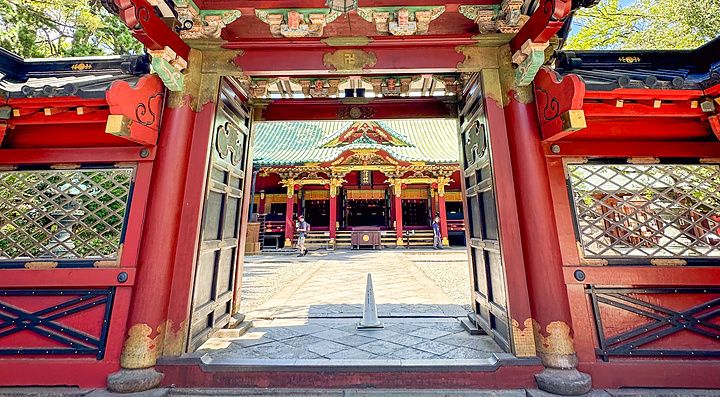
A few minutes from the ticket gates you’ll find Suwa Shrine, set on a rise in the land that locals call Suwadai. It’s the historic guardian shrine of Nippori and Yanaka, the kind of place where you’ll see more elderly locals and kids running past than tourists with cameras.
What makes it special is the edge of the plateau. You look over, and below you there’s a sea of train tracks, with trains coming and going nonstop, one after another.
Around here, Nishi-Nippori is famous among train fans, because dozens of different models run through these few hundred meters of track. You don’t need to know anything about trains to stand there for a few minutes, just watching them go by.
The trees keep the place shady in summer, and in spring a few cherry trees come into bloom. I often stop here when I want to catch my breath before heading down into the tangle of Yanaka’s little streets.
The temples on the plateau
Next to the shrine, on the same rise, is Joko-ji, which people here call the snow temple. The view used to be so open that people came up on purpose to watch the snow fall, and the garden still has the shogun’s stone, the one Tokugawa Yoshimune used to sit on when he came through here on his falconing trips.
Walking down toward Yanaka, you’ll pass two more that in the Edo period were known as the flower temples, with gardens planned so that something was always in bloom. You’ll spot Shusho-in right away by its pink walls with Hotei painted on them, while Seiun-ji is more austere and stays hidden behind its outer wall.
These aren’t places that take half a day. You look in from the gate, maybe step inside for a moment, and keep going. But they’re the reason this stretch of hill was called Higurashi no Sato, the place where you forget what time it is, and people in Edo would climb up here just to while away the day.
Walking to Yanaka
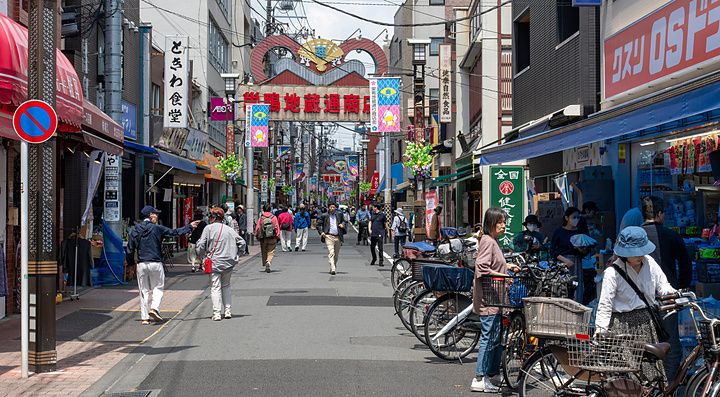
From Nishi-Nippori there’s only one way to go: west and south on foot, into the slice of the city that takes in Yanaka, Nezu, and Sendagi. You’ll find wooden shopfronts, tiny coffee roasters, and little stores that do just one thing and have been doing it for generations.
A little farther on is the shopping street with the sunset steps everyone talks about, and the slope that once had a view of Mount Fuji. That slope is called Fujimizaka, and it was one of the last places in Tokyo where you could see Mount Fuji just standing in the street, without climbing up anywhere. Today the view is gone: a building went up at the far end and blocked it, and instead of the mountain you’ll find a panel with photos of what it used to look like.
Walk up it anyway. It’s a narrow sloping street between temple walls and low houses, and in two minutes you’ll understand why people made a point of coming here for centuries.
A couple of things to plan for. Many shops here close early, in the late afternoon, so if you want to see the streets at their liveliest, come during the day, not for dinner.
In the evening it’s a different place. It goes quiet, with just a few lights still on, and it’s back to being the residential neighborhood it’s always been: nice to walk through, but with few places open. Food here is cheap, simple working-class neighborhood fare, nothing for a special night out.
As for time, I’d set aside a good half day, ideally pairing this area with Nippori and its fabric street. I don’t recommend staying overnight here. You’re better off booking a hotel somewhere more central and coming over on foot one morning, when the little streets are still cool and half empty.
Getting There
Nishi-Nippori is on the Yamanote Line, so you can get there without changing trains from Ueno, Tokyo, or Ikebukuro. Once you're off the train, look for the west exit: you climb a handful of steps, and in a couple of minutes you're up on the plateau, in front of Suwa Shrine and at the edge of Yanaka.
If you're coming from Nippori, the next station over, don't get back on the train for a single stop. It's a walk of about ten minutes, and it often makes sense to do both stations back to back.
If you're coming by subway, take the Chiyoda Line, which runs under the JR station and comes up at the same intersection.
Useful Info
Name: Nishi-Nippori
Time needed: A couple of hours for the plateau, Suwa Shrine, and the temples around it; half a day if you keep walking into Yanaka.
Closed: Many of the shops on Yanaka Ginza and the surrounding streets close on Mondays (some on Tuesdays too), and they pull down their shutters in the late afternoon.
Tips: Don't stop at the shrine grounds. The best part is the edge of the plateau, where the ground drops sharply down to the tracks. Lean on the railing for a few minutes and you'll see all kinds of trains go by one after another. Then walk down toward Yanaka.
Getting there:
- Nishi-Nippori Station (JR Yamanote, JR Keihin-Tohoku, Tokyo Metro Chiyoda, Nippori-Toneri Liner): west exit for the shrine and Yanaka
- Nippori Station (JR Yamanote, Keihin-Tohoku, Joban, Keisei): west exit, then a ten-minute walk
- Sendagi Station (Tokyo Metro Chiyoda): handy if you're coming from the Nezu side
Map
MarcoMaps100% free
This place is on MarcoMaps
Nishi-Nippori
My map of Japan: over 4,000 places I've tried myself, each with photos, rating, and hours. Filter by category and rating, find veg-friendly spots and places near you with GPS. No sign-up, right from your phone.
- 4,000+ places
- Rating, photos, and hours
- Veg friendly
- Near me (GPS)
- Favorites without login
- Works offline

