227 m
Jojakko-ji Temple227 m
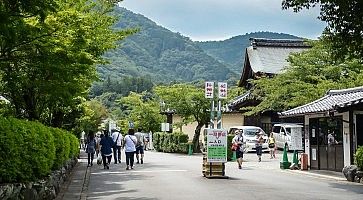
Surrounded by over 200 maple trees.
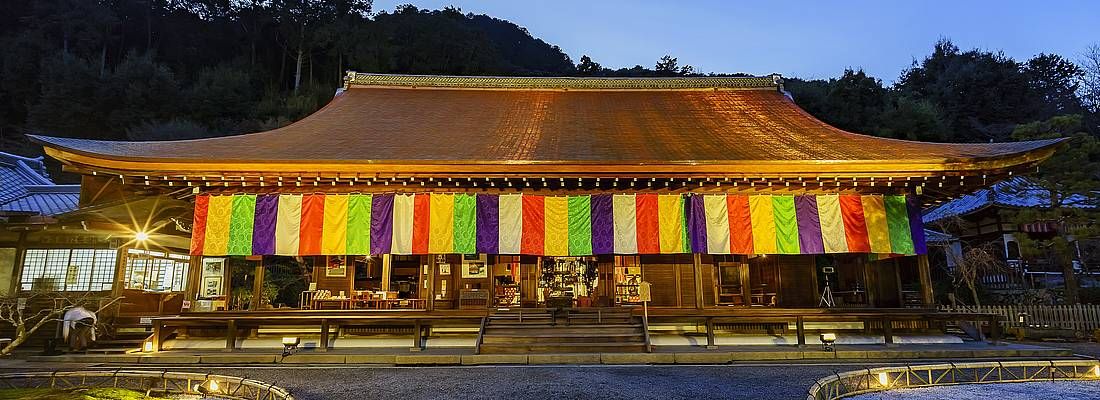
Tucked away in the hills of Arashiyama, Nison-in is a small Tendai temple complex known for its gardens and its paths lined with maple and cherry trees, which in spring and fall turn the grounds into something magical, full of beautiful shades of color. A lot of visitors skip it for the area’s more famous sights, but Nison-in is definitely worth a short stop, especially if you’re looking for somewhere calm and quiet away from the tourist crowds. It’s also very easy to get to, just 15 minutes on foot from the better-known Tenryuji.
Nison-in dates back to the mid-9th century, when it was built as a private place of prayer for Emperor Saga. Its name means “two sacred images,” after the twin statues in the main hall, Shaka Nyorai and Amitabha Tathagata, representing the Historical Buddha and the Buddha of the Pure Land. In fact the two aren’t quite identical: there are tiny, almost invisible differences between them, each with a religious meaning.
The buildings you see today are reconstructions, since the originals were destroyed in the Onin War in the second half of the 15th century. They’re faithful copies of the earlier structures, though, and they give you a clear idea of what the temple originally looked and felt like.
You enter through a large wooden gate from the early 1600s, which once belonged to Fushimi Castle and was later moved here. If you look closely, you’ll spot all sorts of details and decorative motifs on the roof, and the gate’s historical value has made it a designated cultural property of Kyoto City.
The complex has other buildings too, including a small shrine and the Bentendo hall, dedicated to Benzaiten, the only goddess among the Seven Lucky Gods and the patron of music, the arts and good fortune. Take some time to look around the different buildings, but don’t forget to ring the Bell of Happiness, the Shiawase no Kane.
The bell was recast in 1992 to replace the 1604 original, and it’s very popular with visitors, especially around New Year’s. People like ringing it three times as a ritual to bring happiness to themselves and the people they love. Each of the three rings has its own meaning: the first is to give thanks for the life you’ve been given, the second is for the people close to you and for all living beings, and the third is a wish for peace in the world. You’re free to ring it yourself, with no need to ask anyone. If someone’s there before you, just wait your turn.
One of the most interesting parts of the temple is the cemetery at the back of the complex, where history buffs will surely recognize the Japanese emperors and nobles buried there. Nison-in was once considered one of Kyoto’s most important temples, and it hosted many Buddhist ceremonies for the imperial court until the Emperor moved to Tokyo at the start of the Meiji period.
The cemetery holds the ashes of three emperors (Tsuchimikado, Go-Saga and Kameyama), along with the graves of several noble court families. Close by is the grave of Suminokura Ryoi, the merchant who had Kyoto’s canals dug in the early 1600s and made the Hozu River navigable. It’s the same river you float down on the boat ride that starts upstream from Arashiyama.
What really strikes visitors, though, is the beauty of the natural setting around the temple, which has inspired poets and artists over the years. In spring the pink cherry blossoms give the temple a romantic splash of color, and in June the hydrangeas take over with their own colors. In fall the maples, in every shade of bright red, set the temple on fire, and you’ll come away with some beautiful photos.
In spring and fall the temple opens its tea room, Misono-tei, to the public. You can stop for a steaming cup of matcha with traditional sweets while you look out at the temple’s buildings and gardens. The room is simple and refined, with delicate details. It was originally part of the Imperial Palace complex, where it was used by one of Emperor Go-Mizunoo’s daughters. The tea room is especially nice to visit in spring, because it looks right out over the cherry garden.
As soon as you pass through the gate, you’re looking at the sight that really defines the temple. The Momiji no Baba is a wide, gently sloping path lined with maple and cherry trees that leads up to the main buildings. The name combines momiji, meaning maples, and baba, a ground where horses were run, because the path is unusually wide for a temple.
In fall the branches close in overhead and the path becomes a tunnel of red, while in spring the cherry trees turn it pink. This is where you’ll see everyone stop with their cameras. Take it slowly, and turn around halfway up to see how far below you the gate already is.
Nison-in holds several festivals throughout the year, but the most distinctive is probably the one in May, when participants dress in period costumes and re-create the games and performances of the Heian period.
The temple’s full name is Ogurayama Nison-in, because it stands at the foot of Mount Ogura, a hill that looms large in Japanese literature. The poet Fujiwara no Teika had his villa around here, and tradition has it that the Ogura Hyakunin Isshu was compiled there. It’s the collection of a hundred poems by a hundred poets that people in Japan still use for a card game at New Year’s. On the grounds the temple marks the site of Shigure-tei, the poet’s study, although other temples nearby claim the same honor.
The grounds also have a stone monument declaring this area the birthplace of ogura-an, the sweet azuki bean paste that fills half the sweets in Japan. Legend says the first azuki were grown on these hills, and the sweet made from them was offered to the imperial court.
The temple is in the northern part of Arashiyama, away from the area's busiest streets. From JR Saga-Arashiyama Station, allow about 20 minutes on foot heading north. It's a nice walk, because it takes you right past Tenryuji and the bamboo forest.
It takes about the same time if you come on the Randen to Arashiyama Station, and you get the same walk through Sagano.
If you'd rather shorten the walk, the city bus drops you at the Saga Shakado-mae stop, and from there it's 10 minutes on foot.
This place is on MarcoMaps
Nison-in Temple
My map of Japan: over 4,000 places I've tried myself, each with photos, rating, and hours. Filter by category and rating, find veg-friendly spots and places near you with GPS. No sign-up, right from your phone.