Nunobiki Herb Gardens
An herb and flower garden on the mountainside above Kobe, just behind Kitano, where the port and the sea open up below you as you walk.
You explore Nunobiki Herb Gardens from the top down, working your way from terrace to terrace past roses, lavender, a greenhouse full of tropical plants and a footbath overlooking the city. It draws couples, families with small children and older men from the neighborhood who come up for a stroll.
It suits anyone with half a day free in Kobe who wants to spend it outdoors without planning anything.
What’s there
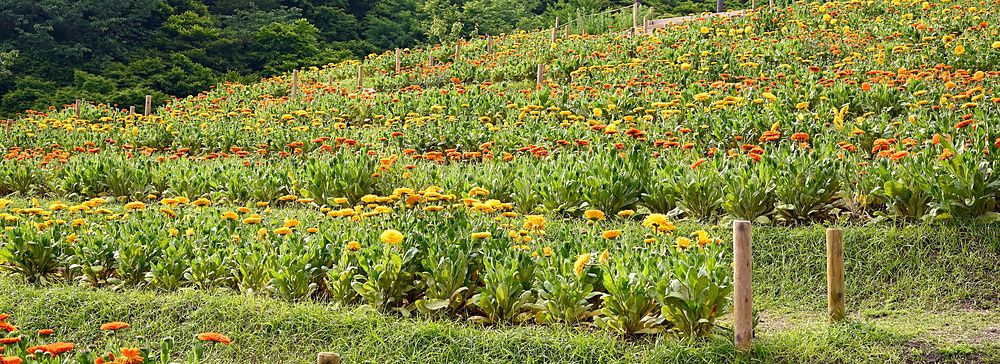
You ride the ropeway up, and from there it’s all downhill, from one garden to the next. There are about a dozen themed gardens, one right after another, with around two hundred species of herbs and flowers. The number only tells you so much. What you really notice is that every fifty meters the plants change, and so do the colors and even the smell.
- Rose Symphony Garden: about sixty varieties of roses, almost all of them English, on a terraced slope. When they’re in bloom you smell them before you see them.
- The greenhouse: two floors of dense tropical greenery, the sound of running water in the background, hanging flower baskets at the entrance and a statue that came from Terni.
- The fragrance museum: vintage perfume bottles in glass cases and about eighty essential oils to smell one after another.
- The herb museum: about a hundred plants grown and cataloged, with park guides who walk anyone interested through what each one is used for.
- The observation plaza at the top: 400 meters above sea level, a pale stone building modeled on a German castle, and Kobe spread out below you from the port to the artificial islands.
- The Kaze no Oka lawn: sloping grass, hammocks hung from the trees, an orchard with citrus, kiwis and apples, and the sea beyond the flower beds.
The fragrance museum is smaller than the name makes it sound: two rooms and that’s it. You can manage the first ten of the eighty oils. After that your nose gives up, so you might as well slow down.
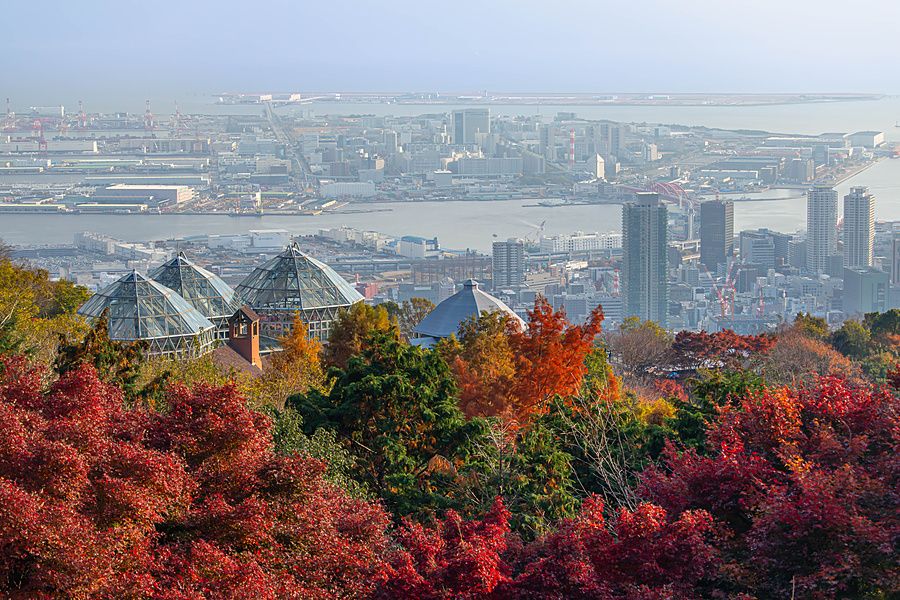
The greenhouse is the real surprise. From the outside it looks like any other botanical garden greenhouse, but inside it’s a forest, with tall plants, shade, humidity and running water loud enough to drown out people’s voices.
Most people stay in the upper part, around the restaurant, the shop and the observation plaza, and then take the ropeway back down from there. That’s why the lower gardens, around the greenhouse and the footbath, stay the least crowded even when it’s busy up top.
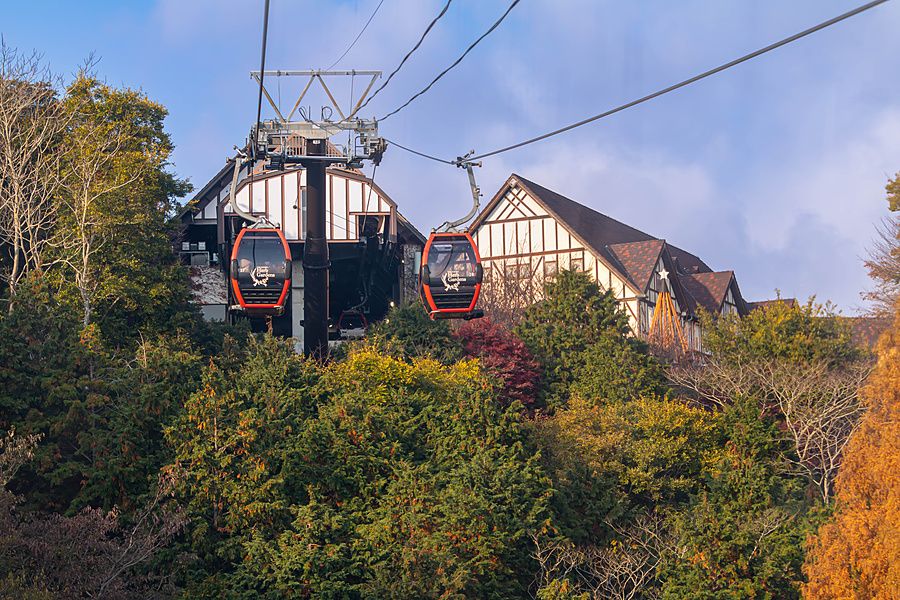
On the ropeway, almost everyone looks toward the city. Below you on the other side, though, you pass Nunobiki Falls and an old stone dam tucked into the woods.
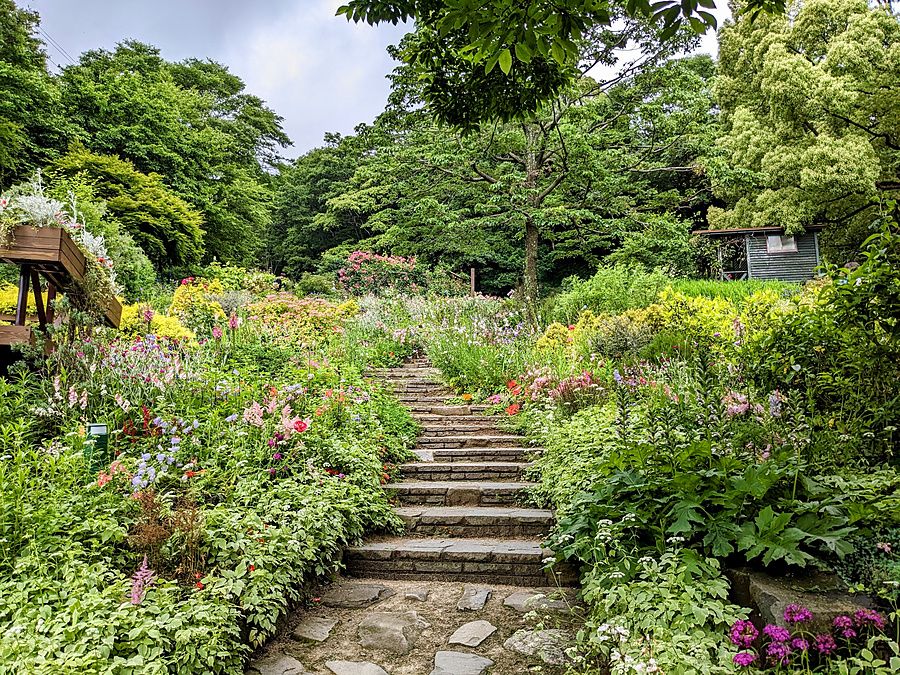
If you’re expecting the endless lavender fields from photos of Hokkaido, adjust your expectations. These are terraced gardens, with well-kept flower beds, pergolas and paths, not fields that run to the horizon.
I keep coming back because it’s the only place I know where you can flop into a hammock in the shade, with fragrant herbs a meter away and an entire port city below you with ships coming and going. I don’t have to plan anything or walk for hours, and every time I find something different in bloom. When I have guests from Italy who want to see Kobe and have half a day, I bring them here, and it’s never let me down.
When to go
The best time is late May to late June, when the roses and lavender are in bloom together. It’s the only time of year when color and scent both hit their peak, and the rose slope is covered in flowers.
The second good stretch is from early November to early December, with red maples on the mountainside. Then the garden matters less than the forest around it.
On weekends and holidays, from late morning to mid-afternoon, a long line builds up at the ropeway station and you’ll have to wait. Inside the park, though, there’s plenty of room, and the crowded feeling goes away almost immediately, because the line is all at the bottom, not among the flower beds.
Early on weekday mornings, there’s hardly anyone around and every hammock is free.
Sunset is a different story, and it’s the time I recommend most. In the twenty minutes after the sun goes down, the sky and the sea turn the same dark blue, and below you the port lights come on one section at a time.
In the evening stay up top, because the lower gardens aren’t lit. In the woods near the top there’s an illuminated trail that kids love.
If it’s raining, don’t bother. At that altitude the clouds sit right on the mountain, so the city disappears, the sloping paths get slippery, and there’s not much left to do besides visiting the greenhouse.
Wind matters too. It’s almost always blowing at the top, and in spring it’s colder than down in the city, so an extra sweatshirt never goes to waste.
Walking down
The park slopes all the way from the top down to the middle station, and some stretches are seriously steep. You walk on stone paths, ramps and steps, never on asphalt.
Nobody makes you walk all the way down. There’s a station halfway down the mountain where you can get back on the ropeway, and that makes all the difference if you don’t feel up to walking to the bottom.
With a stroller, the walk down is a real slog. You have to hold it back with your arms because it keeps trying to roll ahead, and on the stepped sections you have to carry it. If you have a small child, think about a baby carrier.
The same goes for anyone with bad knees. Your knees feel it on the way down, and it’s a good couple of kilometers of nonstop downhill.
Sneakers are fine, but sandals with smooth soles aren’t. There’s shade, but not everywhere. The flower gardens are out in the open, and in July and August the sun beats down.
Along the way you’ll find hammocks and benches in the shade, and halfway down there’s the footbath on The Veranda Kobe terrace, with warm water up to your calves and Kobe’s rooftops in front of you. After all that walking downhill, it’s where everyone stops for twenty minutes without saying a word.
The best photo spot
The best shot is from the Kaze no Oka lawn. Stand below the flower beds with the flowers in the foreground and the sea stretching out behind them, and you don’t need any tricks.
Up top, in front of the castle-style building, everyone takes the same photo, and there’s always someone wandering through the frame.
The spot almost nobody uses is the small wooden deck next to the concert hall, on the Mount Rokko side. It faces Rokko Island, and you’ll find one person there, two at most.
If you can pick your time, go for late afternoon. The low light hits the port cranes and the ships anchored offshore, and the flower beds come out in full color instead of looking washed out the way they do at noon.
At a glance
- The highlight: walking downhill past roses, lavender and hammocks with Kobe’s port in front of you the whole way.
- When to go: late May and June for roses and lavender together, November for the red leaves; late afternoon on weekdays.
- Best for: anyone with half a day in Kobe, couples, families with kids, and people who want nature without having to work for it.
- Atmosphere: well-kept terraced gardens, people sitting down everywhere, wind at the top, the smell of herbs and wet wood in the greenhouse.
Conclusion
What makes this place special isn’t the individual flower beds, beautifully kept as they are. It’s that you look down on them with a whole port city opening up below. I haven’t found that combination anywhere else in Japan, and it’s worth the detour on its own, even if you only have one day in Kobe.
If you’re looking for a historic Japanese garden or a tough mountain hike, this isn’t it, and if walking downhill is hard for you, plan on taking the ropeway back down too.
For everyone else, it’s one of the best places in the city, and if you come late in the afternoon on a weekday, you’ll leave as convinced as I am.