Nyuto Onsen
Everyone who visits Nyuto Onsen falls in love with it. This hot spring area is hidden in the mountains of Akita Prefecture, about four hours from Tokyo by train but worlds away from it. Here the city’s lights and noise give way to the steam rising off the outdoor baths and the quiet of nature in Towada-Hachimantai National Park.
There are seven ryokan, some historic and some more modern, and they’re fed by ten different springs, so you’ll find water that’s blue, milky white, crystal clear or a yellowish brown. There are no public bathhouses, but you can try almost all of the baths without staying the night during certain hours if you pay an entry fee. That makes it the ideal place for a relaxing weekend.
Contents
The ryokan
Each of Nyuto Onsen’s seven ryokan has its own atmosphere and character, so every traveler can find the one that suits them best. Here they are one by one.
Tsurunoyu Onsen
People have been coming to Tsurunoyu since 1638, and it’s the most historic and best-known inn in the area. It’s a good pick if you want to lose yourself in old-fashioned, traditional surroundings and get a feel for the past. Some rooms still have architectural features and details from the Edo period intact, which gives them a rustic, authentic feel that still has a certain elegance.
The inn draws on four different hot springs and has lots of baths: indoor and outdoor, mixed, gender-separated and private. Its large outdoor mixed bath has become the symbol of the area and shows up again and again in promotional materials for Nyuto Onsen.
The heart of the inn is the Honjin, the long thatched-roof building where the men in the lord of Akita’s retinue stayed when he came here to take the waters. The rooms are separated by thin walls and there’s no TV. In the middle of each room there’s an irori, the hearth sunk into the floor, and in winter its fire is the room’s only source of heat. In the evening lanterns light up the snowy walkways, and it feels like a mountain village from three hundred years ago.
The name comes from a legend. A hunter is said to have seen a wounded crane healing itself in these waters, and so the inn became Tsurunoyu, the crane’s bath. Each of the four springs has its own name and character, from the milky white shiro-yu to the clearer water of the other baths, and moving from one to the next in the same evening is half the fun.
The ryokan is open to day visitors from 10:00 to 15:00, and entry costs 700 yen. On Mondays the onsen is closed to day visitors while the baths are cleaned.
Kuroyu Onsen
With more than 300 years of history behind it, Kuroyu is another long-established ryokan, and inside, the rooms smell strongly of the wood it was built from. The rooms are also traditional, with futons and tatami, and there’s a wide choice, including some more spartan rooms. There are also facilities for long stays, like a shared kitchen.
The inn has a wide variety of baths, indoor and outdoor, some with little waterfalls, and they’re fed by several springs, one of them with water the color of milk. The highlight is the large outdoor mixed bath, where the view at sunset is gorgeous. Day visitors can use the onsen from 9:00 to 16:00 for 800 yen. Keep in mind, though, that Kuroyu closes for the winter, roughly from mid-November to early April.
Taenoyu Onsen
Maybe it’s the refined atmosphere, maybe it’s the beautiful woodwork, but Taenoyu Onsen is the ryokan women travelers like best. It’s a modern ryokan with plenty of amenities, set on the banks of the Sendatsu River, and the setting is especially lovely. It has a large outdoor mixed bath that looks out over a waterfall and the beautiful green mountains around it, plus indoor gender-separated baths framed by rocks so they feel more natural.
You can choose between two types of spring water, Kin-no-yu, the golden spring, and Gin-no-yu, the silver spring, and as the names suggest, the difference is the color of the water. Before you get in, sip a cup of tea while you look out at the forest.
The onsen is open to day visitors from 10:30 to 14:00, and entry costs 1,000 yen. It’s closed to day visitors on Tuesdays.
Ganiba Onsen
Ganiba has almost two centuries of history behind it, and it combines traditional surroundings with every modern comfort. It opened in 1846 and takes its name from the many little crabs you can spot in the river, just a few steps from its beautiful outdoor onsen.
The bath sits at the foot of Mount Nyuto, and you can relax in the hot water while you listen to the sounds of nature: the river running past and the birds singing in the forest. Inside there are more baths, separated by gender.
The onsen is open to visitors from 9:00 to 15:30, and entry costs 800 yen. It’s closed to day visitors on Wednesdays.
Ogama Onsen
The modern Ogama ryokan is set in a former elementary school, and that alone makes it one of a kind, with a vintage, slightly lived-in feel alongside modern details and comforts. The outdoor onsen is just as unusual: its light brown spring water stands out against the green of the trees in summer and the white of the snow in winter. Both the outdoor and indoor baths are gender-separated.
One real plus is the convenient location, a couple of minutes’ walk from the Taenoyu-Mae bus stop. In front of the entrance there’s also a small free footbath where you can soak your legs and relax while you take in the scenery. The ski slopes and hiking trails are close by, so it’s even easier to get out and do things both in the warmer months and in winter.
The onsen is open to day visitors from 9:00 to 16:30, and entry costs 700 yen. It’s closed to day visitors on Thursdays.
Magoroku Onsen
If you’d rather be somewhere secluded and intimate, Magoroku Onsen is perfect. It sits off Nyuto Onsen’s main road, in the innermost part of the area, about a 15-minute walk from the bus stop, and the walk is well worth it. The inn is especially known for the quality of its hot spring water, which is often called “healing water” for its many benefits for the body and skin. It has several baths, including a very large outdoor mixed bath, a barrel sauna and an indoor onsen with deep blue water.
The onsen is open to day visitors from 10:00 to 15:00 and closed on Fridays. A day pass costs 700 yen for the gender-separated indoor baths only, or 3,000 yen for all the baths, including the outdoor mixed bath and the sauna.
Kyukamura Nyuto Onsenkyo
Kyukamura Nyuto Onsenkyo is the most modern of the lot, a hotel-ryokan that still keeps the feel and traditions of old Japan. It has lots of amenities, Japanese- and Western-style rooms, and a large onsen area. The outdoor baths are especially nice and comfortable: they’re gender-separated and covered by a roof, so you can enjoy the scenery without bad weather getting in the way.
It’s easy to reach from the bus stop and sits right by the hiking trails that cross the national park, and you can sign up for guided tours at the front desk. The baths are fed by two different springs. The bigger indoor bath has Nyuto water, a sodium bicarbonate spring that’s gentle on the skin, while the small bath and the outdoor one get sulfur water from the Tazawako plateau. Going back and forth between them is the quickest way to see how different the water here can be just a few meters apart.
It’s open to day visitors from 11:00 to 15:30, and entry costs 800 yen.
What the rooms are like
Before you book, you should know that at Nyuto Onsen you sleep the old-fashioned way. In the oldest inns the rooms are tatami rooms where the futon gets laid out in the evening, often without a private bathroom, with shared facilities down the hall. The walls are thin, you can hear your neighbors, and in winter the heat comes from a stove or a hearth. If you want hotel comforts, you’re better off looking at the newer inns.
The reason things are this simple is that Nyuto Onsen started out as a place people went for treatment, not a vacation spot. People from the area would come up at the end of the season and stay for weeks at a time, cooking for themselves in the shared kitchens. That tradition hasn’t gone away, and it’s why, alongside rooms with dinner included, you’ll still find spartan rooms meant for long stays.
Yumeguri pass
If you’re staying at one of the ryokan, you can buy the Yumeguri pass at the front desk. It costs 2,500 yen, is valid for a year from purchase and gets you into every onsen at Nyuto Onsen’s ryokan, with one entry at each. Pass holders also ride for free on the shuttle that links the inns, which runs roughly every one to two hours. You need to book the shuttle at the front desk at least an hour before it’s due to come by.
Mixed bathing at Nyuto Onsen
Some of the best baths here are mixed, and it helps to know how they work before you find yourself in front of the curtain at the entrance. In Tsurunoyu’s big outdoor bath you can’t wear a swimsuit or keep a towel wrapped around you, but the changing rooms and the walkways down to the water are separated by gender, and the water is so milky white that once you’re in, nobody can see a thing. If you’re not comfortable with it, there’s also a women-only bath.
At Ganiba the mixed bath is the one in the beech forest, about fifty meters from the main building, and in the evening it’s reserved for women only during a set time slot. At Taenoyu, on the other hand, the indoor baths switch between men and women every day. The staff move the curtain at the entrance, so you won’t necessarily find the same baths as someone who was there the day before.
Getting there
To get to Nyuto Onsen from Tokyo Station, take the JR Akita Shinkansen to Tazawako Station. From there, continue by bus on the Ugo Kotsu Bus Nyuto Line to Nyuto Onsen-kyo. The ride takes about an hour, and the bus stops at a good number of the ryokan. The ryokan farther from the bus stop offer guests a free shuttle, so all you have to do is arrange a pickup time. If you’re flying into Akita Airport, Nyuto Onsen is about two hours away. From the airport you can take the Akita Airportliner, a shared taxi that runs straight to Nyuto Onsen-kyo. It isn’t a regular bus service and runs by reservation only, so you have to book online or by phone in the days before you travel.
When to go
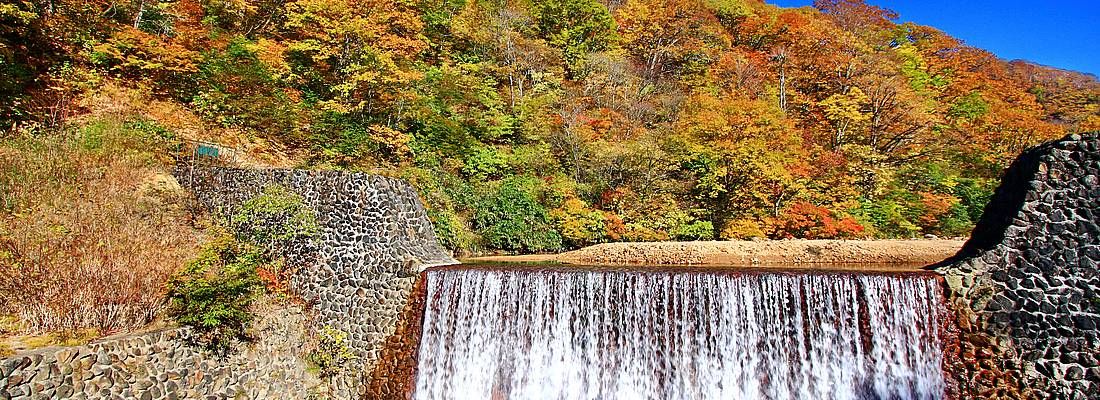
There’s no single best season for Nyuto Onsen, because every time of year has its own appeal when you stay in this wonderful place. In summer you soak surrounded by lush greenery, in fall you’re wrapped in the red and gold of the leaves, and in winter, which is many people’s favorite season, the scenery looks like a romantic fairy tale under a thick blanket of snow. If you’re after the fall colors, the right time is usually the second half of October. The beeches turn yellow first in the upper part of the valley, around Kuroyu, and the color gradually works its way down toward the other inns, so just a few days can make a big difference to the scenery.
Spring is the most overlooked and peaceful season. The snow stays on the ground until well into April and some places only reopen once the road is clear, but the fresh green of the beeches is worth the trip on its own.
When you stay at the ryokan you’ll also get to try the local food, made with fresh, seasonal ingredients from the area, which is one more good excuse to treat yourself to a trip to Nyuto Onsen.
What you eat at the ryokan
At the ryokan in Nyuto Onsen, dinner is almost always included in your stay, and it’s built around what the mountains provide. On the menu you’ll find sansai, the wild greens picked in the beech forests, mushrooms in the fall, and iwana, a river char that’s skewered and slow-cooked around the hearth.
Nyuto’s best-known dish is Tsurunoyu’s yamanoimo nabe, a thick soup with mountain yam dumplings. At the bigger places you’ll often get kiritanpo nabe, Akita’s signature dish, made with rice pressed around a cedar stick and cooked in chicken broth. At Kuroyu, don’t leave without trying the black egg, kuro-tamago. They cook it for hours in the spring water until the shell turns black and takes on the smell of sulfur, and you eat it with a pinch of salt. Breakfast sticks to simple mountain food: rice, miso soup, and preserved vegetables. At dinner, it’s worth ordering some Akita sake, since you’re in one of Japan’s great sake regions.