Ochanomizu
You only really get Ochanomizu by walking around it. It’s right next to Akihabara and Jimbocho, yet it has a feel all its own: students going in and out of the university buildings, white coats from the university hospitals, and store windows packed with guitars.
The name means “tea water.” Back in the Tokugawa era there was a spring here, and its water was carried to the shogun for his tea. These days it’s more a place people pass through than one with big sights, with a river sitting at the bottom of a deep channel between two bridges and a couple of things almost nobody expects. I’d suggest taking your time, because the good stuff here is in the details and on the side streets.
Contents
Restaurants
Nearby neighborhoods

Suidobashi
A man-made gorge
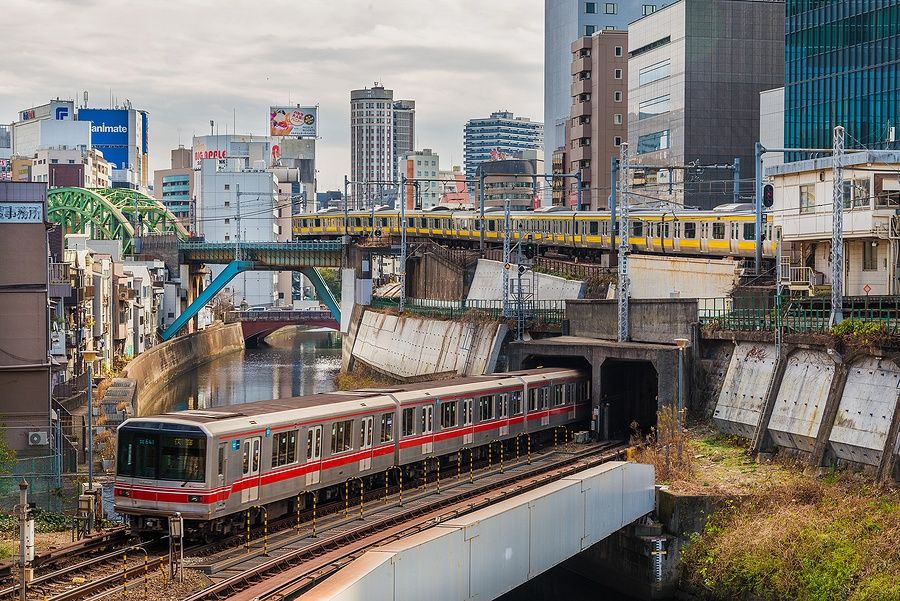
Here the river runs along the bottom of a sort of gorge, and nature had nothing to do with it. The channel was dug by hand in the 1600s: to protect Edo from flooding, the river was rerouted by cutting straight through the hill that stood on this spot.
The job went to the clan of Date Masamune, lord of Sendai, which is why this stretch is still called the Sendai Moat. The cut created the two plateaus you see on either side of the bridge, Surugadai on one and Yushima on the other.
Once you know this, looking down from the bridge feels quite different. What looks like a natural gorge wedged between buildings is actually what’s left of a huge construction project from four hundred years ago, and it’s also the reason the tracks here run on different levels.
The river and Nikolai-do
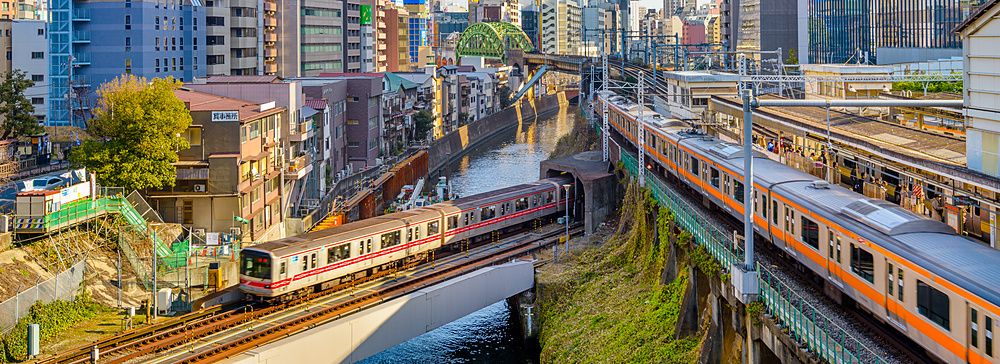
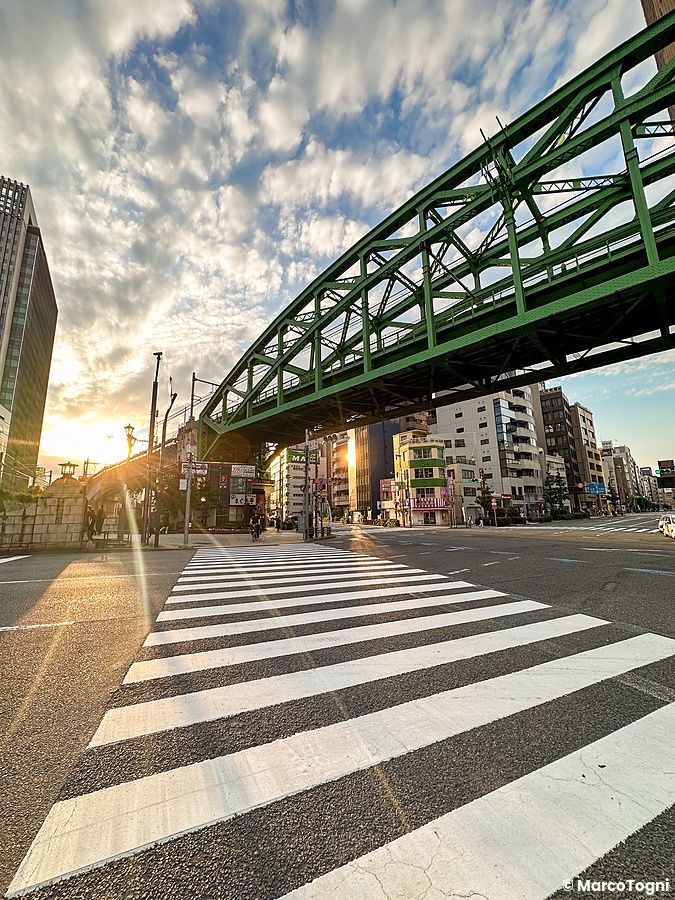
My favorite thing here isn’t on any list of sights. It’s the Kanda River flowing between sheer walls, with Marunouchi trains popping out of the tunnel and crossing on a bridge right above the water. Stand on Hijiribashi bridge and wait: before long a red subway train goes by up top and a JR train lower down, surrounded by greenery. For train lovers it’s one of the best spots in Tokyo, and it doesn’t cost a thing. Stay a few extra minutes and you’ll notice the trains here run on three levels: JR trains along the river, the Marunouchi Line crossing the water in the open, and the Chiyoda Line passing underneath it all, out of sight. It’s one of the few places in central Tokyo where a subway comes above ground, and for a few seconds you get to see it running in daylight.
The bridge is called Hijiribashi, which means holy bridge, because it links two holy places on opposite banks.
On one side is Nikolai-do, an Orthodox cathedral whose big green dome pokes up between the buildings and looks out of place in this part of the city. On the other is Yushima Seido, a Confucian temple with dark roofs and quiet courtyards, linked to the shogunate’s school. Two completely different worlds sit just a few meters apart, and that’s where the bridge gets its name.
Behind the facades
Nikolai-do is named after the Russian missionary who had it built. When it was consecrated in 1891, nothing in this part of the city stood out more. The 1923 earthquake brought down its bell tower and wrecked the dome, and both were later rebuilt lower than before. Inside, it looks nothing like Japan’s other places of worship: icons, gold, and dim light under the dome.
Yushima Seido is the exact opposite, with glossy black buildings, empty courtyards, and a silence that seems impossible so close to Akihabara. The main courtyard holds a bronze statue of Confucius more than four meters tall, which came from Taipei and is considered the largest in the world. The University of Tokyo traces its roots to this shogunate school, and so does a good part of Japan’s modern education system.
An afternoon here
Ochanomizu doesn’t need a whole day, and I’ll say that up front. In a couple of hours you can see the bridges and browse the stores, and that’s plenty to take in. After that, the smart move is to walk on to the neighborhoods next door.
Jimbocho and its secondhand bookstores are a few minutes away on foot, and in the other direction you drift down into Akihabara almost without noticing.
I think the best time is a weekday afternoon, when students fill the cafes and the guitar stores have their signs lit up. Prices for instruments and for used ski and snowboard gear here are some of the most attractive in the city, but if you’re after something specific, it’s a good idea to see what’s out there first, since every store has its own specialty.
Don’t expect a picture-postcard neighborhood or one full of temples. Ochanomizu is a lively area with a bit of a workaday feel, and it’s worth it precisely because it isn’t set up for tourists. I like coming through when I want to browse some books, then some guitars, and spend a couple of minutes standing on the bridge watching the trains.
Guitars and skis
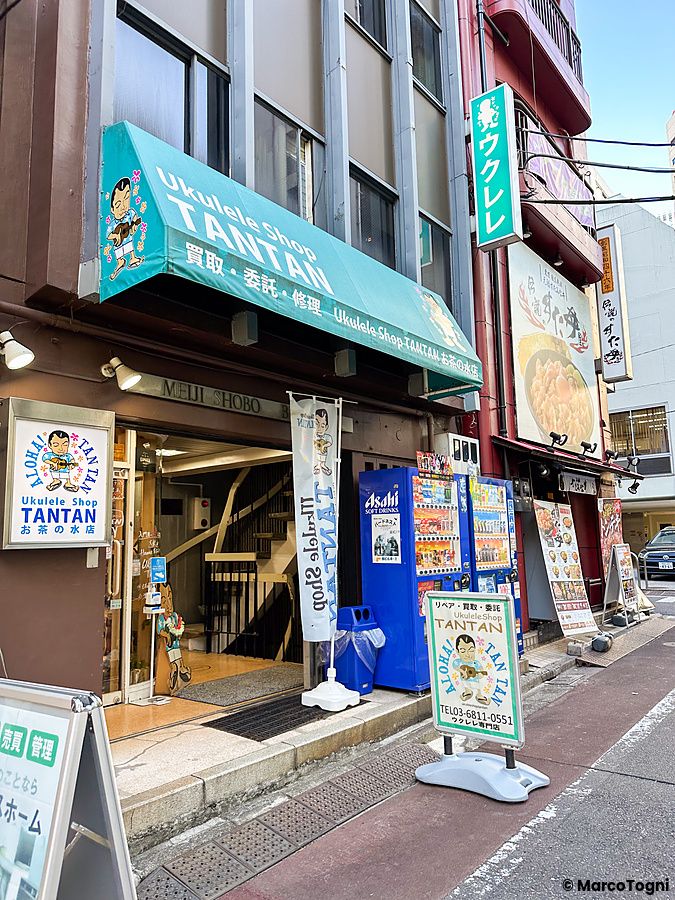
If you’re curious about the music stores, we’re not talking about one storefront but a whole block. Shimokura, open since 1937, carries a bit of everything, from wind instruments and bowed strings to percussion. Kurosawa even has separate stores for drums and for violins, while people go to Ishibashi mainly for guitars and basses.
Almost all of them have a floor of used gear, and that’s where you’ll spend the most time, even if you can’t play a note.
As you head down toward Ogawamachi, music gives way to sports. Entire buildings several stories tall fill up with skis, snowboards, and snowsuits in winter, then reinvent themselves in summer as hiking and camping stores. Tourists always skip this part of the neighborhood, yet it shows you what this area is really like: not many sights, plenty of people at work.
Getting There
The easiest way in is JR Ochanomizu Station, which sits right on the river. The Ochanomizu-bashi exit puts you on Meidai-dori, the street of guitar stores, and from the Hijiribashi exit you're on the bridge in a minute, with the two places of worship facing each other from opposite banks.
From Ginza, Shinjuku, or Ikebukuro, the Marunouchi subway gets you here without changing trains and lets you off in the same area.
If you're already nearby, it makes sense to walk. From Akihabara it's about ten minutes uphill toward the river, and about the same from Jimbocho and its bookstores.
Useful Info
Name: Ochanomizu
Time needed: A couple of hours for the bridges and a look around the stores; half a day if you continue on to Jimbocho or Akihabara
Closed: Nikolai-do: open to visitors only in the afternoon, closed Mondays and national holidays
Yushima Seido: the Taiseiden hall opens only on weekends and holidays, while the grounds are open every day (closed in mid-August and at the end of the year)
Tips: Don't just look at Nikolai-do from outside. On the afternoons it's open, you can go in for a 300 yen donation, and it takes less than ten minutes. On Hijiribashi bridge, stand on the station side, because that's where you can frame the red train above the water.
Getting there:
- Ochanomizu Station (JR Chuo, Chuo-Sobu): Ochanomizu-bashi exit for the stores, Hijiribashi exit for the bridge
- Ochanomizu (Marunouchi subway): right by Meidai-dori
- Shin-Ochanomizu (Chiyoda subway): exit B5, on the side with the sports stores
Map
MarcoMaps100% free
This place is on MarcoMaps
Ochanomizu
My map of Japan: over 4,000 places I've tried myself, each with photos, rating, and hours. Filter by category and rating, find veg-friendly spots and places near you with GPS. No sign-up, right from your phone.
- 4,000+ places
- Rating, photos, and hours
- Veg friendly
- Near me (GPS)
- Favorites without login
- Works offline

