Ohara Museum of Art
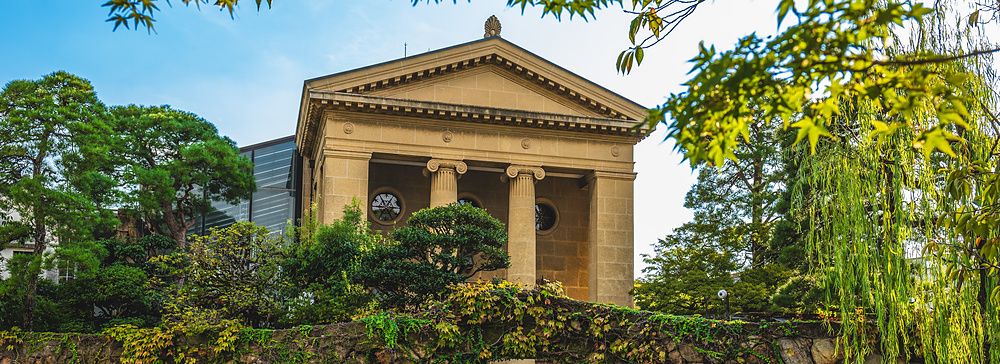
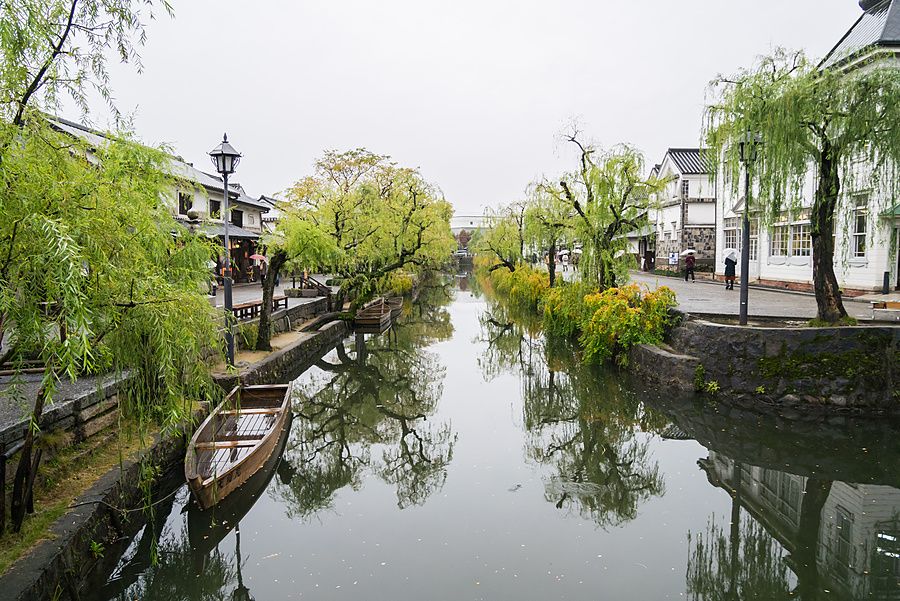
A museum of Western painting in Kurashiki’s historic Bikan district, where among the white storehouses and the willow-lined canal you find yourself facing a columned facade, with two Rodin bronzes standing right by the entrance.
The Ohara Museum of Art is known for El Greco’s Annunciation and Monet’s Water Lilies, but there’s a lot more inside: ceramics, woodblock prints, Buddhist sculpture, Egyptian antiquities, and galleries built into old rice storehouses.
For me it’s the main reason to stop in Kurashiki, and it works even if you know nothing about art and worry you’ll be bored.
What you’ll see
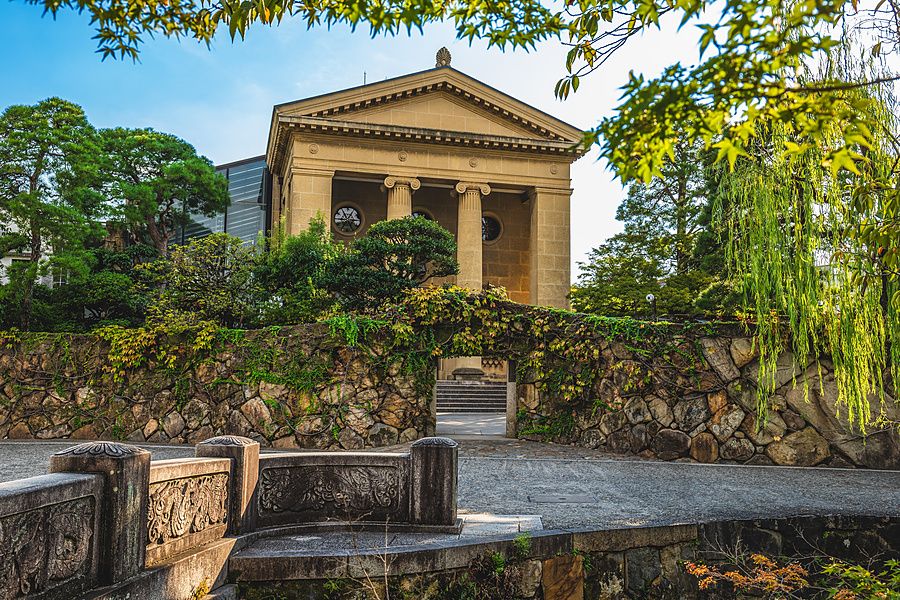
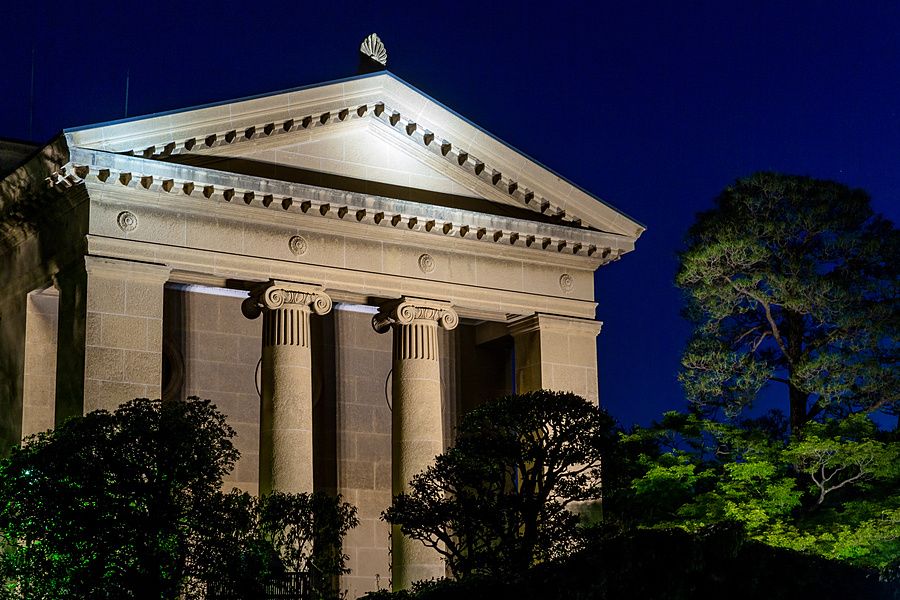
You can’t miss the entrance. There’s an ivy-covered stone wall and columns modeled on a Greek temple, and by the door stand Rodin’s Saint John the Baptist and one of his Burghers of Calais. They’re out in the open, so you can walk all the way around them.
Inside, these are the things people come for:
- El Greco’s Annunciation: it has its own room, with the lights kept low and only the painting lit. Hardly anyone expects to find it in a small town in Okayama Prefecture.
- Monet’s Water Lilies: the painting was bought from Monet himself, at his home in France. It hangs in one of the first rooms of the main building.
- The rest of the main building: Gauguin, Renoir, Matisse, Picasso, Modigliani, Segantini, and modern Japanese painters upstairs. There’s also a round window where you can look out over the district’s rooftops.
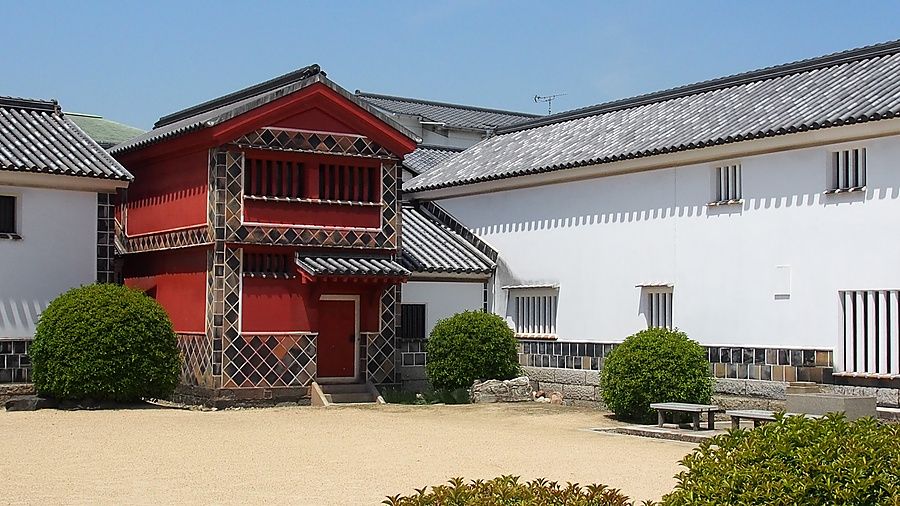
- The crafts and Asian art gallery: two converted rice and cotton storehouses, with white walls in a checkered pattern and one red wall. Inside, each artist has a room of their own: ceramics by Hamada Shoji, Kawai Kanjiro and Bernard Leach, woodblock prints by Munakata Shiko, dyed textiles by Serizawa Keisuke.
- The Asian side of the same gallery: Chinese Buddhist sculpture and ancient ceramics in dim rooms, with hardly anyone around.
- The Kojima Torajiro memorial: it’s in a former bank building in the district, with stained glass and triple-arched windows. It holds his paintings and the Egyptian and Middle Eastern antiquities he collected himself.
A painter from Kurashiki chose the paintings and bought them in Europe with money from a local industrialist, and that’s why there’s an El Greco here and not in Tokyo.
The Annunciation is smaller than reproductions lead you to expect, and the room is narrow. When a tour group arrives, everyone crowds in front of it and you can’t see a thing. Give it two minutes: they all leave together, you get the painting to yourself, and it’s a completely different way to look at it.
Lots of people also do the main building, walk out and head off to eat. I think the storehouse gallery is the part that surprises you most, because every room was built around the artist whose work it holds, right down to the floor, which changes from room to room and creaks differently under your shoes.
One wing of the museum has been closed for renovation for a while, so part of the collection isn’t on display anywhere. If you’re coming for one particular painting, check first what’s on view. Works also go out on loan to other museums, and sometimes the famous piece is away.
Photography isn’t allowed inside any of the buildings. It’ll feel like a nuisance for the first ten minutes, and then you realize it’s why people stand still and look instead of posing.
What this museum really gives you is rare: paintings of this caliber seen up close, in rooms with only a handful of people, with no barriers keeping you three meters back and none of the crowds you’d find in front of the same painters in Europe. You can stand a step from the Monet’s canvas and nobody moves you along.
I go back every time I’m in the Okayama area, and not so much to see El Greco again. I go back because the storehouse gallery has rooms where there’s nobody at all, and spending ten minutes there looking at a Kawai Kanjiro bowl is something that never happens to me in Tokyo.
How the museum started
Two people are behind this museum. Ohara Magosaburo, the textile industrialist who effectively ran Kurashiki, paid for his friend Kojima Torajiro, a Kurashiki painter, to travel to Europe. Kojima picked the paintings one by one, wanting to show them to Japanese painters who would never make it to Europe.
He bought the Monet at Giverny, from the painter himself, and found the El Greco in Paris. After Kojima died, Ohara opened the museum in his memory in 1930, and it was Japan’s first private museum of Western art.
That’s why the columned facade looks so out of place among the storehouses: it was meant to make an impression in a small town that had never seen a European painting.
When to go
On weekdays it’s a pleasure to wander around, especially in the morning. In some rooms it’s just you and the attendant, and you can take all the time you want in front of the Annunciation. Weekends, long weekends and vacation periods are a different story: when too many people pile up at the entrance, they stagger entry, letting people in a small group at a time, and you wait outside for a bit.
By mid-afternoon the district is at its busiest and you feel it inside too, as people in the main building shuffle in a slow line from one painting to the next.
The pond next to the crafts and Asian art gallery has water lilies brought over from Monet’s garden at Giverny, and they flower yellow and pink from late spring into fall. Go in summer and you’ll find them in bloom, with the painting hanging fifty meters away.
In winter the district is empty and you can see the museum in complete peace, but the days are short and the pond is just a rectangle of water.
Rain doesn’t spoil anything. In fact, this is the right place for a bad-weather day, because almost everything is indoors. The only catch is that you go outside between buildings and walk a few minutes along the street, so you’ll still need an umbrella.
Inside the museum
The main building has two floors, and you go up a wide staircase with sculptures placed along the way. There’s an elevator, a ramp at the entrance, wheelchairs to borrow and an accessible restroom. On that front it’s one of the best-equipped Japanese museums I know.
The storehouse gallery is another story. You move from room to room over steps and through narrow passages, the floors are wood or glazed tile, and a stroller is awkward to maneuver.
You do a fair amount of walking, because the buildings are separate and seeing them all means going back and forth through the district. It’s not hard on your legs, it’s hard on your attention: there are a lot of rooms one after another, and if you try to look at everything you’ll come out fried.
My advice is to choose. Either take your time with the main building, or focus on the crafts and Asian art. Rushing through everything is the best way to remember nothing.
Kids do better than you’d expect, but only in the storehouse gallery, with its floors that make noise, odd doors and handrails made to be touched. In front of the paintings in the main building, though, their patience runs out fast.
There’s a museum shop with reproductions and books, and that’s the only place where kids perk up again.
Take your best photo outside, of the facade with its columns and ivy. The light is best early in the morning, when the district is still empty and nobody walks into your shot. With the canal behind you and both Rodins in the frame, that’s the picture of the museum you’ll take home.
At a glance
- The highlight: El Greco’s Annunciation in a dark room all to itself, and the Monet bought from Monet himself.
- When to go: a weekday morning; summer for the water lilies in the pond; avoid weekends and long weekends.
- Best for: anyone passing through Okayama, anyone who wants to see European masterpieces up close, anyone looking for somewhere indoors on a rainy day.
- Atmosphere: small, quiet rooms, low light, creaky wooden floors, hardly a voice.
Final thoughts
What makes this place special isn’t how much there is, it’s the way you get to see it. In Europe you’d be looking at these painters over other people’s shoulders; here you have them to yourself, and the storehouse gallery adds a Japanese side that would justify the visit on its own.
It’s worth the detour, even if it means a special stop on the trip between Osaka and Hiroshima, and it’s one of my three or four favorite museums in all of Japan. If you really can’t stand art, though, or you have small kids and not much patience for reining them in, stick to a walk around the district and skip it. You need a clear head and plenty of time.