 214 m
Kameyama Park214 m
With a nice view.
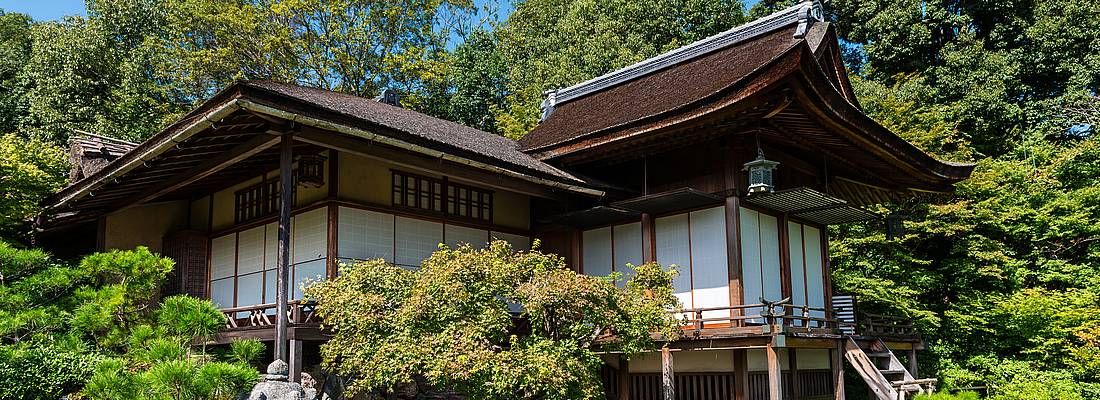
When the sun goes down over Kyoto, the faint lights on the hill above Arashiyama’s bamboo forest remind you that people once lived up here. For years the beautiful Okochi Sanso Villa was home to Okochi Denjiro, one of the best-known Japanese actors of his day. A star of 1930s silent samurai films, he left behind some wonderful movies and a dream villa. Today it’s open to visitors, with gorgeous views of the city and the mountains, and other Kyoto sights are only a short distance away.
The villa is easy to reach from central Kyoto, and it’s one place you really shouldn’t miss. It draws crowds especially in the fall, when people come for the colors of the season. Thirty years of work went into this beautiful blend of traditional Japanese architecture and nature, and every detail looks carefully thought out, just like on a film set.
The villa sits right at the top of a hill, a few minutes from the well-known Tenryuji Temple, and you get there along the path through the Arashiyama bamboo forest. You’ll definitely be struck by the size of Okochi’s estate. It covers 20,000 square meters, with several buildings, lovely gardens and viewpoints where you can look down on the Hozu River and out over the city.
Even from inside the main building, the Daijo kaku, you get beautiful views of Arashiyama and Mount Daimonji, which must have brightened Okochi Denjiro’s days. A small open-air museum covers the actor’s life and career, so foreign visitors who know little about him can get to know him better. Then there’s the small tea room where Okochi Denjiro loved to practice the tea ceremony. Visitors now sit in that same room and are served a steaming bowl of matcha with traditional sweets, and it’s all included with admission.
The best part of the villa, though, is its gardens. They’re divided into different areas to bring out the colors and beauty of each season, so pines, cherry trees, azaleas and maples frame the house in different shades depending on the time of year.
The villa also has a small Buddhist temple with a prayer hall and little stone Buddha statues.
Okochi Denjiro bought this piece of hillside in 1931, when he was at the peak of his career and just over thirty. Film seemed too fleeting to him, since the reels were bound to deteriorate over time, so he wanted to leave behind something lasting: a garden he would design himself.
He worked on it for the rest of his life, right up until his death in 1962, pouring much of his film earnings into it and personally deciding where every building and every plant would go.
The first building he had put up was that little Buddhist prayer hall. He was deeply religious and went there every morning and every evening to say his prayers. Today the whole complex is a nationally registered cultural property, a rare honor for a garden that grew out of an actor’s private obsession.
Whichever station you start from, the last stretch is always the same: you walk uphill through the bamboo forest, and the villa's gate is waiting at the top of the climb. From Saga-Arashiyama Station on the JR Sagano Line, allow about 15 minutes on foot, past Tenryuji Temple and then through the bamboo grove.
It takes about the same time if you come by Randen tram to Arashiyama Station, while from the Hankyu station, which is across the river, it's a good 25 minutes.
If you ride the Sagano scenic train and get off at Torokko Arashiyama, you're already up high, and it's only a 5-minute walk from there.
This place is on MarcoMaps
Okochi Sanso Villa
My map of Japan: over 4,000 places I've tried myself, each with photos, rating, and hours. Filter by category and rating, find veg-friendly spots and places near you with GPS. No sign-up, right from your phone.