Okurayama Observatory
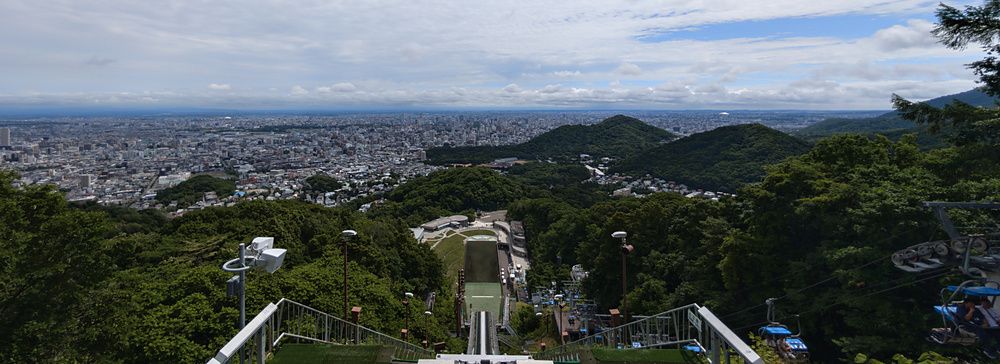
An observation deck at the top of an Olympic ski jump, in the hills west of Sapporo above the Maruyama area. Okurayama puts two things in front of you at once: the inrun dropping straight down beneath your feet, and the city spread out below all the way to the plain and the sea.
You go up for the view, but what sticks with you is seeing it the way a jumper does. It’s the right place if you’ve got half a day free in Sapporo and want to see the city from above without going up a skyscraper, and with kids it’s one of the few things in the area that actually holds their attention.
Contents
What you’ll see
You’re headed for the observation lounge at 307 meters, which sits just behind the start gate the jumpers push off from. It’s what you come up for, but there’s more to look at than that.
- Glass-walled lounge: windows across the whole front, with Odori Park running straight out ahead of you and cutting the city in two all the way to the TV tower, and the green of a university campus off to the right.
- Start gate: the inrun seen from above, with the side rails dropping away sharply and the takeoff at the bottom. Your knees go weak, and no photo captures how steep it is.
- Two-seat chairlift: five minutes sitting out in the open, with the ski jump sliding past beside you and the distance numbers painted on the landing slope going by one after another.
- Ishikari Plain and the bay: past the buildings the flat land stretches all the way to the sea, and on clear days you can see distant mountains more than 80 kilometers away.
- Miyanomori ski jump: the smaller one, on the other side of the little valley, is easy to pick out from up there. Seeing the two side by side shows you how different they are.
- Olympic museum at the base: six simulators, including ski jumping, cross-country and bobsled, plus the skis and the torch used at the Sapporo Olympics.
The lounge at the top is enclosed and heated, which is a lifesaver in winter, but the glass reflects a lot. If you want a clean photo, take it outside in the little open area where you get off the chairlift, before you climb the stairs.
The stairs are the other thing you should know about. There’s no elevator or escalator at the top, so you walk up from the chairlift exit to the lounge. It isn’t a long climb, but with a stroller or bad knees it’s a real pain.
If you’re afraid of heights, the ride down is worse than the ride up. Going up, you face the slope and watch the city open up little by little. Coming down, you’re sitting facing the drop with the city seeming to rush up at you, and some people ride all the way down gripping the bar without looking.
The most common mistake is skipping the museum, since lots of people head straight for the chairlift. With kids it’s the other way around: the simulators keep them hooked more than the view does.
Just about every city has somewhere you can look down on it from, so the view alone isn’t what Okurayama gives you. What makes the difference is that you’re standing on top of a real, working sports venue, with the slope right under your feet and a track that stays in use even in summer, when they cover it with artificial turf. That’s why I go back every time someone comes to visit me in Sapporo. My favorite part is the look on people’s faces when they lean out over the inrun, and after two minutes everyone stops looking at the city and looks down.
When to go
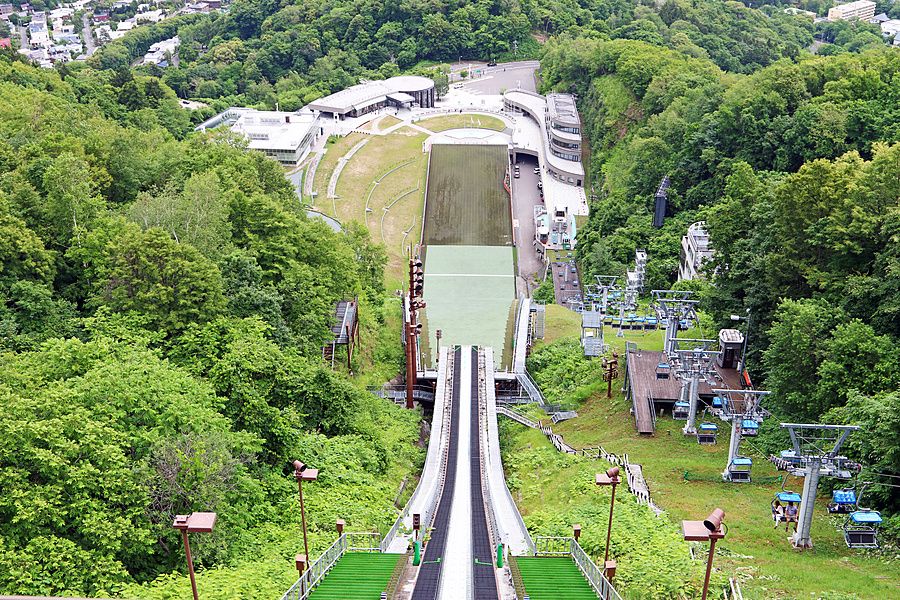
It all comes down to the sky. With low clouds or haze you’re going up for nothing: the plain disappears, you can’t see the sea, and all you’re left with is the rooftops of the nearby buildings. When the air is clear, though, you can see all the way to the horizon.
Wind is the other variable. When it’s blowing hard the chairlift shuts down, and there’s no way to know ahead of time.
Early morning is the quietest time, with two or three people in the whole lounge and nobody in front of the windows. In the afternoon the tour buses and school groups show up, and that’s when a line forms at the bottom of the chairlift, with chair after chair going up full of kids.
A sunny weekend is the worst combination, especially down in the plaza where the lift starts.
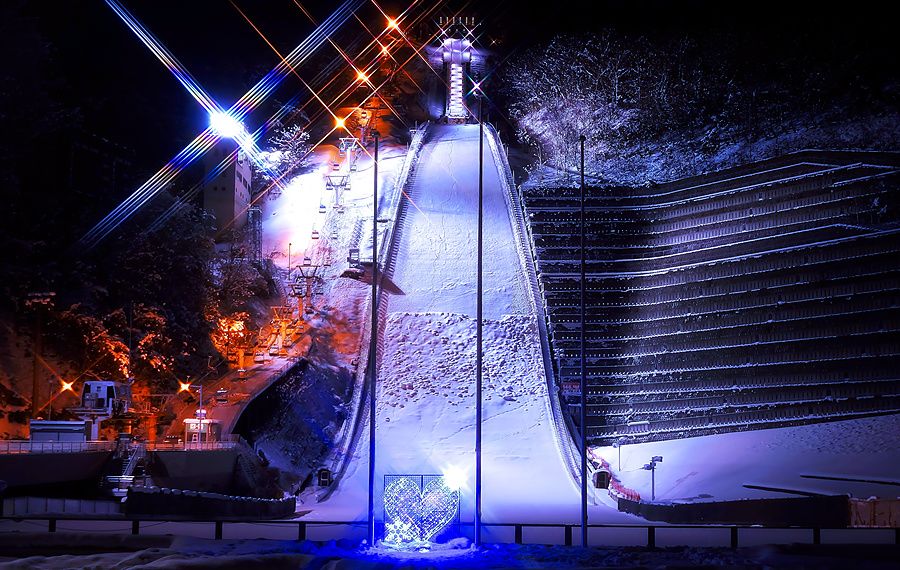
In summer the best time is the evening. The city lights up all at once and Odori turns into a strip of light running straight through the dark. Sapporo’s night view was named one of Japan’s New Three Major Night Views, and from here you see it beyond the black outline of the inrun.
In winter the slope is white and the woods are heavy with snow, but five minutes sitting still in the open at that temperature feel like forever. Bring gloves, a hat and something for your ears. That’s not your mom talking: it’s the only way to get to the top and enjoy it instead of counting the seconds.
In fall the woods around the ski jump turn yellow and red and the chairlift runs right through them, so that’s when the ride itself is at its prettiest.
Going up
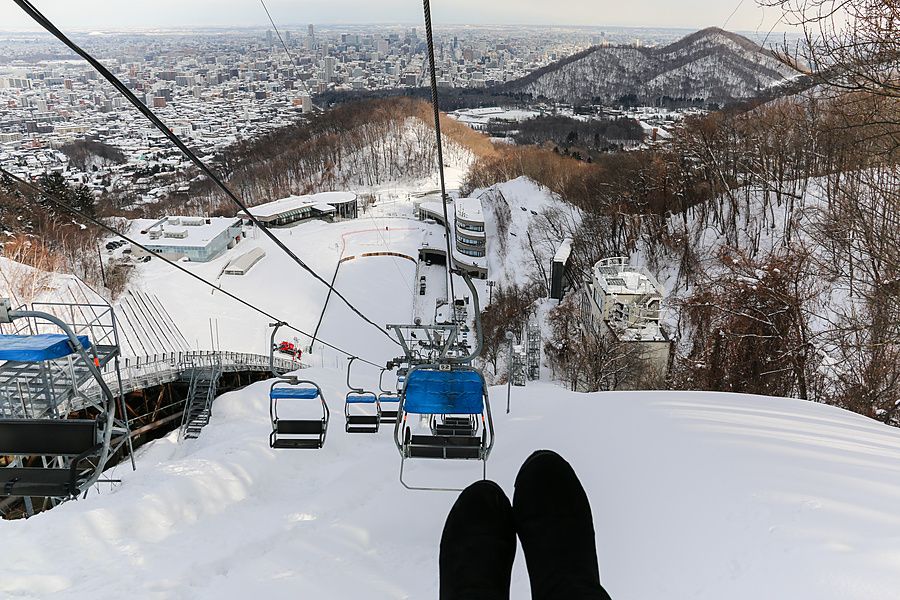
The chairlift is an old open two-seater, the ski-resort kind, with a bar you pull down over yourself. It starts out flat, then gets steeper, and at some point there’s nothing but sky in front of you.
This isn’t a scenic elevator with piped music. You feel the wind and hear the hum of the cable, and if you look to your right the ski jump is right there, a few meters away, with its concrete frame.
There’s also a walking trail up through the woods, starting on the right as you face the jump. It’s a serious climb on steps and packed dirt, not a stroll. If your legs are up to it, you can walk all the way to the top, but don’t bother in street shoes.
Most people take the chairlift, and they’re right to.
With small kids, think twice about taking the chairlift, because it’s open, nothing straps you into the seat, and the last stretch is steep. Older kids, on the other hand, love it, and at the top they all press their faces against the glass and picture themselves on the inrun.
There’s also a small café up there with soft serve that’s fairly well known in Sapporo, and you can eat it sitting in front of the windows with the city below you.
At the foot of the jump
The bottom isn’t just where you start. Looking at the jump from below, from the landing area, is a whole different experience: the structure goes up and up, the judges’ tower hangs off to one side, and just following the numbers painted on the slope tells you how long a jump is. The jump is named after the businessman who had it built, and it was rebuilt for the large hill event at the Sapporo Olympics. World Cup ski jumping is still held here between January and February, on dates that change every year. If you’re in town then, don’t pass up the chance to watch the jumpers in person from the landing area.
If you’d rather not go up, you can stop here and still take in the jump at its full height.
The Olympic museum is right by the base of the chairlift. Inside you’ll find memorabilia from the Sapporo Winter Olympics, including skis from the jumping team that racked up the medals, and above all the simulators.
The ski jump one puts you in the inrun position on a moving platform, so everyone ends up trying it, adults included. The bobsled and cross-country ones are more playful, but they’re still fun.
In a building next door there’s a café and a shop where everyone ends up buying something: sweets you can only get here and souvenirs with the ski jump printed on them. It’s not why you come, but if it’s raining or you’re waiting for the wind to die down, it’s somewhere to stay warm without getting bored.
At a glance
- The highlight: leaning out over the inrun from the start gate, with all of Sapporo spread out below.
- When to go: clear days, early morning to have the lounge almost to yourself, summer evenings for the lights.
- Best for: anyone with half a day in Sapporo, anyone traveling with older kids, sports fans, and anyone who wants a view over the city and the plain.
- Vibe: a real sports venue with few frills, an open chairlift, people laughing nervously, and a quiet glass-walled lounge at the top.
Bottom line
What makes Okurayama special isn’t the view itself, it’s where you’re looking from: the top of an Olympic ski jump that people still jump from. It’s worth the detour even though it pulls you away from the usual downtown sights, and if the sky is clear it’s the best thing you can do in Sapporo with a few hours to spare.
If you get fog or a solid gray sky, though, save it for another day. Without a horizon there’s not much left, and the trip up loses half its point.
Useful Info
Map
This place is on MarcoMaps
Okurayama Observatory
My map of Japan: over 4,000 places I've tried myself, each with photos, rating, and hours. Filter by category and rating, find veg-friendly spots and places near you with GPS. No sign-up, right from your phone.
- 4,000+ places
- Rating, photos, and hours
- Veg friendly
- Near me (GPS)
- Favorites without login
- Works offline

