 905 m
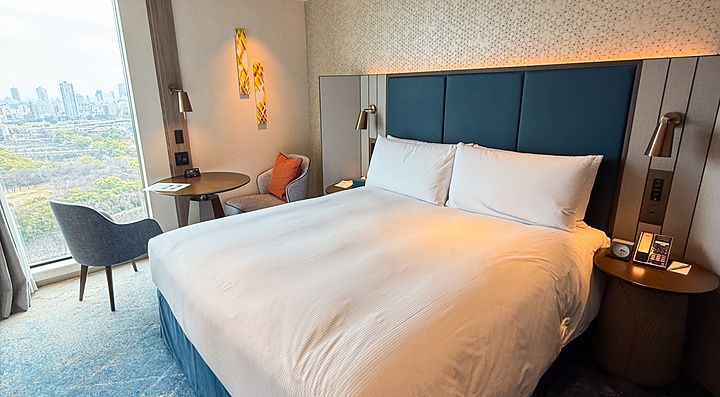
DoubleTree by Hilton Osaka Castle905 m
Castle views and an executive lounge.
Opened in 2001, the Osaka Museum of History is housed in a tall, modern tower right across from Osaka Castle, with beautiful views of the castle from the top floors. Inside, you get to trace the history of this fascinating city, from ancient times, when Osaka was the country’s political and religious center, all the way to today, when Japan’s first capital has become a lively metropolis full of shopping centers, restaurants and nightlife. History and culture buffs will love it, but I’d recommend it to everyone, even people who don’t usually enjoy museums. The exhibits use lots of audiovisual material, replicas, scale models and interactive rooms, so the visit is educational and fun at the same time. On top of that, you get to enjoy a beautiful view of the whole city.
The first thing that strikes you is where the museum is: a modern building with a curved glass exterior, right next to the NHK television station.
The entrance level has a restaurant, a shop and a very spacious lobby, but the visit starts on the upper floors, so take the elevator straight to the top. That’s where the story of Osaka begins, with views of the castle and the whole city. There are actually two routes: a short one of about an hour that covers the essentials, and a slightly longer one that gives you a more detailed and complete picture.
The story opens in 651, when the first palace, Naniwa Palace, was built in what was then the country’s capital. Nothing of it survives today. The palace was abandoned when the capital moved to Nara and was later destroyed, and only a few remains came to light during excavations in the 1950s and ’60s. In this section, though, you can see replicas based on the archaeological finds, along with mannequins in period costume and videos about life at the palace back then, with its ceremonies and festivities. The reconstruction here isn’t a model you look at from a distance: you walk through it. You find yourself in a life-size section of the Daigokuden, the great ceremonial hall, with red-lacquered columns 70 centimeters thick and court officials lined up as if in the middle of a ritual.
Then you turn toward the windows, and that’s the best part. From 57 meters up you look straight down at the lawn where the palace actually stood, the archaeological site at the foot of the tower. You get the reconstruction and the real ruins, one right above the other.
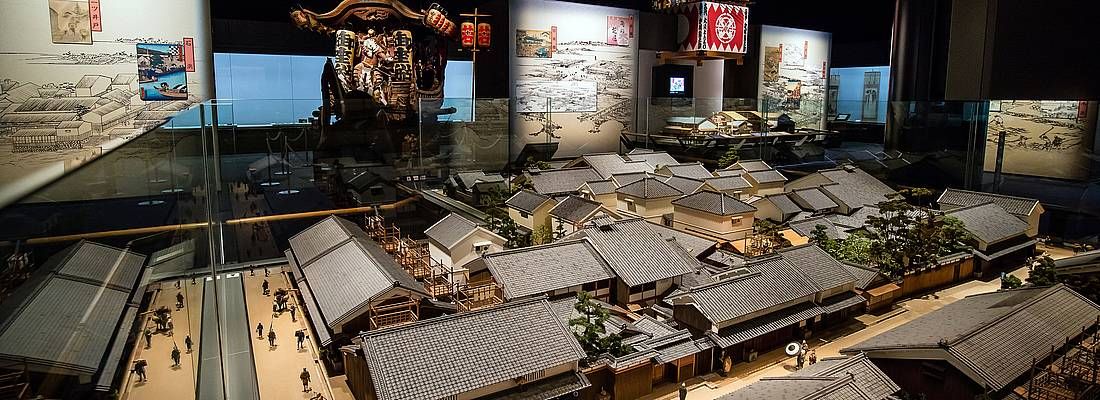
As you go down floor by floor, you move forward in time, through the Middle Ages and into the start of a more modern era, the Edo period (1603–1868). Back then Osaka was known as the “Venice of the East,” because it was one of the country’s most important ports and a thriving trading center. It was also a city with a strong artistic and cultural identity, where new kinds of theater and puppet shows took shape. The highlight of this floor is a 1:20 scale model of the city teeming with life: the merchant shops of Semba, the boats on the canals and the theater signs of Dotonbori, with hundreds of tiny figures that show better than any caption how busy this place was.
A bunraku theater puppet guides you through the scenes, into the Osaka of rice warehouses and wealthy merchants, back when the city was nicknamed Japan’s kitchen.
One floor further down you reach one of the interactive sections, which shows an unusual, little-known side not just of Osaka but of Japan as a whole: its passion for archaeology. Japan has an unusually high number of archaeologists compared with any other country, and this section on the eighth floor recreates an archaeological site where you can see what it’s like to be one, digging for finds and cataloging them. There are also other games and puzzles, all with an archaeology theme.
Then you jump ahead in time to the seventh floor, the last one on the route, where the city’s story comes to a close, covering the early 1900s to the present day. This is the age of industrial Osaka, when businesses flourished and shopping arcades, subway lines and futuristic buildings went up.
Other floors host temporary exhibitions, which you can stop and see if you like. Back on the first floor you’ll find the museum’s little shop for souvenirs and the restaurant if you want a snack. The part that will surprise you most, though, is hidden under the building’s glass floor: excavations that reveal the foundations of the ancient Naniwa Palace, which the museum was built on top of.
The museum stands at the southwest corner of Osaka Castle Park, on the same block as the NHK building. The station you want is Tanimachi 4-chome: take exit 2 or 9 and in a couple of minutes you're in front of the glass tower.
If you're getting around on the JR Osaka Loop Line, get off at Morinomiya instead and walk across the castle park. It's about 20 minutes on foot, a nice walk but a lot longer.
This place is on MarcoMaps
Osaka Museum of History
My map of Japan: over 4,000 places I've tried myself, each with photos, rating, and hours. Filter by category and rating, find veg-friendly spots and places near you with GPS. No sign-up, right from your phone.


Osaka Museum of History - nearby you will find: