72 m
Maisen72 m
Unbeatable tonkatsu.
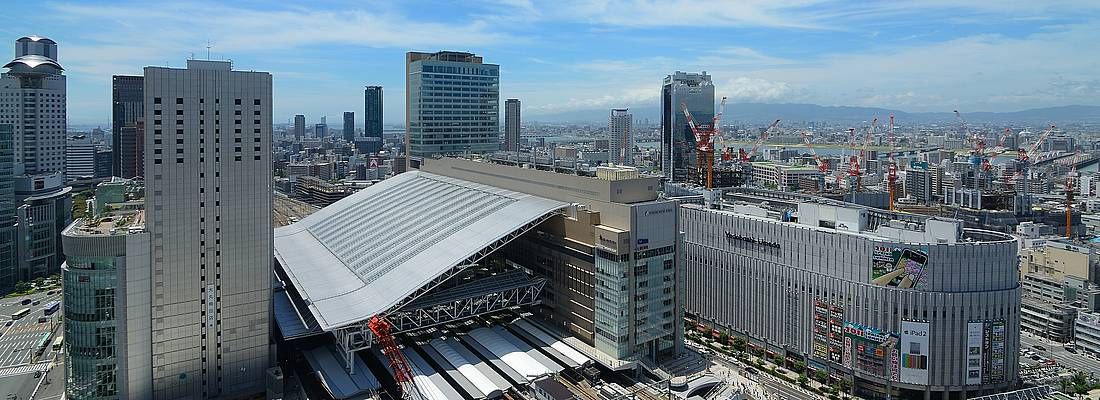
Unveiled in 2011 after a major redevelopment, Osaka Station is one of the most beautiful in the country. It’s also one of the busiest, with 2.3 million passengers a day and a long list of local and regional lines that stop here and connect it to the cities of the Kansai region. Now called Osaka Station City, it really does feel like a city within the city: spread across its floors and around the tracks are shopping malls, tourist services and food halls, so visitors and commuters waiting for a train have everything they need.
Osaka Station is in the Umeda district, surrounded by some of the city’s main shopping and entertainment areas, which makes it a great starting point for soaking up Osaka’s nonstop energy.
Unlike the southern neighborhoods such as Shinsaibashi, Nanba and Tennoji, northern Osaka, including Umeda, only started to develop in the early 1900s. Today it’s the city’s modern center, packed with skyscrapers and the offices of international companies.
One of the things that sets Osaka Station apart is its huge glass roof, which links the buildings in the complex and creates several open-air spaces you can use all year round. The best known is the elegant Toki no Hiroba plaza, whose name means “plaza of time and space.” It was designed by Mitooka Eiji and features two clocks, one gold and one silver, which have become a popular meeting spot for locals. The plaza has places to sit and relax, and from up there you can look down on the rows of tracks below. Underground tunnels and elevated walkways connect the north building with the south one, so it’s easy to get between the two towers, each of which has its own services and attractions.
The North Gate Building is the northern tower. Inside you’ll find a shopping mall, a multiplex movie theater, a fitness club with a gym and spa, and several green spaces where you can take a break.
The Lucua mall has hundreds of shops on twelve floors, where you can buy just about anything, from fashion to beauty products and souvenirs. There are plenty of places to eat too, with a whole string of restaurants on the top floor and the usual depachika in the basement.
If you want to rest and get some fresh air, take the elevator up to the 10th and 11th floors, where there are two open-air terraces called Yawaragi no Niwa and Kaze no Hiroba. Among the greenery and flower-filled lawns there are benches where you can sit and take in the view over northern Osaka. Yawaragi no Niwa is actually a small Japanese garden, with cherry, pine and maple trees that change color with the seasons, while Kaze no Hiroba is built around running water and rose pergolas. Something you really won’t find anywhere else is Tenku no Noen, the “farm in the sky,” which you reach by a staircase from the 11th floor, and where you can relax among small fruit and vegetable plots. The vegetable garden itself is even higher up, on the 14th floor, and besides the vegetable beds it even has a small rice paddy: a little piece of countryside hanging over the tracks.
Unlike the North Gate Building, which opened in 2011, the southern tower was already standing, but it’s been renovated. Today it has a shopping mall, Hotel Granvia Osaka, a clinic and a few spots to relax.
The Daimaru Department Store takes up the lower floors with lots of shops and services, while the upper floors are home to Lucua South, with the Pokemon Center and the Nintendo store. In the basement there’s the usual depachika with its food counters. Up on floors 15, 16 and 17 you’ll find Taiyo no Hiroba, the “sun plaza,” spread over three terraces with lots of seating and a restaurant-cafe with outdoor tables.
Besides the malls I’ve already mentioned, the station’s basement levels are full of passageways lined with shops, cafes and small restaurants, so you can shop or grab a bite as you walk from one platform to another.
The area around the station is great for shopping too. The Hankyu Department Store is in the historic former station building, with many floors of shops, pastry shops and restaurants.
Hep Five is another popular mall, easy to spot thanks to the Ferris wheel on its roof, which gives you amazing views over the city. If you’re into gadgets and electronic accessories, I recommend the Yodobashi Camera store, with six floors of shops.
The main tourist services are in the First Floor Central Concourse. There you’ll find a tourist information office and train information counters where you can ask questions about the city and the trains, buy passes for attractions and transportation and pick up maps. The station also has luggage lockers in various spots, usually next to the ticket offices. They come in different sizes and prices, but if your bags are really bulky you can leave them at the baggage storage counter in the First Floor Central Concourse.
Throughout the station you’ll also find ATMs, currency exchange offices and multilingual touch screens with information and tips about Osaka and the station.
The Osaka/Umeda complex is actually made up of several separate stations used by four railway companies.
On the elevated level there are two stations:
These stations are on the basement levels:
The station’s bus terminal is on the north side of the building, right outside the first-floor exits. From here you can catch both local buses around the city and long-distance buses connecting Osaka to other cities in Japan.
If you need a taxi, head to the southwest side of the station toward the Sakurabashi Exit. You’ll see the line of waiting taxis right in front of it.
On the northwest side of the complex, beneath the Umekita district, there’s a section of the station that’s almost separate from the rest, with platforms 21 to 24. A long passageway inside the ticket gates links it to the rest of the station, so if you’re heading there, allow a few extra minutes of walking.
This is where trains to Kansai Airport leave from, along with trains to Wakayama and the Kii Peninsula, while the other platforms serve the Osaka Higashi Line.
It’s also the most futuristic part of the whole station. The platforms are lined with full-height platform doors that slide to line up with each train’s doors, and some gates open with facial recognition, with no ticket or card needed.
The current station dates from 2011, but Osaka Station itself goes back to 1874, when the line between Osaka and Kobe opened. Back then you’d have found a small Western-style red-brick building, just two stories high and surrounded by rice fields. It was the station that turned Umeda into the city’s main transportation hub, and the whole area grew up around it.
As the city grew, it soon needed a bigger, more modern building, and putting it up around the time World War II broke out was no easy job. Meanwhile, several private railway and subway stations opened next to Osaka Station, and in the 1960s the shinkansen terminal opened a little farther north, at Shin-Osaka Station. Osaka Station kept being renovated and expanded bit by bit until the major rebuild was completed in 2011, which created this mini city and has made it more and more of a tourist attraction.
Osaka Station sits in the middle of Umeda, and you can get there from pretty much anywhere in the city. From Kansai Airport, the Haruka express pulls into the underground platforms in the Umekita area, and an indoor passageway takes you from there to the rest of the station.
From Shin-Osaka, where the shinkansen stop, it's just a few minutes on the JR Kyoto Line. From Namba and Shinsaibashi in the south, the easiest option is the Midosuji subway line, which drops you off on the complex's basement levels.
Once you're in the area, you don't need to go outside: tunnels and walkways link all the Umeda stations and the department stores around them.
This place is on MarcoMaps
Osaka Station
My map of Japan: over 4,000 places I've tried myself, each with photos, rating, and hours. Filter by category and rating, find veg-friendly spots and places near you with GPS. No sign-up, right from your phone.


Osaka Station - nearby you will find: