Pigment
A shop selling artists’ paints and painting supplies in Tennozu, on the Shinagawa waterfront, that looks more like an art gallery than an art supply store at first glance. It’s called Pigment, and it’s known for its powdered pigments: thousands of shades in glass jars, alongside brushes, washi paper, glues and ink sticks for traditional Japanese painting.
It’s meant for painters, but I’d tell you to go in even if you’ve never picked up a brush. Step inside and you’ll find one of the most unusual places in Tokyo, and a jar of pigment is a gift nobody else brings back from Japan.
Contents
What they sell and what it costs
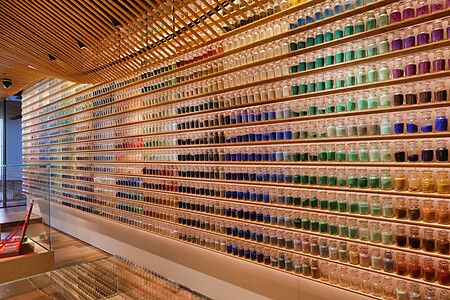
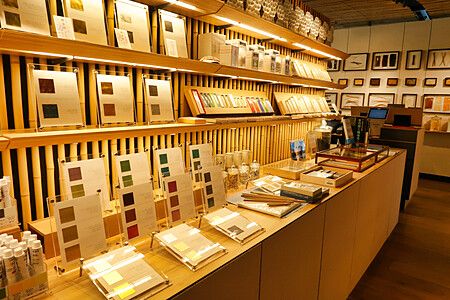
There are about 4,500 pigments, from mineral ones made by grinding stones like azurite, malachite and cinnabar to modern synthetic ones and pearlescent colors. They’re sold as loose powder in jars, and the powder only turns into paint once you mix it with animal glue, which is the method used in traditional Japanese painting on paper and silk. On the shelves you’ll see the same mineral in several jars marked with different numbers, which tell you how finely it’s ground. The finer the powder, the lighter the color, so a single stone gives you a whole range of shades.
Around the pigments you’ll find everything you need to use them, from the tools for applying them to the paper you paint on.
- Natural mineral pigments: powders made from ground stone, sorted by shade.
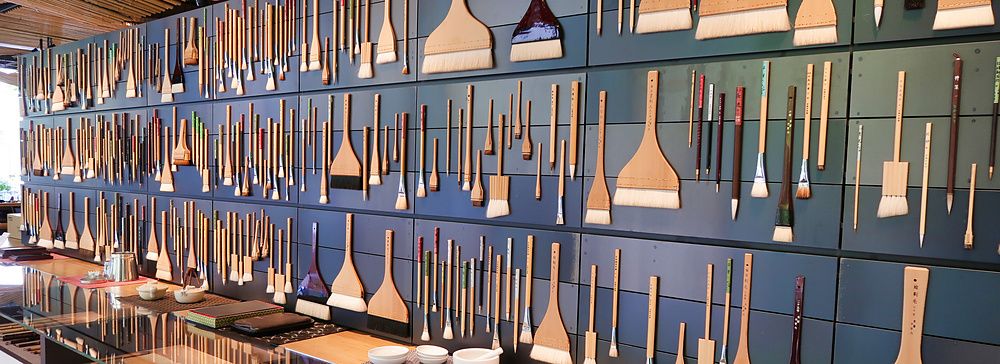
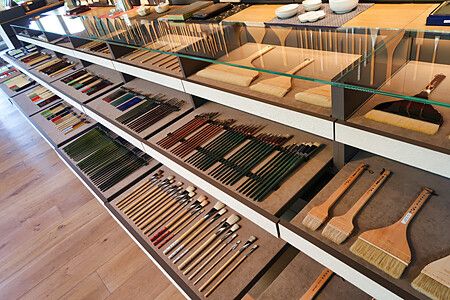
- Brushes, fine to wide: more than 600 kinds, made of goat, weasel or rabbit hair or nylon, including the ones used to restore historic monuments in Kyoto.
- Antique ink sticks: about two hundred kinds of old sumi, plus the inkstones you grind them on.
- Animal glues: about fifty kinds of nikawa, the glue that makes the powder stick to the paper.
- Echizen washi: sheets made the traditional way in the Fukui area, the right paper for these colors.
- Starter sets: a box with a set of jars, the glue, a flower-shaped dish for mixing a little color at a time, and a brush.
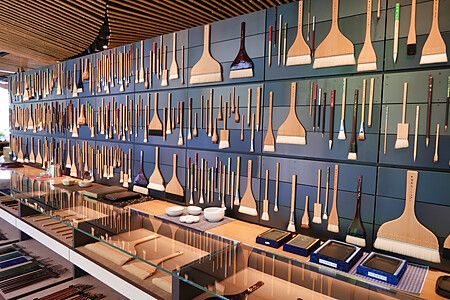
Under the brush wall there’s a display case with more painting tools, including mortars for grinding pigments, and that’s the part I’m most curious about. The powders are light, but the jars are glass, so wrap them in a sweater in your suitcase or you may end up with clothes dyed blue.
You can’t paint with the powder alone, though. If you’re shopping for a kid who likes to draw, or for someone who only uses tube watercolors, this isn’t the right place. Without the glue and a bit of practice, the pigment just stays in its jar, looking pretty on a shelf.
Small jars are cheap, around 300–700 yen depending on the color, and you can buy them one at a time instead of getting the whole set. Complete starter sets go up to around 18,000–25,000 yen, and the good brushes and antique ink sticks are priced like professional tools.
If painting is your thing, the price is fair, because in Europe you can only get these materials online, and even then it’s a struggle. When I need a gift for a friend who paints, I make a special trip here. Two or three mineral colors cost me less than a dinner out, and the bag weighs next to nothing.
Inside the shop
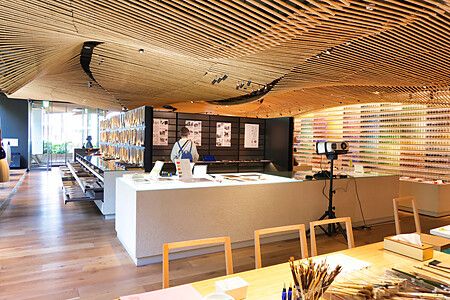
Kengo Kuma, the architect behind Tokyo’s National Stadium, designed the interior. The ceiling is made of thin bamboo slats that dip and rise in waves, and from below it looks like a reed curtain moving in the wind.
Pale wood shelves cover the main wall, holding hundreds of glass jars lined up along the color spectrum: blues blend into greens, then yellows and reds, without a single gap. It’s the first thing you notice when you walk in, and you end up standing in front of it longer than you planned.
The brushes are on the opposite side, each hung separately on dark panels, from one as thin as a needle to one as wide as your hand. In the middle there’s a white counter with workstations and a projector, which they use for workshops and for testing materials.
People keep their voices down in here, like in a museum, and some spend half an hour at the shelves without buying anything. You can take photos with your phone, but not with a big camera.
Staff and tax-free shopping
What sets Pigment apart from an ordinary art supply store is the staff. They’re artists, and some of them have a PhD in painting materials. Ask how to use a glue or why one pigment costs more than another, and they’ll answer patiently and even explain how to prepare it.
Some of them speak English, so you can ask questions even if you don’t know Japanese. They also run workshops where you choose a pigment and make your own color.
The shop offers tax-free shopping for tourists, so bring your passport if you’re planning to buy a set or some serious brushes. Cards from abroad work fine.
Quick take
Pros:
- thousands of pigments on display, including rare minerals, sold one jar at a time
- Kengo Kuma interior with a wall of graded colors, worth seeing even if you don’t paint
- staff who really know their materials, some of whom speak English
Cons:
- you need glue and some basic technique to use the powders; they’re not ready-to-use paints
- fragile glass jars to pack in your suitcase
Best for: painters looking for Japanese materials they can’t find in Europe, or anyone who wants to see one of Tokyo’s most beautiful interiors
Atmosphere: quiet and museum-like, with pale wood, bamboo and a wall of color
Final thoughts
You don’t come to Pigment for the sheer number of products. You come for the expertise. If you paint, every yen you spend here is worth it, because along with the glues, papers and hard-to-find pigments, you get someone who explains how to use them.
If you don’t, twenty minutes is enough to see a space unlike anything else in the city, and a jar that costs a few hundred yen is the most original souvenir you can bring home.
Getting There
The shop is on the ground floor of the Terrada Harbor One building, on the Tennozu canal. The easiest way to get there is the Rinkai Line: at Tennozu Isle Station take Exit B, and you'll be there in about 3 minutes on foot.
If you're coming from Hamamatsucho on the Haneda monorail, get off at Tennozu Isle, take the South Exit and walk for about 5 minutes.
Useful Info
- Tennozu Isle Station (Rinkai Line): Exit B
- Tennozu Isle Station (Tokyo Monorail): South Exit
Map
This place is on MarcoMaps
Pigment
My map of Japan: over 4,000 places I've tried myself, each with photos, rating, and hours. Filter by category and rating, find veg-friendly spots and places near you with GPS. No sign-up, right from your phone.
- 4,000+ places
- Rating, photos, and hours
- Veg friendly
- Near me (GPS)
- Favorites without login
- Works offline

