 685 m
Higashiyama685 m
Stone-paved lanes, stairways, and traditional houses.
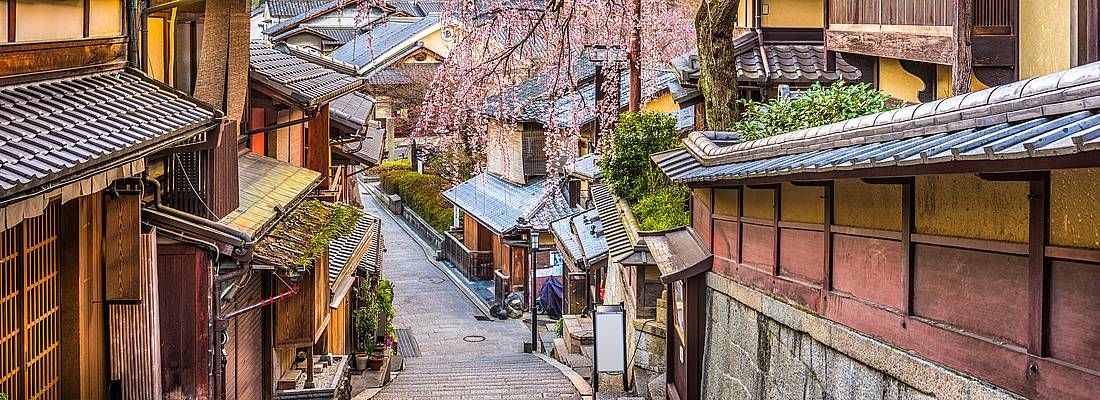
Ninenzaka and Sannenzaka are a piece of old Kyoto that’s still standing. You don’t need much imagination to picture the city before the modern age arrived. Just walk up these two narrow stone lanes, where traditional houses, teahouses, inns, shops and small restaurants line the winding streets, and the power lines still hang overhead like in an old photo, only in vivid color.
The cherry trees draw crowds in spring, but the area is busy all year round. Yasaka Shrine, Maruyama Park, Kiyomizudera Temple and Kodaiji, a Zen temple, are all close by, and these two slopes are the natural way to get from one to the next.
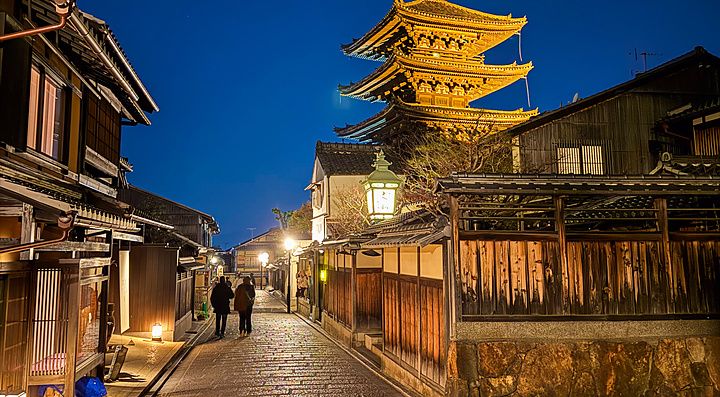
As you walk Ninenzaka, the five-story Yasaka-no-to Pagoda stays with you the whole way, and its imposing silhouette is in view from every point along the street. Ninenzaka was built in 807, and today it has a lively, vintage feel. Both sides are lined with shops, cafés and restaurants in traditional wooden buildings, where you can buy souvenirs and local products or stop to try a local specialty. Paper parasols, lanterns and wooden signs with Japanese lettering make the whole place feel genuine and full of character. Probably the only modern touch is a Starbucks inside a historic teahouse, but drinking coffee from the famous American chain on a tatami floor is one of the many experiences you can only have in Japan.
The street climbs gently, with a few bends, which makes it a perfect place to stop for photos, sit down with a cup of matcha or do some shopping. You’ll find pretty much everything for sale: kimono, fans, fabrics, washi paper goods and much more. If you want to stay in the area, there are plenty of traditional inns along the street. Pilgrims and merchants traveling between Tokyo and Kyoto once slept here, and today the same inns host tourists who want to sleep in rooms with a sense of history.
Almost nothing here breaks the spell, and that’s no accident. Since 1976, the whole area has been protected by law as a preservation district for traditional buildings, one of the first in Japan, and the protected zone was later extended to take in the flagstone lane of Ishibe-koji.
Within the protected area, nothing gets changed on a whim. Roof tiles, wooden facades, colors and signs all follow strict rules, and even vending machines and convenience stores have to blend in, with dark casings and curtains instead of the usual neon lights. It takes constant upkeep, and that’s why the two lanes look the way they do: they’re not a set built for tourists, but a piece of the city that’s still standing.
Just one year younger than Ninenzaka, Sannenzaka is a 100-meter-long street that leads up to Kiyomizudera Temple. Here, too, you walk along a curving lane on a gentle slope, lined with so many historic buildings that the area was designated a protected historic district.
The old wooden houses are home to cafés and small shops selling souvenirs, sweets and Japanese snacks, good for refueling before you head up to the temple. Between the houses you catch glimpses of lovely, well-kept gardens tucked out of sight, quiet green corners that make you want to step inside to take photos and look around.
Sannenzaka is also where you’ll find the Kiyomizu Sannenzaka Museum, which I recommend if you’re into Japanese art. It displays many works by artists from the Edo (1603–1868) and Meiji (1868–1912) periods, mostly small-scale pieces: maki-e lacquer, cloisonné enamel, Kyo-Satsuma ceramics and chased metalwork, made with a precision you only really appreciate with your nose pressed to the glass. The collection is small and takes just under half an hour to see, and it shows how far Japanese craftsmen could go when they were working for Western collectors in the 19th century.
From Kyoto Station, the bus is the most direct way. Take the 206 or the 86 to the Kiyomizu-michi stop, then walk up Kiyomizu-zaka and you'll reach the start of Sannenzaka in a few minutes.
If you're coming by train, you can get off at Kiyomizu-Gojo on the Keihan Line and allow about 15 minutes, all of it uphill. From Higashiyama Station on the Tozai subway line, you come in from above instead, walking down to the two lanes through Maruyama Park.
If you're already in Gion, it's worth walking: from Yasaka Shrine, follow Nene-no-michi and you'll come out right on Ninenzaka.
This place is on MarcoMaps
Sannenzaka and Ninenzaka
My map of Japan: over 4,000 places I've tried myself, each with photos, rating, and hours. Filter by category and rating, find veg-friendly spots and places near you with GPS. No sign-up, right from your phone.


Sannenzaka is more than a photogenic slope to walk down. Its stone steps carry a persistent legend: anyone who falls here is said to get three years of bad luck, or in the darker versions, three years taken off their life. The idea goes back to where the street used to lead. People once climbed this way to Toribeno, the great burial ground of ancient Kyoto.
Luckily, there’s a fix. At the bottom of the slope, a shop still sells dried gourds, called hyotan, which according to tradition catch the soul of anyone who trips and lift the curse. Whether you buy one or not, it’s a good idea to watch your step anyway, because the stone gets slippery and the steps are trickier than they look.
Sannenzaka and Ninenzaka - nearby you will find: