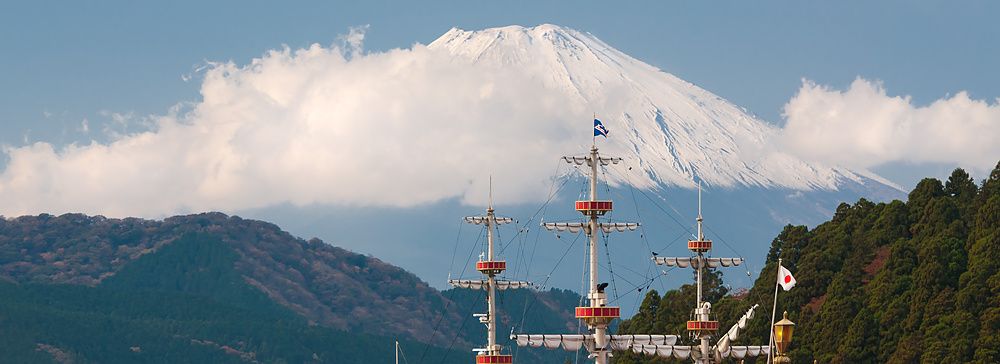
Where to See Mount Fuji from Hakone
Few views in Japan stop you in your tracks the way Mount Fuji from Hakone does. Don’t expect a guaranteed postcard shot, though. Just like in Tokyo or at Lake Kawaguchi, you need luck and patience here, plus the right spot. I’ve been several times, and when the sky is clear there’s nothing better than watching the volcano rise behind Lake Ashi.
Below are the best places to see it, how to improve your chances of spotting it, and a few tricks I’ve picked up over the years. If you know them before you go, you’ll spare yourself a lot of frustration.
Contents
- When you can see Fuji from Hakone
- Lake Ashi and the classic view
- The red torii on the water
- Mount Komagatake and its 360-degree view
- Fuji from the Hakone Ropeway
- Owakudani, a different kind of view
- The imperial villa park on the lake
- The best ryokan and hotels with a Fuji view
- Places to skip
- Tricks to improve your chances
- Hakone or Kawaguchiko for Fuji?
- Final thoughts
When you can see Fuji from Hakone
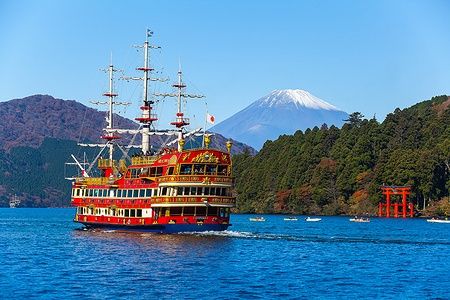
First of all, Fuji isn’t always visible from Hakone. On some days you can’t see it at all, not even from the best viewpoints.
Visibility mostly comes down to:
- the season
- the weather
- the humidity
Your best chances are in winter and early spring, from December to March. The air is drier then and the sky tends to be clearer, especially on windy days that sweep the haze away.
The worst months are summer and early fall, especially July to September, when the heat and high humidity often turn the air milky. Even under a clear sky you might not see Fuji at all, because of a light haze that’s invisible to the naked eye.
Whatever the season, aim for early morning, before 9:00 or 10:00. Earlier is even better if you can manage it, ideally an hour after sunrise. As the day goes on, humidity tends to rise and clouds form more easily around Mount Fuji. Of course this is only a rule of thumb, and things change from day to day.
Lake Ashi and the classic view
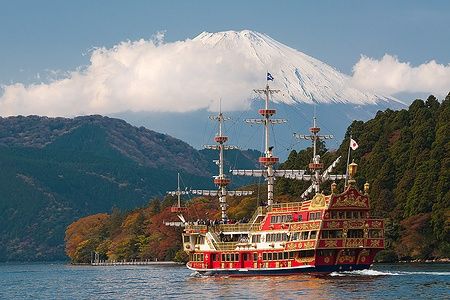
For the classic Hakone shot with Fuji in the background, the place to go is Lake Ashi (Ashinoko).
The best-known view is from the south side of the lake, with Fuji rising above the water and often the famous red torii of Hakone Shrine in the foreground. It’s one of the defining images of the area, which is why you see it so often in guidebooks and tourist brochures.
I recommend a few key spots for this view:
Motohakone It’s the easiest spot to reach by public transportation. The sightseeing cruises on the lake leave from the pier here too, and when conditions are right you can see Fuji right from the shore. You could also head higher up the mountain, but you’d only be wasting your time.
Lake Ashi cruises The sightseeing boats take you out on the lake, so you can find the best angle for the conditions at that moment. When Fuji is visible, I strongly recommend taking the cruise.
The red torii on the water
A few minutes’ walk from the Motohakone pier stands Hakone Shrine’s red torii on the water, the Heiwa no Torii, and it shows up in most of the photos people take around here. The spot is hugely popular: in the middle of the day people stand in an orderly line waiting their turn to take a picture in front of the torii, and the wait can be long.
Here too, early morning is on your side. There’s hardly anyone around, the light on the water is soft, and those are the hours when the volcano is most likely to show itself. Keep in mind, though, that from the spot right in front of the torii, Fuji doesn’t fit in the same frame, so walk a few meters along the shore until you find the right alignment.
Mount Komagatake and its 360-degree view
Another fantastic spot for Fuji is the summit of Mount Komagatake, which you reach on the Komagatake Ropeway.
From the top the panorama is amazing, with Mount Fuji on one side, Lake Ashi on the other and, on a very clear day, even Sagami Bay and Tokyo in the distance.
Check the weather before you go up, because low clouds can cover the summit even when the sky looks clear down below. Look at the live webcams or ask the staff before you buy your ticket. The view isn’t the only thing up there: the Motomiya, the original Hakone Shrine, sits on the grassy plateau, which makes the trip up interesting even when Fuji stays hidden. There’s no shelter at all at the top and the wind blows almost constantly, so it’s a lot colder than on the lakeshore.
Fuji from the Hakone Ropeway
Another good way to see Fuji is to ride the Hakone Ropeway, the well-known cable car between Sounzan and Togendai.
On the stretch between Owakudani and Togendai, if the sky is clear, a spectacular view of Fuji suddenly opens up in front of you.
Grab a spot on the west-facing side of the gondola and have your camera ready. On the best days the view is genuinely moving.
Owakudani, a different kind of view
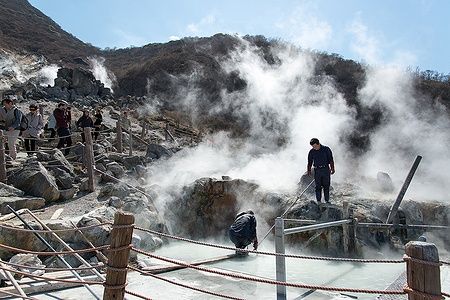
The volcanic area of Owakudani is one of the most visited places in Hakone, known for its sulfur fumes and black eggs. It also gives you a very striking view of Fuji.
From the observation terrace near the Ropeway station you can see Fuji rising above the steaming hills. It’s a more dramatic and unusual view, very different from the classic one over the lake.
The early-morning rule applies here too: the later it gets, the more likely clouds are to cover Fuji.
The imperial villa park on the lake
Between Motohakone and Hakone-machi, a wooded peninsula juts out into the lake, and that’s where you’ll find Onshi Hakone Park, the grounds of the former imperial villa built in 1886. It’s one of the best viewpoints in the area, and it stays surprisingly quiet even when the shore in front of the torii is packed.
The best view is from the observation building in the middle of the park. From the upstairs balcony you get Lake Ashi, Mount Komagatake and, when the air is clear, the outline of Fuji all in one frame. A short climb through the trees takes you there, and the walk alone is worth the detour, with the cherry blossoms in spring and the fall colors later in the year.
The best ryokan and hotels with a Fuji view
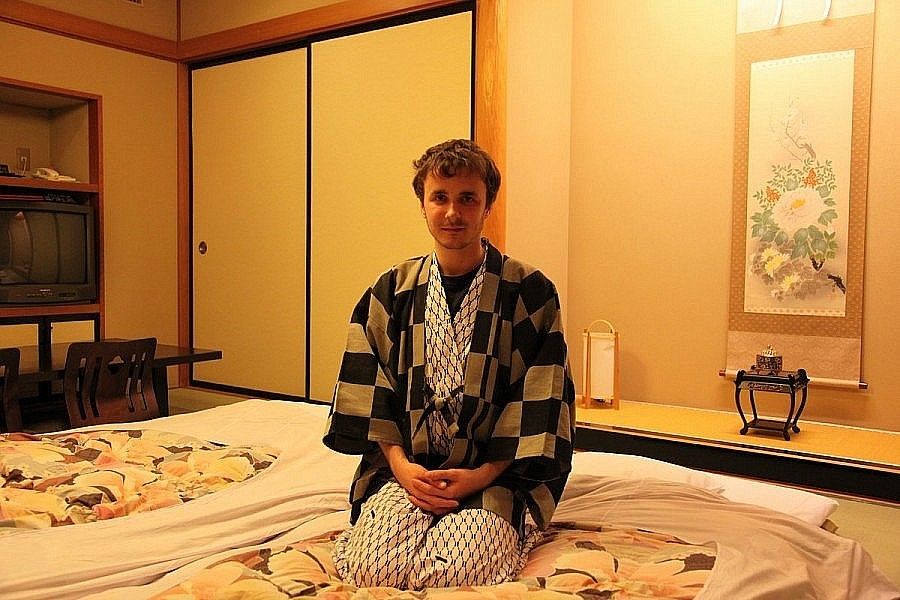
Of course, not every hotel can offer that, because Fuji is only clearly visible from certain parts of Hakone. Hotels with a direct view are mostly in two areas:
Gora A well-known hot spring area, up high. You can see Fuji from some rooms and outdoor baths, but it depends on which way the hotel faces.
Motohakone and Hakone-en These lakeside areas have the most scenic views. Mid-range to upscale hotels and traditional ryokan with onsen often say whether a room has a Fuji view.
Before you book, read the descriptions carefully: many hotels list a “possible Fuji view” because it depends on the weather. There are no guarantees, but on a clear day it’s an experience you won’t forget.
Places to skip
Not every part of Hakone is good for seeing Fuji. I’d suggest you don’t waste time in areas like these:
Hakone-Yumoto It’s the gateway to Hakone, but the surrounding mountains block any view of Fuji.
Central Gora (the lower part) Some hotels have a view, but you won’t see Fuji walking around central Gora.
Art museums Many of Hakone’s famous museums (Pola Museum, Open Air Museum, etc.) are surrounded by nature, but you won’t get a glimpse of Fuji from them. If seeing it is your priority, don’t count on these stops.
Tricks to improve your chances
Here are a few practical tips that over the years have helped me see Fuji from Hakone more often:
- Check the live webcams Several webcams in Hakone are pointed at Fuji. A quick look before you head out saves you a wasted trip.
- Plan at least two days Don’t rush in and out. The longer you stay in Hakone, the better your chances of catching a clear spell.
- Start early in the morning If you can, arrive the evening before and get up early. Visibility is best early in the day.
- Keep your expectations flexible You need luck. If Fuji doesn’t show up, enjoy the scenery and Hakone’s other attractions anyway, because they’re worth it either way.
Hakone or Kawaguchiko for Fuji?
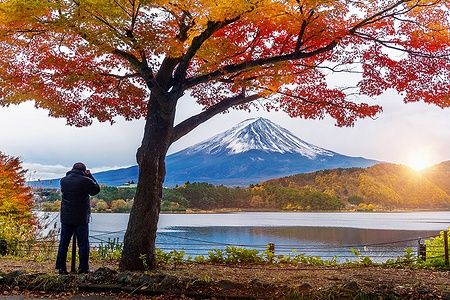
People ask me this a lot. If your top priority is getting great photos of Fuji, Kawaguchiko is probably a bit more reliable. As you can see in the photo, taken around Kawaguchiko, the view is wider and Fuji is closer. To give you a concrete idea, from Hakone the volcano is about 30 kilometers away, while from Kawaguchiko you’re roughly half that distance. The difference shows right away in photos: from there Fuji fills twice as much of the frame and you can make out the gullies on its slopes, while from Hakone it stays an outline on the horizon, smaller but set in scenery you won’t find at Kawaguchiko.
From Hakone, though, you get more varied and striking views, with combinations you won’t find anywhere else, like Lake Ashi and the volcanic landscape of Owakudani.
Personally, I’d think of Hakone more for the overall experience (onsen, nature, art, local food), while Kawaguchiko is ideal for a trip built around Fuji and postcard photos.
Final thoughts
My advice is to go to Hakone with the right attitude: don’t set off fixated on seeing Fuji no matter what.
Go there to explore a one-of-a-kind place full of history and nature. And if luck is on your side that day, when you see Fuji’s perfect outline rising behind Lake Ashi, it’s a memory you’ll carry with you forever.
You’ll find other articles on the site to help you plan your visit to Hakone and Mount Fuji, and I recommend reading them to put together the perfect itinerary.