Senbei
Senbei are one of the easiest Japanese snacks to try, and one of the best. They’re the rice crackers you’ll find everywhere, from konbini to the old shops in Asakusa where they’re still turned by hand on the grill, and they change quite a bit from one region to the next.
A lot of travelers first taste them out of a supermarket bag, but a hot senbei fresh off the grill is something else, and it’s worth tracking down. They’re also one of the easiest souvenirs to pack in a suitcase.
Contents
What senbei are
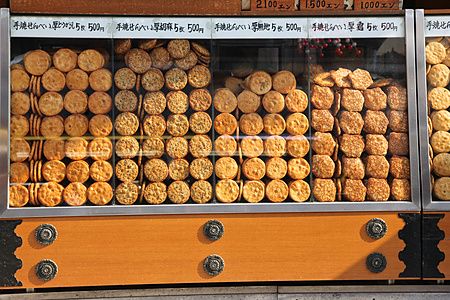
Senbei are Japanese rice crackers. They’re made with regular rice, the kind you eat with meals, called uruchimai. The rice is cooked, pounded into a dough, rolled out into thin sheets and cut into discs.
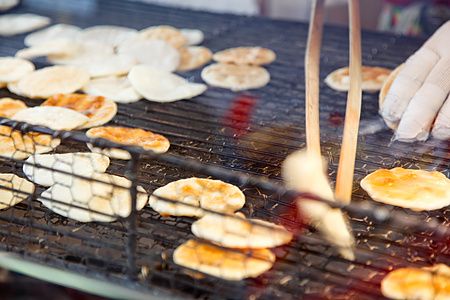
The discs are left to dry, then cooked on a grill or an iron plate. They get flipped constantly while they cook, and at the end they’re brushed with soy sauce, which many shops thin out with a broth of kombu and bonito.
What you end up with is a hard, dense disc, much more compact than any Western cracker, and the first bite really does go crack. You taste toasted rice rather than anything fried, and the flavor is closer to the crispy layer of rice stuck to the bottom of the pot.
The word goes back centuries. Documents from the eighth century already mention a roasted rice confection that’s considered the ancestor of today’s senbei, even though back then it was something completely different.
Some people in Japan trace the name to a woman called Osen, who lived in the Edo period and supposedly flattened and cooked leftover dango rice balls instead of throwing them away. It’s a legend, but people still love telling it, especially in Soka, the city that has made senbei its symbol.
Senbei, arare and okaki
On a Japanese supermarket shelf, rice crackers go by at least three different names, and it’s easy to get confused. What sets them apart is the type of rice.
Senbei are made with regular rice, which is why they come out hard, thin and crunchy. Arare and okaki are made with glutinous rice, the same rice used for mochi, and they puff up more as they cook. The bite is lighter and more crumbly, sometimes almost spongy.
Between arare and okaki, the main difference is size:
- Okaki are the bigger pieces, often irregular, and in many parts of Japan the word also covers the handmade glutinous rice crackers sold in traditional sweet shops.
- Arare are the tiny bits you eat by the handful, like the well-known kaki no tane shaped like persimmon seeds.
- Senbei proper are the flat discs, bigger than your palm in the classic versions, or square or rectangular depending on the shop.
In everyday speech, though, nobody is that precise, and a lot of Japanese people call anything crunchy, salty and made from rice a senbei. The formal name for the whole category is beika, which simply means rice confection, and you’ll mostly see it on packaging.
Flavors and textures
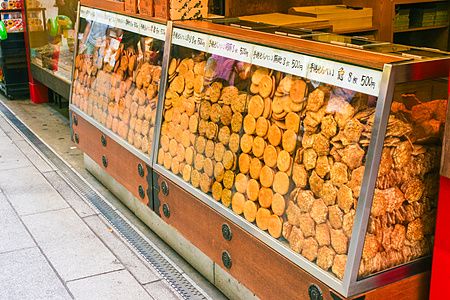
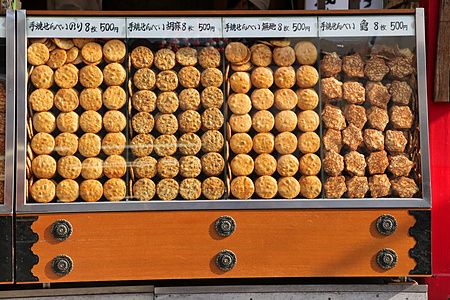
The basic flavor is soy sauce, and most of the senbei you’ll see are a dark hazelnut brown with a glossy surface. There are tons of variations, though.
One kind comes wrapped in a sheet of nori, which gives it a taste of the sea, and the cracker goes a little soft where the seaweed touches the sauce. Another is coated in coarse sugar, sweet and salty at once, and it’s one of my favorites when I want something with tea. Then there are chili, sesame, green tea and shrimp versions, plus plain salted ones, pale in color, where all you taste is the rice.
Texture also changes a lot from one type to another. The handmade ones that get pressed while they cook are rock hard, and if your teeth aren’t in great shape you need to go easy, seriously. Factory-made ones are usually lighter and puffier.
There’s also the opposite of crunchy: nure senbei, which literally means wet senbei. Right after it comes off the grill it gets dunked in soy sauce, so it stays soft and chewy. A lot of people are puzzled by the first bite, but then they finish the whole bag.
Regional varieties
Every part of Japan has its own senbei, and some of them aren’t even made of rice. These are the ones you’ll run into most often in souvenir shops and train stations:
- Soka senbei comes from the city of Soka, just north of Tokyo. It’s the classic rice disc with soy, hard and grilled, the one most people picture when they think of senbei.
- Nanbu senbei comes from northern Tohoku, around Hachinohe and Iwate, and it’s made with wheat flour baked in round molds. The thin edge that squeezes out of the mold is called mimi, meaning ears, and some people buy just the edges. The best-known version is the one packed with sesame seeds.
- Nure senbei from Choshi, in Chiba Prefecture, is the soft one soaked in soy, and it’s no coincidence that it comes from a town that has lived off soy sauce production for centuries.
- Kawara senbei, typical of Kobe and Kagawa Prefecture, is a sweet cookie made with flour, sugar and eggs, shaped like a Japanese roof tile and often stamped with a design.
- Ebi senbei is the shrimp cracker, a specialty of Aichi Prefecture, where almost all of Japan’s production is concentrated. It’s made with shrimp and starch, not rice.
Nanbu senbei came out of necessity. In northeastern Japan a cold wind blows in from the sea, and for centuries it made rice hard to grow, so families got by with wheat and buckwheat, making flatbreads they cooked over the hearth at home.
Choshi’s nure senbei got famous all over Japan thanks to a railway. Choshi’s small local line was about to go under, and it saved itself largely by making and selling its own nure senbei. Senbei are still one of its main sources of income today, so buying them is a small way of helping out the line.
Soka and its history
If any city makes its living from senbei, it’s Soka, in Saitama Prefecture, just over the Tokyo border. In the Edo period it was a post town on the Nikko Kaido, the main road linking Edo, as Tokyo was called then, with the northern provinces. The poet Matsuo Basho passed through too, and he mentions it in his most famous travel diary.
Travelers would stop, eat, and take with them senbei grilled over charcoal and brushed with soy. Over time, the city’s name and the cracker’s became almost interchangeable.
Soka senbei follow a specific technique. While the disc cooks, it gets pressed down with a ceramic tool called an oshigawara, which keeps the dough from puffing up and forming bubbles. That’s why it comes out so dense and hard.
A cracker also has to meet a few requirements to be officially sold as Soka senbei: local rice, a craftsman with at least ten years of experience, and pressing during cooking. The city has dozens of shops, and along the old post road you walk past storefronts where they grill right in front of the window.
Grilling your own in Soka
I recommend Soka because you can grill your own senbei there. It takes under an hour from central Tokyo on the Tobu Skytree Line, which leaves from Asakusa, and the trip easily fits into a morning.
There are two well-known places to do it. At Shimeya, an old shop about ten minutes on foot from Soka Station, there’s a corner of the store with a grill where you pay per cracker, and the staff show you how to flip and press it. At Soka Senbei Garden, a few minutes from Shinden Station, there’s a bigger space with a shop, a café and outdoor grills, and each person can grill a couple of senbei without booking ahead.
The cost is low, a few hundred yen, but it’s a good idea to check current prices before you go. A few practical tips:
- Go on a weekday, because on weekends families with kids show up and there’s a line at the grills.
- Expect to get a bit of soy sauce on your fingers and to feel the heat of the grill, especially in summer.
- Eat at least one senbei right away, fresh and still hot. That’s what makes the trip different from buying them in Tokyo.
- Take a walk through the shops along the old road too, where you can buy single senbei and compare different styles.
To be honest, it’s not a trip I’d recommend if you only have a few days in Japan. It’s at its best if you’ve already been in Tokyo for a while, if you’re traveling with kids, or if you want to see ordinary suburbs, the kind tourists almost never reach.
Where to buy them in Tokyo
For a senbei grilled on the spot, you don’t need to leave the city. Tokyo’s old senbei shops are mostly in the older part of town, what the Japanese call shitamachi, around Asakusa, Ueno and Yanaka.
In Asakusa, along Nakamise and the streets around Sensoji, several shops grill in front of passersby, and from the street you can watch the discs being turned on the grill one by one.
You can also buy just one hot piece to eat right there. The cracker is thick and hard, but it smells of scorched soy sauce in a way the packaged ones never do.
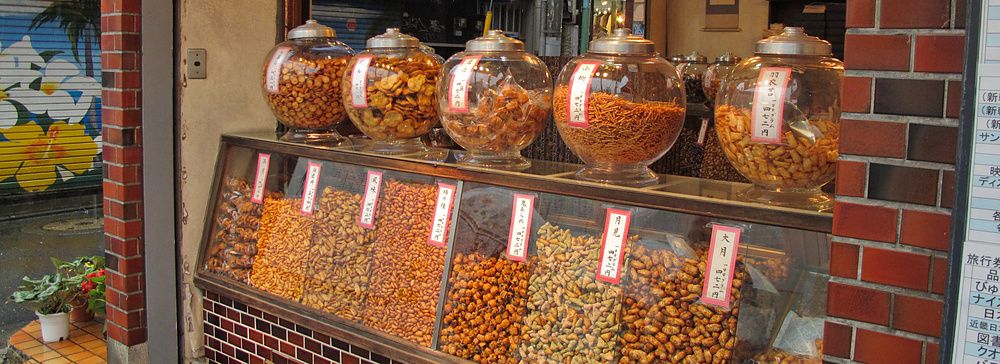
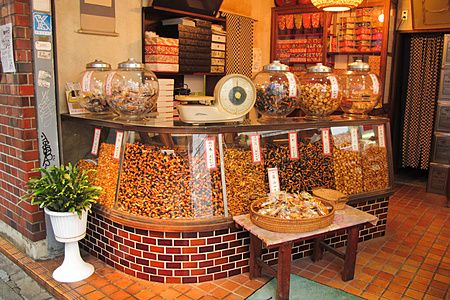
In Yanaka, near Sendagi Station, there’s Kikumi Senbei, in business since 1875. Their senbei are square, which is rare, and you can buy them one at a time from the big glass jars in the window, in a few flavors including soy, chili and sweet. The name has a story too: in the late 1800s, the nearby Dangozaka slope was known for its chrysanthemum displays, kiku in Japanese, and the shop got its start selling senbei to the visitors. One of its regulars was the writer Mori Ogai, who lived at the top of the slope and bought his senbei here to eat with tea.
Outside these shops, the places with the widest selection are:
- Department store basements, the depachika, where old brands have counters with gift boxes and individually wrapped senbei.
- Big stations like Tokyo Station, with regional souvenir shops where you’ll find Nanbu senbei, nure senbei and kawara senbei without having to travel to where they come from.
- Shopping streets in the old neighborhoods, like Nakamise in Asakusa or Yanaka Ginza, where you can buy single senbei to munch on as you walk.
- Regional antenna shops, the spaces prefectures open in Tokyo to sell their products, which are great for finding local varieties.
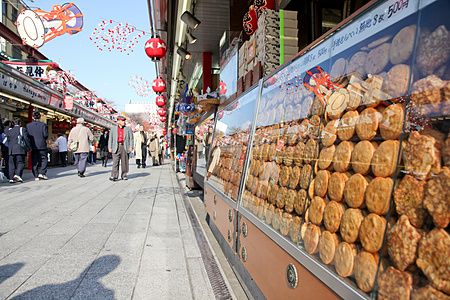
When I have guests who want to know what a real senbei is like, I always take them to get a hot one at a neighborhood shop. Once they’re holding it, they can tell right away how different it is from the ones in supermarket bags.
Supermarket senbei
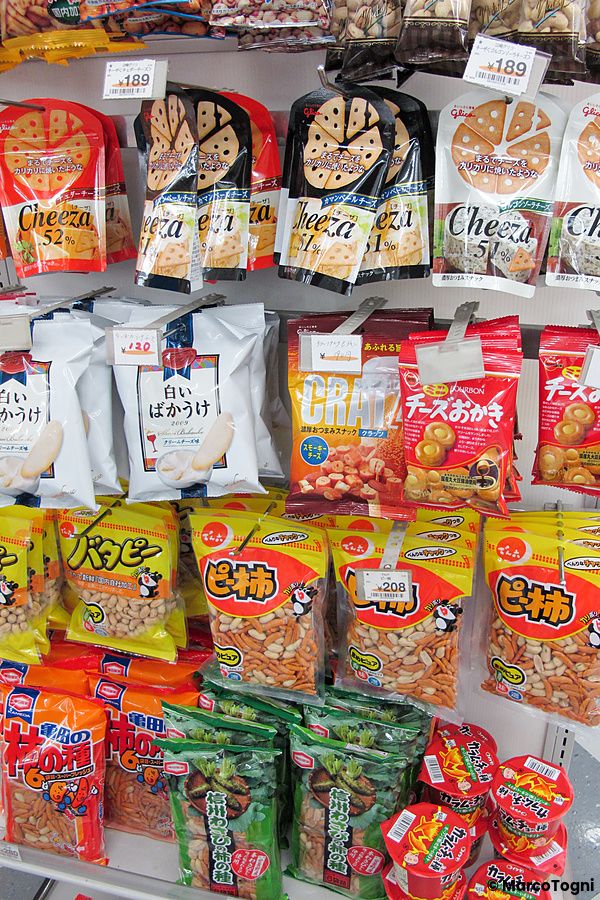
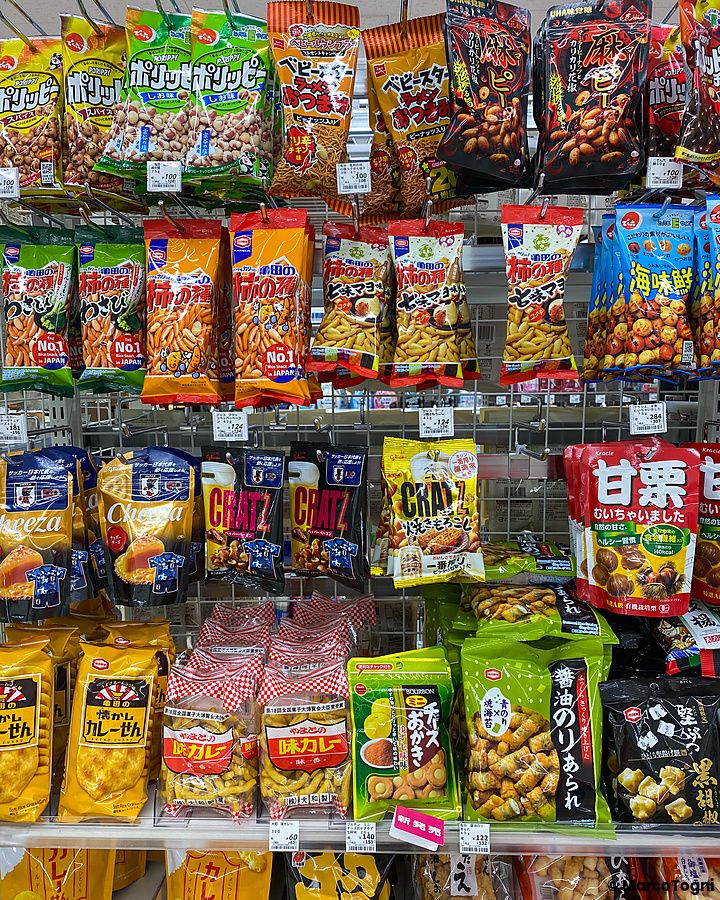
Let’s be honest, most of the senbei people eat in Japan come out of a factory. And that’s fine, because some of the mass-produced ones are really good and dirt cheap.
The most important region is Niigata, rice paddy country on the Sea of Japan. About seventy percent of the country’s rice crackers are made there, and it’s also home to Kameda Seika, the best-known company in the business.
These are the ones you’ll always see in supermarkets and konbini:
- Kaki no tane, spicy little arare shaped like persimmon seeds and mixed with peanuts. They’re the best-selling crackers in Japan and the classic beer snack.
- Happy Turn, small discs coated in a sweet and salty powder that’s seriously addictive. Kids love them, and plenty of adults do too.
- Yuki no Yado, rice senbei topped with a creamy white glaze, made by another Niigata company.
- Mixed bags of arare and okaki with a bit of everything inside: nori, shrimp, soy sauce and sugar.
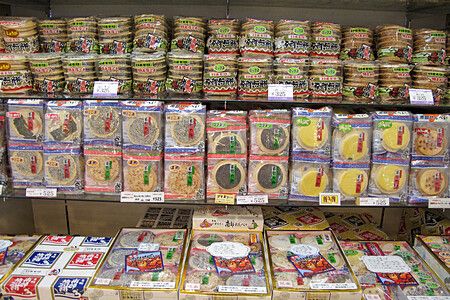
A bag costs a few hundred yen, and many are divided into single-serving packs that are easy to toss in your backpack. In the snack aisle, look for the words senbei, arare or okaki. There’s often an entire shelf of them.
Taking them home
Senbei are one of the easiest Japanese souvenirs to pack. They’re dry, they keep for a long time, and since they’re packaged baked goods, they won’t give you any trouble at baggage checks.
Handmade ones are fragile, though, and above all they hate humidity. Once the bag is open they go soft fast, especially in summer, and a soft senbei pretty much defeats the purpose.
A few precautions will spare you some disappointment:
- Buy senbei that come in individually sealed packets, since they keep better and are easier to hand out as gifts.
- Pack the boxes in the middle of your suitcase, wrapped in clothes, because the thin discs break easily when they get knocked around.
- Handmade senbei don’t last as long as factory-made ones, so check the expiration date.
- Skip nure senbei as a gift if you have a long trip ahead, because they expire quickly and not everyone likes the taste.
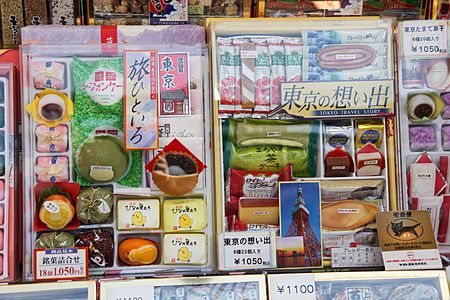
The tin boxes from the long-established brands are sold in department stores and make an impressive gift. If you’d rather spend less, a couple of bags of kaki no tane take up hardly any space and almost everyone likes them.
My advice
If I had to pick just one thing to do with senbei in Japan, I’d tell you to eat one hot off the grill at a shop in Asakusa or Yanaka. It’s cheap, it takes a minute, and one bite tells you why some shops here have been making nothing else for more than a hundred years.
Then go to a supermarket, fill your basket with random bags and try everything, even the ones that don’t appeal to you. Sweet, spicy, soft or hard as a rock?
Everyone ends up with a favorite, and mine is still a simple soy sauce senbei, with a cup of green tea on the side.