Setagaya
Setagaya is the Tokyo where people actually live, not the one on the postcards. It’s the most populous ward in the city, and yet you only have to walk out of the station to find quiet streets, low houses, parked bicycles and small neighborhood shops.
It’s not a place with one sight after another, and that’s fine. You come to slow down, to ride a tram that feels like it’s from another era and to see a temple full of lucky cats. If you’ve already done Shibuya and Shinjuku and want to see what everyday life in Tokyo looks like, I think this is the place.
Contents
Restaurants
Nearby neighborhoods

Jiyugaoka
Gakugei-Daigaku
The cat tram
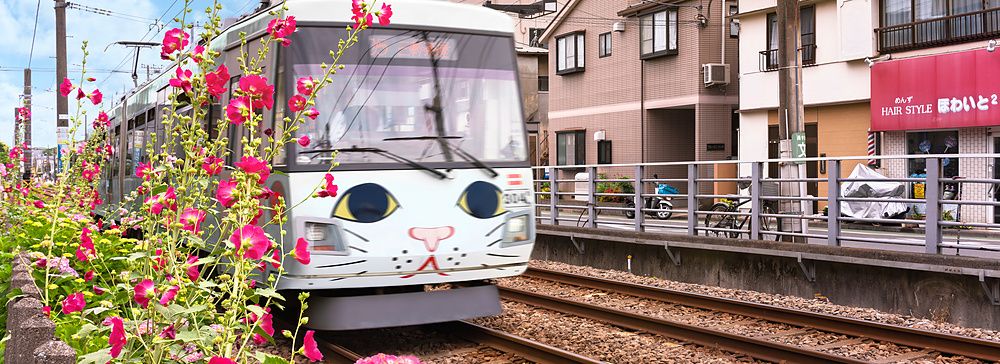
The nicest way to get around Setagaya is on an old two-car tram on Tokyu’s Setagaya Line. It runs from Sangenjaya to Shimo-takaido, a ten-stop ride through a part of the city made up of houses, tiny vegetable plots and railroad crossings.
Every so often the maneki-neko version comes by, covered in cat decorations, with paw prints on the floor and paw-shaped hand straps. It’s slow, around 40 km/h, and the cars are short, so at rush hour you’ll be standing and packed in tight.
If you have time, my advice is to ride it without watching the clock and get off wherever you feel like it. One stop worth getting off at is Miyanosaka, where an old green car, no. 601, sits in front of the community center. It was built in 1925 for the Tamagawa tram, ended up on the Enoshima railway and finally came back home.
During the day the doors are open and you can climb aboard for free. Inside you’ll find the wooden seats and old photos of the line, and usually a few grandpas from the neighborhood sitting in the shade.
The Gotokuji legend
According to legend, Gotokuji is the reason lucky cats exist at all. The story goes that in the Edo period a lord of the Ii clan was passing the temple on his way back from a hunt, just as a storm was about to break, when a cat beckoned him inside with its paw.
He took shelter, and supposedly that’s where the idea of the maneki-neko, the cat with the raised paw, came from. Ever since, Gotokuji has been the Ii clan’s family temple, and their graves are here.
What really gets you is the open area next to the three-story pagoda, where visitors leave thousands of white ceramic cats, from tiny ones to some half the length of your arm.
People keep quiet here, and there are far fewer visitors than at the temples in central Tokyo. Once you know the story, you’ll see every cat with a raised paw you come across in Japan in a different light.
Two enemies, one ward
A few tram stops from Gotokuji is Shoin Jinja, the shrine dedicated to Yoshida Shoin, who taught many of the men who would go on to carry out the Meiji Restoration. His grave is on the grounds, at the back on the right.
Now here’s the twist. Ii Naosuke, the head of the government who had him executed in 1859 during the Ansei Purge, is buried right at Gotokuji, the cat temple.
So two sworn enemies lie a few minutes apart by tram, in the same quiet ward. It’s one of the things I like most about Setagaya, and you won’t find it written anywhere as you walk around.
Taking it slow
Be aware from the start that Setagaya is huge, and there’s no single center you can check off in an hour. It’s the ward with the most residents in Tokyo, and it’s all homes, schools and local streets, so this isn’t the place to work through a list of sights.
The best way to do it is to give it half a day without rushing, ideally in the morning or early afternoon, when the little shops along the tram line are open and the light is good for photos. The area winds down early in the evening. For nightlife, Sangenjaya and Shimokitazawa are close by: they’re actually part of Setagaya and only a few minutes away.
I recommend it mainly to people coming back to Tokyo for a second time who’ve already seen the major areas.
If it’s your first week in the city, I’d save it for later. But if you’re looking for ordinary Tokyo, where people do their grocery shopping by bike and kids walk home from school, you’ll find it here without even trying.
The Boroichi market
Twice a year the neighborhood looks completely different. The Boroichi is always held on the same days, December 15 and 16 and January 15 and 16, and it’s been running for more than 400 years.
Hundreds of stalls line the street in front of the daikan’s old house (the daikan was the official who ran the village in the Edo period), selling used tools, kimono, ceramics, plants and all kinds of odds and ends. The crowds are huge—so much for a quiet neighborhood.
The longest line is always the one for daikan mochi, hot mochi made only on those four days. If you’re in Tokyo on those dates, I think it’s worth the trip out here.
Todoroki Valley
Also in Setagaya, but on the other side of the ward, is the only gorge in Tokyo’s 23 wards. The Yazawa River has carved out a ravine about a kilometer long, and you walk through it on a narrow path, among ferns, bamboo and trees that close over your head.
The path really is one person wide, so everyone goes slowly and steps aside for each other, and in some stretches there’s no railing on the water side.
At the far end you climb up to Todoroki Fudoson temple, which has a terrace looking out over the treetops and a teahouse where you can stop for something sweet. Hearing only the water and no traffic, in Tokyo of all places, is quite something.
Getting There
From Shibuya it's just a few minutes on the Den-en-toshi Line to Sangenjaya, where the Setagaya Line tram starts. This is the easiest way into the area.
Coming from Shinjuku, take the Keio Line to Shimo-takaido, the other end of the line, and ride the same route in reverse.
For Gotokuji temple, get off the tram at Miyanosaka and walk five minutes, or take the Odakyu Line from Shinjuku to Gotokuji Station. If you plan to hop on and off several times, the tram day pass costs 380 yen.
Useful Info
Name: Setagaya
Time needed: Half a day for the tram and Gotokuji, a full day if you add Shimokitazawa or Todoroki Valley
Tips: Take a close look at the Gotokuji cats. They don't hold a gold coin and they only raise their right paw, because here they bring connections and opportunities, not money. You can buy one at the temple and take it home, and if your wish comes true, you bring it back and leave it there with the others.
Getting there:
- Sangenjaya (Tokyu Den-en-toshi, Setagaya Line tram): southern end of the tram line
- Shimo-takaido (Keio, Setagaya Line tram): northern end
- Gotokuji (Odakyu) and Miyanosaka tram stop: for the cat temple
Map
MarcoMaps100% free
This place is on MarcoMaps
Setagaya
My map of Japan: over 4,000 places I've tried myself, each with photos, rating, and hours. Filter by category and rating, find veg-friendly spots and places near you with GPS. No sign-up, right from your phone.
- 4,000+ places
- Rating, photos, and hours
- Veg friendly
- Near me (GPS)
- Favorites without login
- Works offline

