Setsubun in Japan
Setsubun is one of my favorite Japanese festivals, because it’s celebrated at home, it makes kids laugh, and it ends with a huge sushi roll that you eat in silence. It falls in early February, in the dead of winter, and for one day supermarkets, schools and temples fill up with demon masks and bags of soybeans.
It isn’t a national holiday. Offices stay open and nobody takes time off, yet almost every family celebrates it. If you happen to be in Japan around then, you can experience it as a tourist too, at a temple or just by walking into a konbini.
Contents
What is Setsubun?
Setsubun literally means seasonal division. There used to be four setsubun a year, one before each season began, but today the name only refers to the one that comes before risshun, the first day of spring in the traditional calendar. For centuries that changeover was a kind of New Year, which is why Setsubun comes with so many purification and good-luck rituals.
It usually falls on February 3, but not always. The date depends on the position of the sun and every so often it moves to February 2, so I’d check the calendar for the year you’re traveling.
The roots go back a long way. The imperial court of the Heian period held a ritual brought over from China, tsuina, where evil spirits were driven out at the end of the year with masks and shouting. Over time the ritual left the palace, moved to the temples and then into ordinary people’s homes, where in the Edo period it took on the form it has today: you throw beans at the demons, the oni, who stand for illness, bad luck and anything else you don’t want to carry into the new season.
Bean throwing
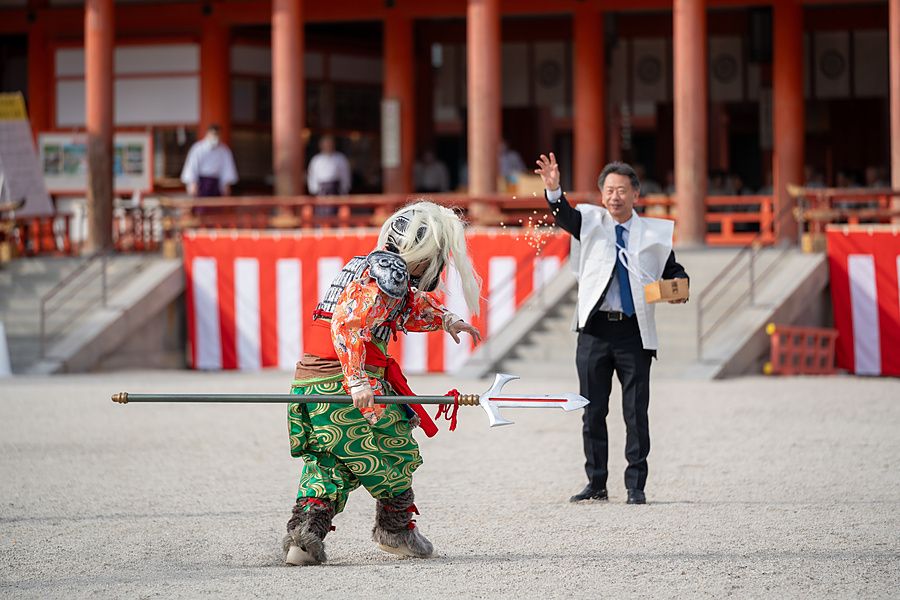
The heart of the festival is mamemaki, or bean throwing. It’s done with roasted soybeans, which for the occasion are called fukumame, lucky beans. They have to be roasted, not raw, because a raw bean left on the floor could sprout, and that’s said to bring bad luck.
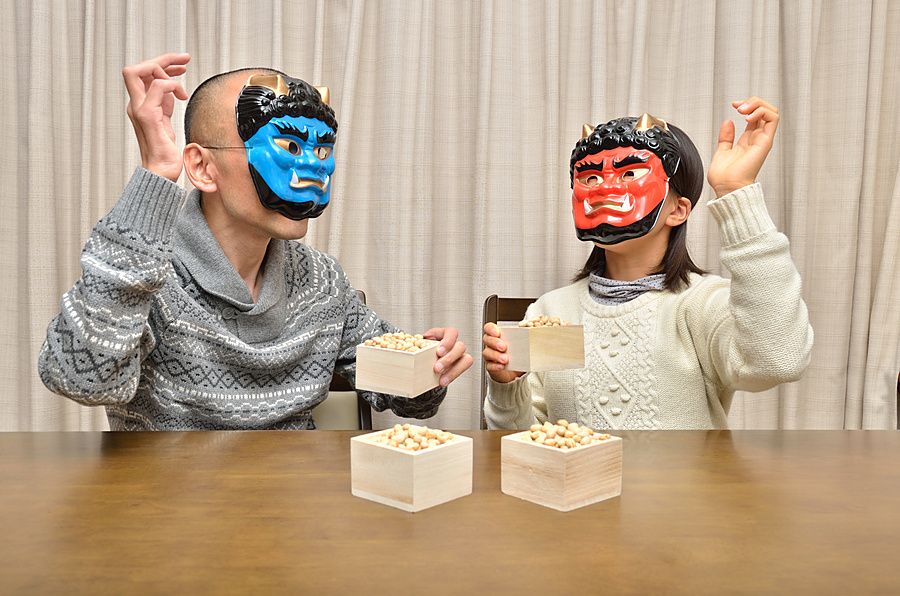
It usually goes like this. Someone in the family, often the dad, puts on an oni mask, and everyone else pelts him with beans, shouting oni wa soto, fuku wa uchi, meaning demons out, luck in. Then they open the doors and windows and throw beans outside too, to chase the oni out of the house, and quickly shut everything again so the good luck stays inside.
Once the throwing is over, everyone eats one bean for each year of their age, plus one extra in many areas, for good health in the year ahead. That’s easy as a kid, but as an adult it turns into a bit of a jaw workout, so older people often stop at a handful or have them in a tea called fukucha.
Toward the end of January, supermarkets start stocking packs of roasted beans with a red or blue cardboard oni mask inside to cut out. They only cost a few hundred yen, and I think they’re one of the most fun souvenirs you can bring home from a winter trip, and one of the least obvious.
A few details that surprise people the first time they hear about them:
- In Hokkaido, Tohoku and parts of Kyushu, many families throw peanuts in the shell instead of soybeans, because they’re easier to pick up out of the snow and the shell keeps them clean even after they’ve landed on the ground.
- By tradition, people with the surname Watanabe don’t need to chase away the oni. The story goes that a warrior ancestor, Watanabe no Tsuna, cut off a demon’s arm, and ever since the oni have stayed away from that family.
- At some temples and in a few families nobody shouts oni wa soto, because it’s believed that no demon can stand in the presence of the local deity. They only say the part about luck.
- At kindergartens the bean throwing is a full-blown event. A teacher or a dad plays the oni, and for the youngest kids it’s a scare they remember for days.
Ehomaki
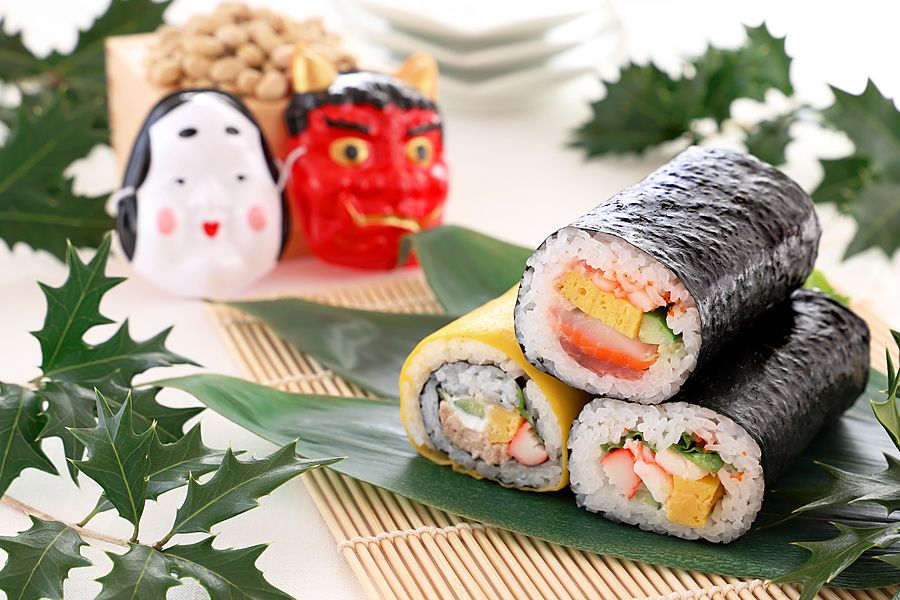
The other ritual, and the one you’ll see everywhere, is ehomaki. It’s a futomaki, a thick sushi roll, that you eat whole on the evening of Setsubun while facing the year’s lucky direction, in silence and without stopping until the last bite. Cut it, the saying goes, and you cut your luck too.
The direction, the eho, is wherever a deity called Toshitokujin is that year, and it changes every year among a handful of specific compass points, like east-northeast or south-southeast. Supermarkets write it in big letters above the ehomaki counter, and some people even use the compass on their phone to get it right. There are usually seven ingredients inside, one for each of the Seven Lucky Gods: sweet omelet, eel or fish, cucumber, cooked shiitake mushrooms, kanpyo (strips of dried gourd), pink denbu (sweetened fish flakes) and others depending on the recipe.
The ritual comes from the Osaka area, and for a long time it stayed a Kansai thing. It went national thanks to the konbini, which started selling it in the late 1980s, first in a few regions and then across the whole country, until it was commonplace in Tokyo too.
These days, at the end of January, every konbini, supermarket and department store puts out flyers so you can preorder one. Prices run from around 500–1,000 yen for a simple roll up to department store versions with crab, tuna or beef that easily go over 3,000 yen. You’ll also find smaller versions for kids, sweet ones that are basically roll cakes, and creative ones filled with cutlet or salad. I’d get the classic version at least once, because it’s a well-made futomaki and the ritual makes more sense that way.
The funniest sight is a whole family sitting in silence, everyone turned the same way, each holding their own roll. I swear keeping a straight face is the hardest part.
Other customs
Beyond beans and sushi there are some lesser-known customs, and they vary a lot from region to region. The oddest is hiiragi iwashi, a sprig of holly with the head of a grilled sardine stuck on it, hung on the front door. The pointy leaves poke the oni in the eyes and the fishy smell keeps them away. Today you see it mostly in the countryside or outside the occasional traditional house, and rarely in city apartment buildings.
In many homes people actually eat grilled sardines on the evening of Setsubun, and in some areas there’s Setsubun soba, tied to the idea of New Year and a fresh start. In Tokyo and the Kanto region some families make kenchinjiru, a vegetable soup, but that’s more of a local habit.
Setsubun at temples
If you want to see Setsubun done big, you need to go to a temple or a shrine. Almost all of them hold a public mamemaki. Monks, celebrities, sumo wrestlers or people born under the current year’s zodiac sign, the toshiotoko and toshionna, climb onto a stage set up for the occasion and throw small bags of beans, candy and sometimes small prizes into the crowd.
Down below, people raise their hands and hold open their bags and hoods, and some even bring an upside-down umbrella to catch more. It’s free and it’s fun, but there’s a lot of pushing, so if you have small kids, think carefully about where you stand.
A few places I recommend, depending on where you are:
- Sensoji in Asakusa, Tokyo, holds a very popular mamemaki that opens with a dance of the Seven Lucky Gods. Nobody shouts oni wa soto there, because in front of Kannon there are no demons to drive out.
- Naritasan Shinshoji in Narita, handy if you’re passing through the airport, is famous for bringing sumo wrestlers on stage along with actors from the public broadcaster’s historical drama of the year, and here too people only shout the part about luck.
- Zojoji, near Tokyo Tower, holds a bean throwing with well-known guests and the tower in the background, while Kanda Myojin near Akihabara has a ceremony with archers and participants in traditional dress.
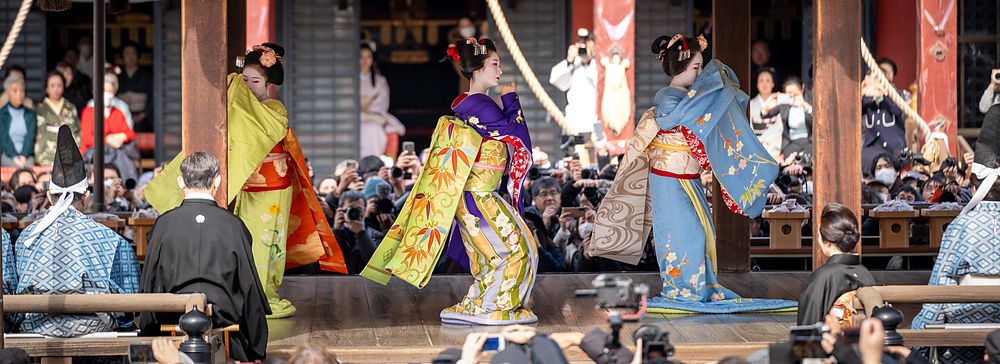
- In Kyoto, at Yasaka Shrine in Gion, maiko and geiko dance on stage before throwing the beans, and it’s one of the few chances to see them for free.
- Also in Kyoto, Yoshida Shrine holds a festival that runs several days, with stalls and a big bonfire where old amulets are burned, and Rozanji has a dance of red, blue and black oni who get driven out with beans and arrows.
Some places flip the formula. At a few temples, like Kinpusenji in Yoshino, Nara Prefecture, people shout fuku wa uchi, oni mo uchi, meaning luck in, and demons in too. There the oni are seen as creatures to welcome and redeem, not to chase away.
My practical advice for the most famous temples is to get there well ahead of the throwing, because the area in front of the stage fills up early, and if you show up at the last minute you’ll see little and catch even less.
Experiencing Setsubun as a tourist
Even without a Japanese family to stay with, Setsubun is easy to experience. Just walk through konbini and supermarkets at the end of January and you’ll see displays full of masks, beans and signs showing the year’s direction. In the depachika, the department store food floors, people line up at the ehomaki counters, especially on the afternoon of Setsubun itself.
There are only a few simple things I think are worth doing:
- Preorder an ehomaki a few days ahead at a konbini or department store, because the most popular ones sell out and on the day you’ll only find what’s left.
- Buy a pack of fukumame with the mask and do your own mamemaki in your room, maybe with the window open for the demons-out part, but don’t throw beans into the street or the hotel hallways.
- Pick a temple near where you’re staying and check its website for the bean-throwing schedule, since it’s often held several times during the day.
- If you’re traveling with kids, look for smaller neighborhood shrines, where there’s less pushing and kids are let through to the front.
Don’t expect a street party with music and fireworks like the summer matsuri. Setsubun is more low-key: it lasts one day, it mostly happens at home and in temples, and in the evening the city looks completely normal. That’s exactly why I like it. It feels like a family tradition that’s still very much alive, not an event put on for visitors.
Visiting in early February
Early February is one of the coldest times of the year. Mornings are freezing even in Tokyo, and in Kyoto you really feel the damp cold. Bring layers, gloves and something warm, because in front of a temple stage you can end up standing still for an hour.
The upside is that it’s low season for tourism. Flights and hotels are cheaper than in spring and fall, and apart from the day of the bean throwing the temples are quiet. On top of that, the first plum trees start to bloom at this time of year, and in many gardens and shrines the white and pink blossoms come out right around Setsubun.
If you’re in Japan in February, it’s easy to combine Setsubun with the Sapporo Snow Festival, which takes place around the same time, or with a hot spring trip, since hot springs are at their best in the middle of winter.
Is it worth it?
Honestly, I wouldn’t plan a trip just for Setsubun, but if you’re in Japan in early February I’d go out of my way not to miss it. It’s a couple of hours at a temple, a sushi roll in the evening and a pack of beans to throw around your room, but it shows you a side of Japanese life that usually stays behind closed doors.
If I were you, I’d go to the bean throwing at a big temple in the morning, spend the afternoon in a depachika watching the ehomaki line, and in the evening eat my roll facing the right direction without saying a word. Does it actually bring luck? I don’t know. But it can’t hurt.