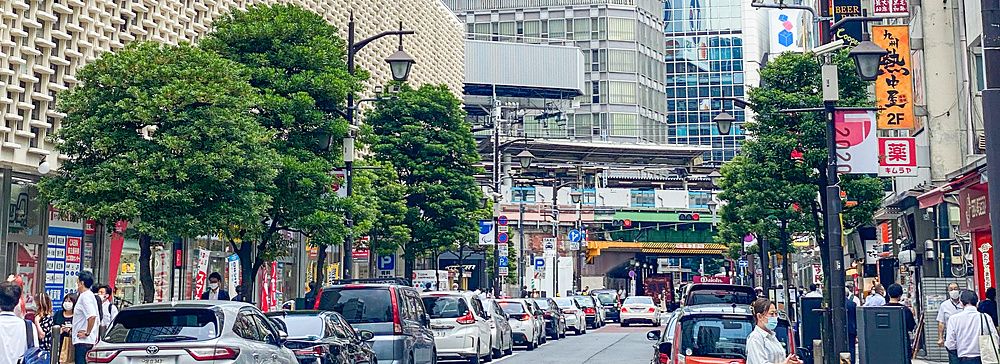

Shimbashi
In Shimbashi, Tokyo works and then stops for a drink, all within a two-minute walk. This is office-worker territory, full of people in suits and ties who duck into the little bars under the train tracks after work to unwind.
Japan’s first railway started here, and you can still feel it: trains rumbling overhead, people in a hurry, an old locomotive parked in front of the station. It’s not a postcard neighborhood and you don’t come here for the sights, but if you want to see the real city, away from the usual tourist spots, I think it’s worth a visit.
Contents
Restaurants

Shops

Nearby neighborhoods


Yaesu
Toranomon
Which exit to take
The station is huge and four different rail companies serve it, so the first thing to figure out is which side to come out on. It really changes the kind of day you’ll have.
On one side is the Karasumori exit, to the west, with narrow alleys and signs stacked one on top of the other. On the other is the Shiodome side, to the east, which is all glass skyscrapers, elevated walkways and offices.
- Karasumori side (west): alleys and tiny bars squeezed in under the tracks, where you can eat and drink without spending much.
- Shiodome side (east): glass towers, covered walkways and the museums, more orderly and quieter.
- This is also where the Yurikamome starts, the driverless elevated line that runs to Odaiba.
During the day I’d suggest coming out on the Shiodome side, where you can walk around comfortably among the towers, and saving Karasumori for after dark. Over on the Shiodome side, on the facade of the Nippon TV headquarters, you’ll also find the giant copper clock designed by Hayao Miyazaki. It’s twelve meters tall and packed with gears, bells and little moving figures. The show isn’t nonstop. The clock comes to life a few times a day for a couple of minutes, and it’s one of those things almost nobody expects to find among the office towers.
In the evening
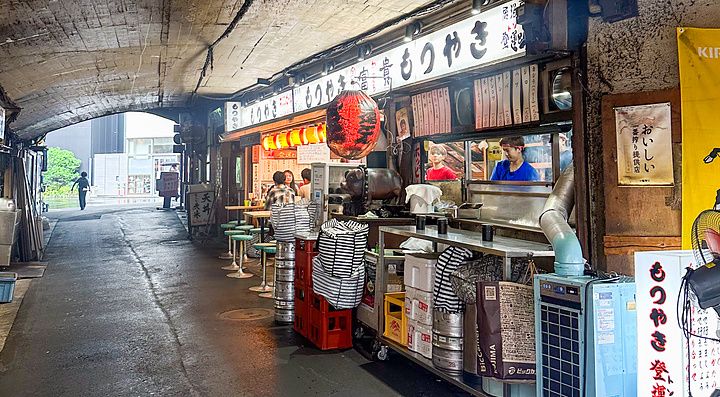
In the evening Shimbashi turns into a different place. Once office hours are over, the streets under the tracks fill up with office workers loosening their ties, and the smell of grilled chicken hits you before you even turn the corner.
This strip under the tracks is called gado-shita, which means the space under the railway girders. It’s lined with tiny bars built into the arches, and the trains passing overhead make everything shake. Most of these places are standing only or have just a handful of stools, you don’t spend much, and they’re easy to walk into even on your own. Almost every counter serves the same food, and it’s exactly what you want: grilled skewers, pork offal, something fried. For drinks, there’s beer, chuhai or Hoppy, which is still hugely popular here. In summer the tables and plastic crates spill out onto the sidewalk, and you end up eating practically in the street with the trains going by above you.
Menus are often only in Japanese, but most of the time you can just point at whatever’s on the grill.
The classic meeting spot is the little square with the old black steam locomotive up on its pedestal in front of the station. I’m pointing it out because there’s a nice story behind it: it never actually ran out of here. It was brought over from a depot near Himeji and set up there as a reminder that Japan’s railways started in Shimbashi. The square, which people here call SL Hiroba, is also where TV crews go looking for street interviews. If you see a microphone pointed at a man in a suit who’s just left the office on Japanese TV news, nine times out of ten the interview was shot here. It happens a lot in the evening, and by then the people being interviewed have already had a drink or two, which is part of why Shimbashi has the reputation it has on TV.
If you want the full atmosphere, come on a weeknight. On weekends many of the little bars stay closed, because their customers are office workers.
The building in front of the station
Step out on the west side and it’s right in front of you: a boxy, somewhat run-down concrete block called the New Shimbashi Building, put up in the early 1970s. From the outside it doesn’t look like much, but inside it’s a vertical city. Four floors plus a basement are crammed with tiny rooms two meters by three, barbershops, foot massage places, little shops reselling discounted tickets and tiny bar counters.
It’s the place to go if you want to see 1970s Japan without leaving Tokyo. In the basement you eat curry and one-plate meals at the counter, elbow to elbow with office workers on their lunch break, and in the evening people drink upstairs in rooms that hold six. It isn’t pretty and doesn’t try to be, but it’s worth a visit even just to wander the hallways and peek at the doors.
On to Odaiba
Shimbashi isn’t somewhere you’d spend half a day. It’s more a starting point than a destination. The Yurikamome leaves from here on its elevated track and gets to Odaiba in fifteen minutes, curving onto the Rainbow Bridge with the sea on one side and the towers on the other. If you sit up front, where the driver would normally be, you get a view straight down the tracks. It isn’t covered by the Japan Rail Pass and it’s a bit pricey for such a short line, but the ride is worth the fare.
You’re also a short walk from Ginza and from Hama Rikyu Gardens on the water, so it makes sense to pair Shimbashi with one of those areas rather than treat it as a stop on its own.
As a place to stay, I think it’s a good base. There are plenty of business hotels, it’s really convenient for trains and quieter than Shinjuku at night, and dinner is right there as soon as you step outside. The one thing to keep in mind is that during the day on weekends it’s a lot sleepier. The offices set the pace here, and when the offices close, everything changes.
Getting There
Shimbashi is on the Yamanote line, so you can get here without changing trains, in just a few minutes from Tokyo, Ginza, Shibuya or Shinjuku. Take the Hibiya side exit if you want the locomotive square and the alleys under the tracks, or the Shiodome side if you're heading for the glass towers.
You can also walk here from Ginza in about ten minutes, and in about the same time from Hama Rikyu Gardens, which are just past Shiodome.
For Odaiba, go up to the elevated Yurikamome station, since the line starts right here. It takes about fifteen minutes to reach the first stops on the island.
Useful Info
Name: Shimbashi
Time needed: About an hour during the day, two or three hours in the evening
Closed: The crowd here is office workers, so on weekends, and especially on Sundays, many of the little bars under the tracks stay closed.
Tips: Come in the evening, but on a weekday. From 18:00 the alleys under the tracks fill up and the tables come out onto the sidewalk, while on weekends you'll find shutters pulled halfway down. At the smallest places you drink standing up, and you often pay in cash.
Getting there:
- Shimbashi Station (JR Yamanote, Keihin-Tohoku, Tokaido, Yokosuka; Tokyo Metro Ginza; Toei Asakusa): Hibiya exit for the square with the locomotive, Karasumori exit for the alleys
- Yurikamome Shimbashi Station: terminus of the elevated line to Odaiba
- Shiodome Station (Toei Oedo, Yurikamome): the most convenient for the skyscraper side
Map
MarcoMaps100% free
This place is on MarcoMaps
Shimbashi
My map of Japan: over 4,000 places I've tried myself, each with photos, rating, and hours. Filter by category and rating, find veg-friendly spots and places near you with GPS. No sign-up, right from your phone.
- 4,000+ places
- Rating, photos, and hours
- Veg friendly
- Near me (GPS)
- Favorites without login
- Works offline

