Shimenawa (Sacred Rope)
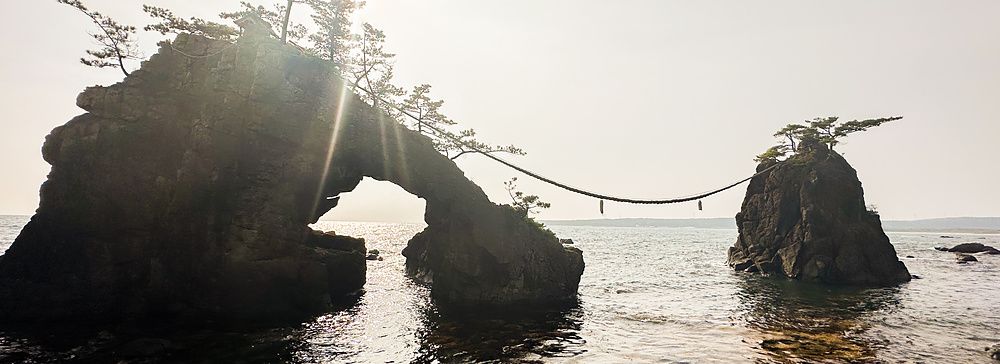
Shimenawa are the thick rice-straw ropes you see hanging at the entrance to Japanese shrines, wrapped around sacred trees and even strung between two rocks out at sea. Once you learn to spot them, you start seeing them everywhere, including places you’d never expect.
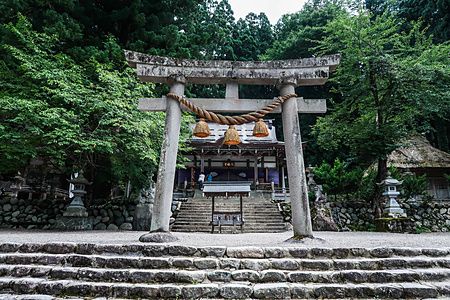
First-time visitors to Japan tend to photograph them without really knowing what they are. For me, they’re the easiest way to understand Shinto, because they mark a boundary and tell you that beyond that point you’re in a different kind of space. They don’t only hang in front of shrines, either. You’ll find them on construction sites for new houses, on the belt worn by sumo’s top champions and, at the end of December, on supermarket shelves.
Contents
What a shimenawa is
A shimenawa is a twisted rope, usually made of rice straw, that marks off a sacred space. The name can be written with several different characters in Japanese, but the meaning doesn’t change: a rope that closes off an area, like a fence.
In Shinto, Japan’s native religion, the kami (the gods) can inhabit a place, like a tree, a rock or a waterfall. The rope marks that spot as theirs and keeps out anything impure, acting as a kind of invisible barrier that in Japanese is called kekkai.
Almost every rope has strips of white paper hanging from it, folded in a zigzag and called shide. Their shape looks like a lightning bolt and evokes purity and divine power, and you’ll see the same strips tied to the wand the priest waves during purification rites.
There are often tufts of loose straw dangling at regular intervals too. They’re not sloppy workmanship but part of the design, and in some parts of Japan people see them as the rain that makes the rice grow.
The cave myth
The shimenawa goes back to the Kojiki, Japan’s oldest collection of myths and chronicles. It tells how Amaterasu, the sun goddess, is offended by her brother and shuts herself inside a rock cave called Ama no Iwato, leaving the world in darkness.
To lure her out, the other gods throw a noisy party outside the entrance. When Amaterasu peeks out to see what’s going on, one god pulls her out and another immediately stretches a rope across the cave so she can’t go back in. That rope is considered the ancestor of every shimenawa.
I like this story precisely because it shows in very concrete terms what the rope is for. It isn’t a decoration. It’s a line that separates two worlds and keeps you from going back.
Telling the types apart
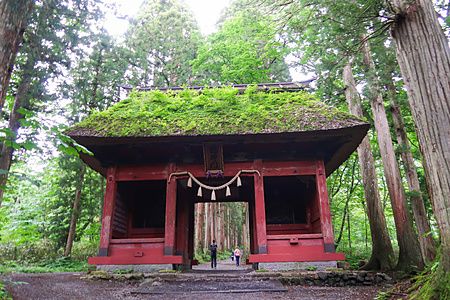
Not all shimenawa have the same shape, and after a while you’ll be able to tell them apart at a glance. These are the most common variants:
- Daikon-jime, named after the Japanese white radish: it’s thick in the middle and tapers toward both ends, and it’s the type you’ll often see in front of a shrine’s main hall.
- Gobo-jime, which looks like a burdock root: it starts thick at one end and gradually narrows toward the other, and it’s also widely used on home altars.
- A plain rope of even thickness, stretched between two posts or around a tree, found mostly in sacred groves and outdoor sites.
- The New Year versions, decorated with fern leaves, a bitter orange or a small fan, which people hang on the doors of their homes.
Check which way the rope is twisted, too. Ordinary rope is twisted to the right, while many shimenawa are twisted the opposite way, to the left. In Japanese tradition the left is associated with the sacred and the right with everyday life, which is also why the thicker end usually goes on the left as seen from the deity’s side.
There are some notable exceptions, though, and the most famous is Izumo Taisha, which I’ll get to shortly. There the rope hangs the opposite way from the ones at most shrines, and nobody has yet come up with a single explanation everyone agrees on.
Where to find them
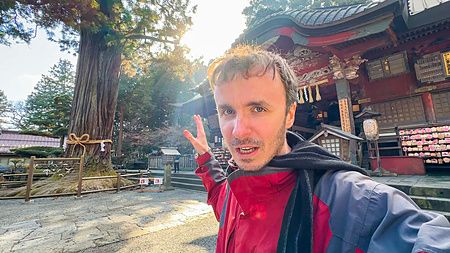
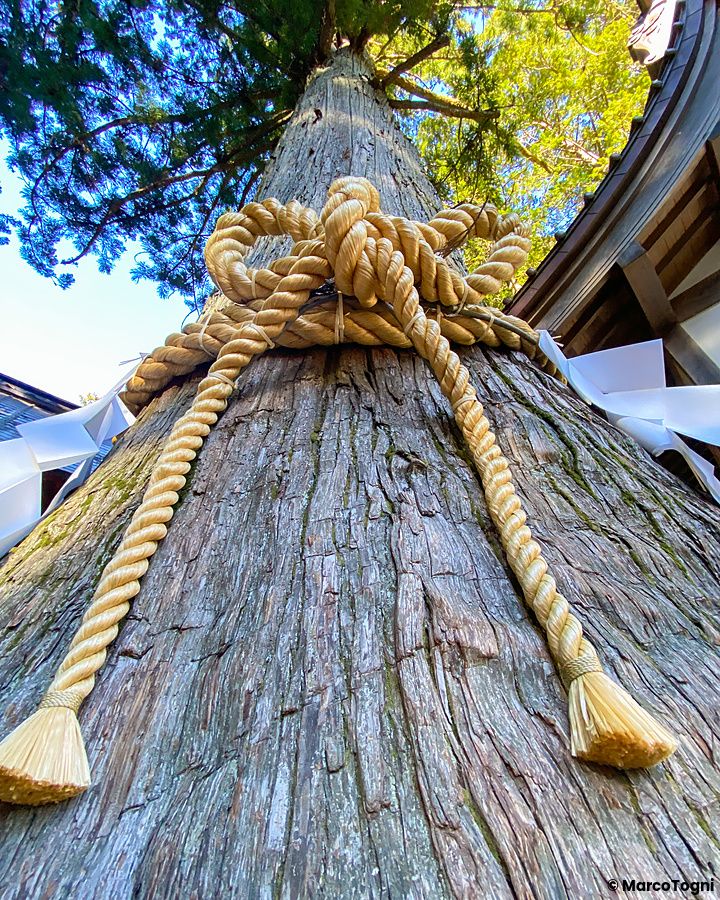
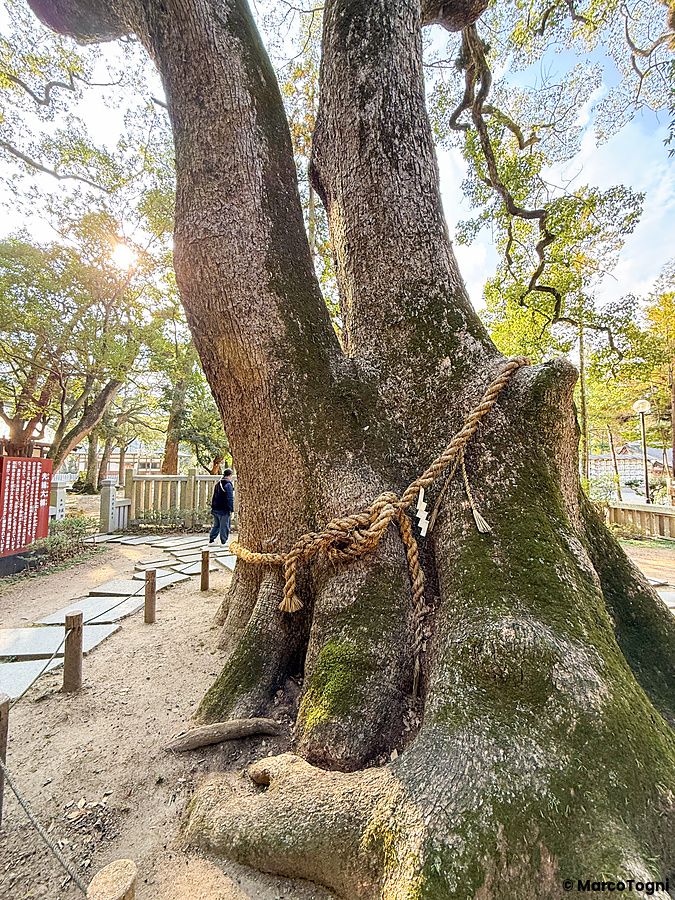
Shrine entrances are the obvious place, but if you ask me, the most interesting shimenawa are the ones away from the buildings. When you see a rope tied around the trunk of a huge tree, that’s a shinboku, a sacred tree where the kami is believed to come down or to live. They’re often camphor trees or centuries-old cedars, with a sign next to them giving their age.
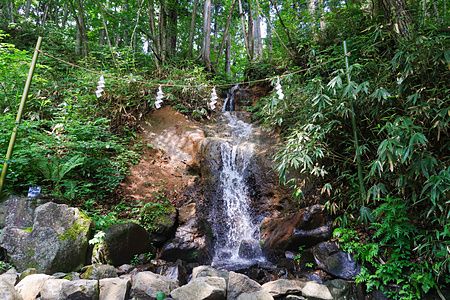
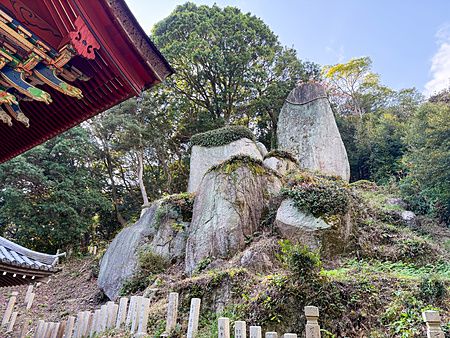
Rocks work the same way. A boulder with a rope around it is an iwakura, a seat of the deity, and in many cases it was a place of worship long before anyone built the shrine nearby. Waterfalls can have their own rope too, and Nachi Falls on the Kii Peninsula is one of the best-known examples.
Shimenawa also turn up well beyond the shrines. When a new house is going up, the site is purified in a ceremony where four bamboo poles are linked by a sacred rope, and you sometimes come across one in residential neighborhoods, on a freshly cleared lot.
In sumo, the yokozuna’s belt (yokozuna is the highest rank) is a thick white rope with shide hanging at the front. It’s a shimenawa in every sense, and the champion wears it for his ring-entering ceremony. In person it’s far more massive than it looks on TV. It isn’t made by outside craftsmen but by the wrestlers from his stable, in a ceremony called tsuna-uchi held before the Tokyo tournaments. Dozens of rikishi twist the rope together, keeping time as they work, and if you get the chance to watch, you’ll see the same idea behind the shrine ropes: a sacred object made by a whole community.
Izumo Taisha
If you want to see the most famous shimenawa in Japan, you have to go to Izumo Taisha in Shimane Prefecture, one of the country’s oldest and most important shrines. The giant rope hangs in front of the Kaguraden, the hall where ceremonies and weddings are held. It’s about 13 meters long and weighs around 5 tons.
What gets you once you’re standing underneath is how thick it is. It hangs high up, about five meters off the ground, yet it feels close enough to touch, and the ends hanging down are as big as a tree trunk.
The rope is replaced every five to eight years. The new one is made by craftsmen from Iinan, a small mountain town in the same prefecture that specializes in exactly this work and makes sacred ropes for shrines all over Japan.
Visitors have a habit of throwing coins at the rope, trying to get them stuck in the straw for good luck. I’d advise against it. The rope is a sacred object, the coins damage it, and the shrine specifically asks people not to do it.
The rope in front of the main hall itself is smaller, and people who rush through sometimes think they’ve already seen the famous one. The Kaguraden sits a little to the left of the shrine’s main axis, so take your time walking around, because that’s where almost everyone takes their photos.
The Wedded Rocks
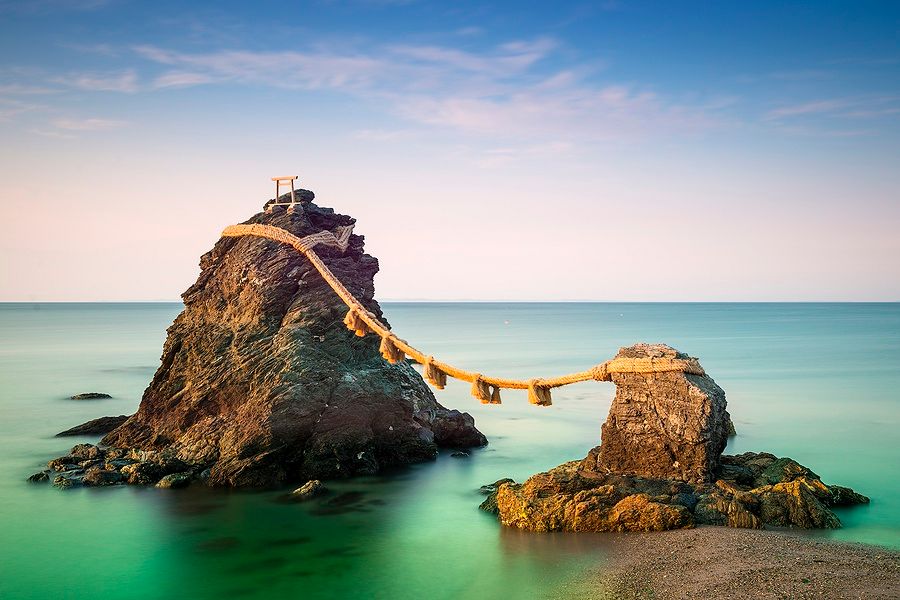
The other shimenawa everyone knows, maybe without knowing what it’s called, is the one at Meoto Iwa, the Wedded Rocks of Futami, on the coast near Ise in Mie Prefecture. They’re two rocks in the sea, one bigger and one smaller, joined by a bundle of ropes that stands for the bond between husband and wife.
There are five ropes, each about 35 meters long, and the salt air wears them out quickly. That’s why they’re replaced three times a year, in spring, September and December, in a public ceremony where worshippers go into the sea and pass the ropes along by hand to the sound of traditional chants.
The spot is easy to get to if you’re already visiting the Ise Grand Shrine. I think it’s at its best early in the morning, when there aren’t many people around and the light comes in off the sea. In the months around the summer solstice the sun rises right between the two rocks, and on those days the area fills up with photographers.
New Year shimenawa
At the end of December the sacred ropes leave the shrines and move into people’s homes. Front doors, gates and even car grilles get shimekazari, decorated versions of the shimenawa meant to welcome the kami of the new year and keep bad luck away.
You’ll find them on sale in the last few weeks of the year at supermarkets, department stores, home goods stores and the stalls outside shrines. Prices vary a lot. The smallest cost a few hundred yen, while ones handmade by craftsmen easily run 5,000–10,000 yen or more.
Many Japanese families still follow a few unwritten rules, and if you want to buy one for your home in Japan, it’s worth knowing them:
- They usually go up after December 13, the day New Year preparations traditionally begin, and the most popular date is the 28th.
- People avoid the 29th, because the number nine sounds like the word for suffering, and they also avoid the 31st, because putting decorations up at the last minute is considered disrespectful to the kami.
- They come down at the end of the New Year period, which lasts until January 7 across much of eastern Japan and until the 15th in many parts of Kansai.
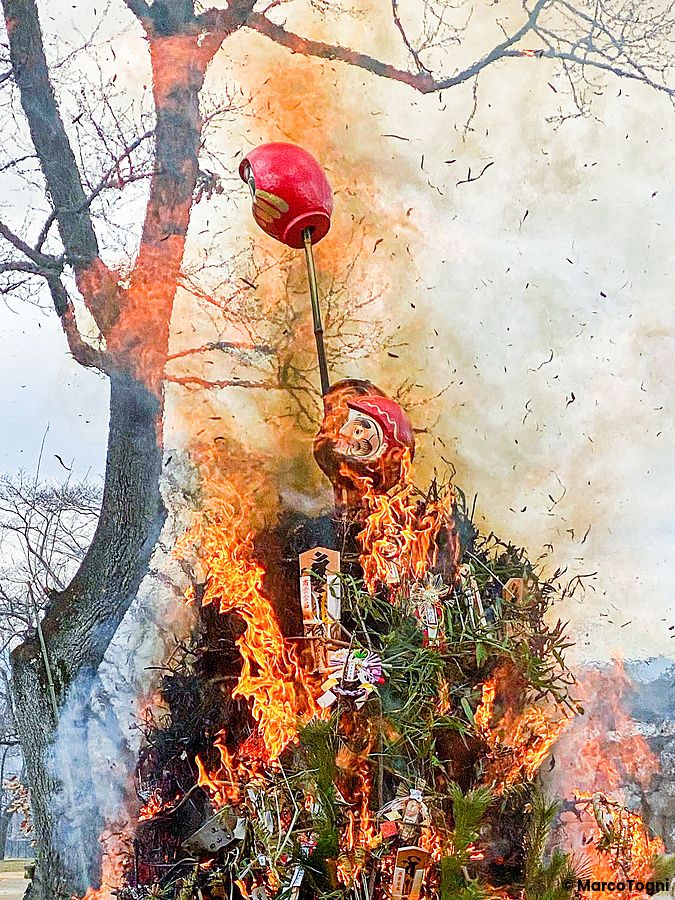
- They don’t go out with the regular trash. People take them to a shrine, where they’re burned in mid-January in a big bonfire called dondo-yaki or sagicho.
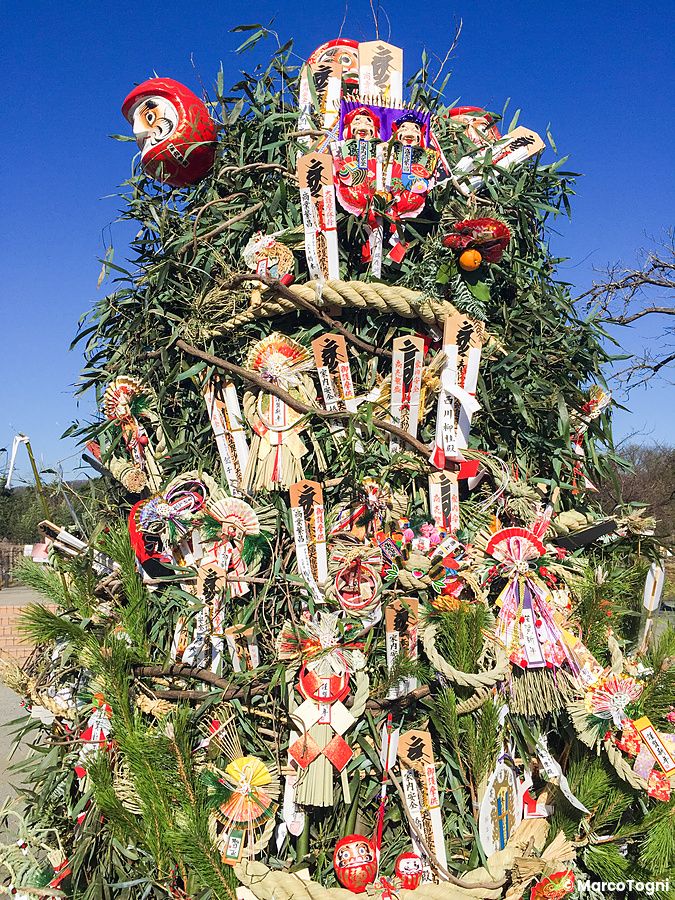
If you can’t take yours to a shrine, what a lot of people do instead is wrap it in white paper, purify it with a pinch of salt and throw it out separately from the rest of the trash. Ise does things differently. There the New Year rope stays on the door all year round, with a tag that carries a protective inscription, and as you walk the streets near the shrine you’ll see one on almost every house.
How they’re made
A traditional shimenawa is made of rice straw, and for the finest ropes the rice is cut while it’s still green, before it ripens. That way the straw keeps its pale green color longer and stays softer to work with.
One person with some practice can make a small rope. The giant ones take dozens of people, months of preparation and tons of straw, and it takes a truck to get the Izumo rope from the workshop to the shrine. Many shrines also use synthetic materials that imitate straw and last longer, especially for ropes that hang outdoors.
In the countryside, making the ropes for the village shrine is still a community job, done by the locals at the end of the year. When you see one hanging at a small mountain shrine, chances are it was twisted by someone from the village.
What not to do
When it comes to a shimenawa, there’s only one rule: don’t touch it. It may hang low and look like nothing more than a rope tied around a tree, but for people who see it as sacred, it marks a boundary that isn’t meant to be crossed.
I see visitors make the same mistakes over and over:
- Leaning on the rope or the shide to pose for a photo, sometimes even tugging on them a little to get them just right in the frame.
- Stepping over the rope strung around a tree or a rock to get closer to the trunk, when the whole point of that rope is to tell you not to go past it.
- Throwing coins or pushing things into the straw. Besides being disrespectful, it damages something that takes months of work to make.
- Buying a shimekazari as a souvenir and leaving it up at home for years as a decoration, without knowing that in most of Japan it only goes up for New Year’s.
Taking photos is perfectly fine, unless a sign says otherwise. And if you’re walking under a torii with a rope hanging from it, give a small bow before you go through. Nobody will ask you to, but it’s what Japanese people do, and it gives you a better sense of where you are.
My advice
If you’re short on time, there’s no need to plan a trip just to see a shimenawa. Just walk around shrines in Tokyo or Kyoto and you’ll come across dozens of them. What I always tell people is to look at them closely: notice the shape, which way the rope is twisted, and what’s behind it.
If you’re passing through Shimane, though, Izumo Taisha is worth the detour, if only to stand under that enormous rope for five minutes. And if you happen to be in Japan in late December, walk into a supermarket and find the shelf with the shimekazari. You’ll see a tradition more than a thousand years old sitting right there next to the mochi and the New Year’s sake, for sale like anything else.