Shinkansen Luggage Rules
Shinkansen luggage stresses out a lot of travelers, because what you read online sounds alarming: mandatory reservations, limited seats, extra fees. The truth is that in most cases there’s nothing to worry about. Here I’ll explain in simple, practical terms how it actually works when you bring bags on the Shinkansen, when you need to book, when you can just get on, and how to avoid the usual mistakes.
Contents
- Rules for large suitcases
- Size limits
- What doesn't count as oversized luggage
- How to book a seat for your suitcase
- If you don't book: what actually happens
- Where to put regular suitcases
- Seats with extra space are limited
- Lockable luggage racks in the vestibules
- Using a luggage delivery service
- Green Car and luggage
- Non-reserved cars
- When it pays to travel light
- Lockers and alternatives
- Final thoughts
Rules for large suitcases
Some Shinkansen lines now have a rule you need to know about if you’re traveling with very large suitcases: you need a special reservation. Specifically, if height, width and depth add up to more than 160 cm, you have to book a seat with luggage space. It doesn’t cost anything extra, but you have to select it when you book. If you show up without one, you may have to pay a 1,000 yen penalty, and you could also end up with nowhere to put your bag.
These rules apply mainly on the lines tourists use most:
Other lines, like the Hokuriku or the Tohoku, don’t have strict limits for now, but I’d still avoid giant suitcases, if only out of consideration for other passengers. The same 160 cm rule also applies on the Nishi-Kyushu Shinkansen, the line between Takeo-Onsen and Nagasaki. The easiest way to remember it: if you’re traveling along the Tokyo–Osaka–Kyushu corridor, assume the rule applies; if you’re heading north or taking the Hokuriku line, it doesn’t.
Size limits
Short version: 99% of the time, your suitcase won’t go over the 160 cm limit.
The 160 cm total (height + width + depth) is a pretty generous limit, but some checked bags do go over it. Size L suitcases sometimes measure 170–180 cm, so if you have one like that, it’s worth measuring it before you leave.
Anything between 160 and 250 cm counts as oversized but can come on board with a reservation. Anything over 250 cm can’t come on board at all: you have to ship it with a courier.
What doesn’t count as oversized luggage
Not everything bulky falls under the 160 cm rule. Strollers, wheelchairs, musical instruments and sports gear like skis, snowboards and golf bags don’t count as oversized luggage, so you can bring them on board without booking any special space, whatever their size.
Common sense still applies, though, because there’s only so much room on board. If you’re traveling with long, awkward items, it’s still a good idea to aim for the last row, where you get the space behind the seats, or to leave them in the vestibule between cars. Small kids are no problem at all: you keep the stroller folded in front of you and it doesn’t bother anyone.
How to book a seat for your suitcase
When you book online (on the official JR Central site or other platforms like SmartEX), you can select the “Oversized Baggage Area” option. These are simply the seats in the last row of the car, the ones with free space behind them where you can slide your suitcase in.
If you book at the Midori no Madoguchi (the ticket office), just tell them you have a large suitcase. Some ticket machines also let you pick seats with extra space. If you’re not sure, always ask a staff member to confirm.
If you don’t book: what actually happens
Officially you’re supposed to pay a penalty, but in practice nobody’s going to throw you off the train. If they catch you sitting in a regular seat with an oversized suitcase, though, they may ask you to move. And on some packed trains there really isn’t room for a giant suitcase, so you risk getting in other people’s way or having to keep it in front of your legs for the whole trip.
I strongly advise against winging it: book the right seat and save yourself the stress.
Where to put regular suitcases
If your suitcase is under 160 cm total (a medium-size or carry-on suitcase, say), you don’t need to do anything. You can keep it in front of you if it’s not too big, or put it on the overhead rack if you can lift it up there.
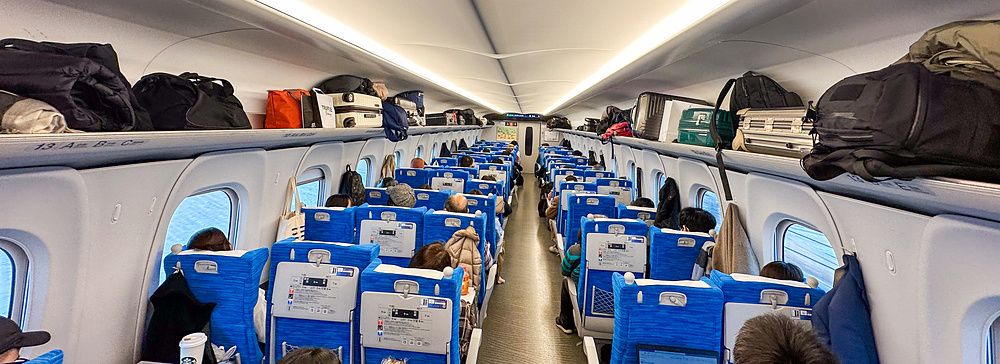
Shinkansen overhead racks are much bigger than the ones on planes. They’re open, with no doors, and a carry-on roller bag easily fits lying flat, along with backpacks and other bags. The other thing that helps is the legroom: in ordinary cars there’s so much of it that you can keep a small suitcase in front of you for the whole trip. Just make sure it doesn’t stick out into the aisle, because carts and people heading to the vestibule go by all the time.
Seats with extra space are limited
Seats with room for large suitcases aren’t available in every car. They’re usually only the ones at the back of the car, in both ordinary class and the Green Car, and not every train has them.
If you’re traveling at busy times like Golden Week, New Year’s or Obon, they can sell out right away. Book early, especially if your suitcase is huge, or ship it with a courier.
Lockable luggage racks in the vestibules
On the 16-car Tokaido and Sanyo trains, besides the space behind the last row, there are luggage racks in the vestibules, the entry areas between one car and the next. They’re split over two levels and easily fit a medium suitcase, even one you’d check on a plane.
What makes them so useful is that they lock. There’s a combination lock with a lever, and you can also lock them by tapping your IC transit card, so you can go back to your seat without worrying about a suitcase you can’t see. One tip: make a note of the car number where you left your bag and go get it a few minutes before your stop, because the train doesn’t stop for long.
Using a luggage delivery service
If you’re staying several days in one city, a really convenient option is takkyubin, the hotel-to-hotel or airport-to-hotel luggage delivery service.
For about 1,500–2,500 yen per suitcase, you can travel light and find your bags waiting for you at your destination. I use it a lot for long trips like Tokyo–Kyoto, and I recommend it to everyone. It’s safe and reliable, and it lets you enjoy the trip a lot more.
Green Car and luggage
The Green Car (Japan’s first class) doesn’t have much more room for suitcases. The only advantage is that, since it’s usually less crowded and the seats are wider, it’s easier to fit your suitcase in front of you.
But if your luggage is oversized, you need the special reservation in the Green Car too.
Paying more won’t solve everything on its own: you still have to figure out where your bags will go.
Non-reserved cars
Some Shinkansen cars are non-reserved, so you can board without a seat reservation. They don’t have any seats with space for large suitcases, though, and with luggage over 160 cm you can’t ride in a non-reserved car: you have to book a seat with luggage space. With a regular suitcase it’s fine, although at rush hour you might not find a seat or have to sit apart from the people you’re traveling with.
If you want a comfortable trip, I recommend always reserving, even if it costs a little more.
When it pays to travel light
On a short day trip like Tokyo–Hakone or Osaka–Himeji, you’re better off leaving your suitcase at the hotel or in a coin locker. Traveling light makes a huge difference on the Shinkansen: you get on and off faster, you don’t block the aisle, and you can sit wherever you like.
There are large lockers in almost every station, so just put your suitcase in one and catch your train without a care.
Lockers and alternatives

If you can’t find an available locker, try:
- Leaving the station and looking for others nearby
- Asking your hotel to hold your bags before check-in
- Using a luggage storage service
These options can save you when the station is packed with tourists.
Final thoughts
Bringing suitcases on the Shinkansen doesn’t have to stress you out. Yes, there are rules you need to know, especially if you’re traveling with oversized luggage, but with a little planning it all goes smoothly. Japan has plenty of practical solutions, from seats with extra space to takkyubin, and in the vast majority of cases you don’t need to do anything complicated. My advice is to measure your suitcase before you leave, always reserve a seat (even for short trips), and consider shipping your bags when you’re crossing half the country. That way you can enjoy the Shinkansen for what it is: one of the most comfortable, punctual and relaxing ways to travel anywhere in the world.