Shiroyone Senmaida Rice Terraces
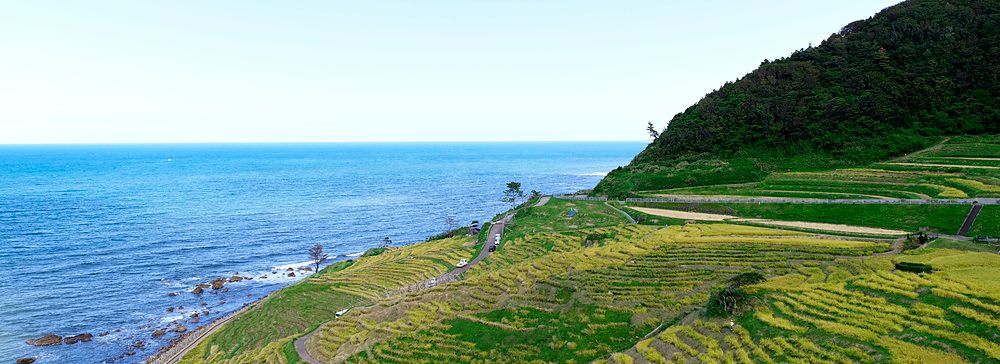
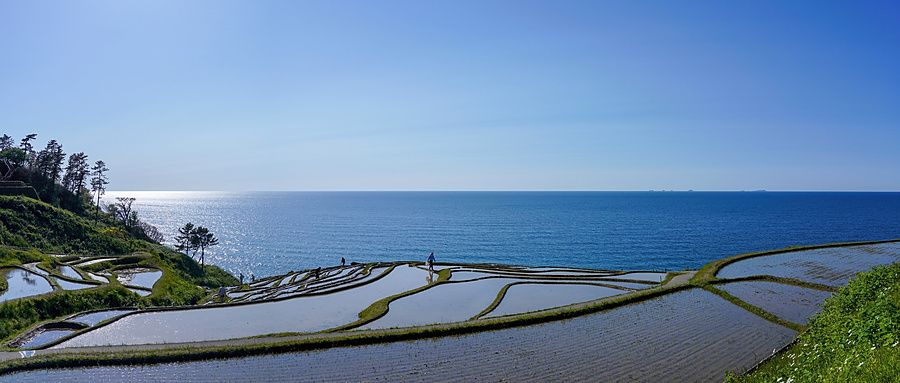
A hillside of terraced rice paddies in Wajima, on the Noto Peninsula, running from the road all the way down to the sea: more than a thousand tiny fields sit one below the other, with the Sea of Japan right at the bottom. The Shiroyone Senmaida Rice Terraces are known for exactly that, paddies and waves in a single view, and for the way they change color from one season to the next.
Stop here if you’re driving around Noto, if you love the real Japanese countryside, or if you’re after the best sunset over the sea on this coast. Even people who know nothing about rice paddies end up standing there staring.
What you’ll see
From above, the terraces look like a giant staircase cut into the hill. The hill is steep and drops straight down from the road to the beach. There are more than a thousand fields, most of them the size of a room and some no bigger than a rug. Because they’re so small and oddly shaped, farm machinery can’t get in, so nearly all the work is done by hand, the way it was centuries ago. That’s why the terraces are protected as a national Place of Scenic Beauty, and they’re part of the Noto area that the FAO recognizes as a Globally Important Agricultural Heritage System.
- The viewpoint at the top: a viewing deck next to the parking lot looks out over the whole slope down to the water, and it’s where everyone takes the classic photo.
- The path through the paddies: it runs down between the fields along the levees almost to the rocks, and it’s the only way to see up close how big each paddy really is.
- The shore at the bottom: from the rocks you look up at the hill, with the terraces climbing one above the other against the sky.
- The name posts: lots of the fields have a wooden post in front with the name of whoever adopts the field and pays to keep it farmed: individuals, companies and even a few famous names like Go Nagai, the creator of Grendizer.
- The open sea: on clear days you can see the small islands offshore, and in winter the waves crashing below the terraces are as much a part of the show as the fields.
- The snack shop by the parking lot: a low building with Noto products, onigiri made with rice from these terraces, and something hot to eat while you look down at the slope.
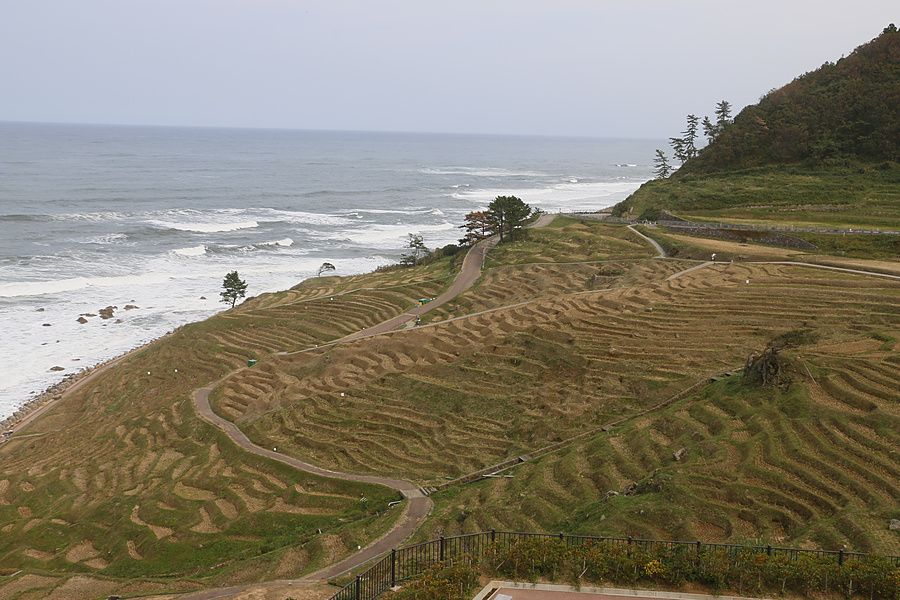
The earthquake that hit Noto did a lot of damage here too. On top of the New Year’s Day 2024 quake, that September brought torrential rains that hit the peninsula again, and right afterward only about a hundred of the 1,004 fields were being farmed. Today roughly half the fields are farmed. Some collapsed and others no longer hold water, so from above you’ll notice patches of bare earth among the green or gold, and a few rebuilt levees where the soil is still pale.
For me this doesn’t take anything away. If anything, it adds to it. You see locals and volunteers rebuilding field by field by hand, and once you realize how much work goes into every single step, the view hits even harder.
The path through the paddies was also closed for a long time after the earthquake. If you find it open, go down, because it’s a completely different experience from looking down from the top. There are steps, mud after rain and a stiff climb back up, but regular walking shoes will do. If you have a stroller or someone who has trouble walking, stay on the viewing deck, which is more than enough on its own.
Watch out for the kites. Plenty of them circle low over the terraces, and the moment you pull out an onigiri outdoors they’ll snatch it right out of your hands.
In photos the place looks as big as a valley. In person it’s just one slope, but the details make it feel endless: the crooked fields following the hill, the narrow levees, the name posts, the sound of the sea carrying all the way up to the road.
When I’m in Noto I always stop, even if it’s just for ten steps out on the viewing deck. It’s one of the few places in Japan where you see people’s work and nature together, and it’s different every time I come back.
When to go
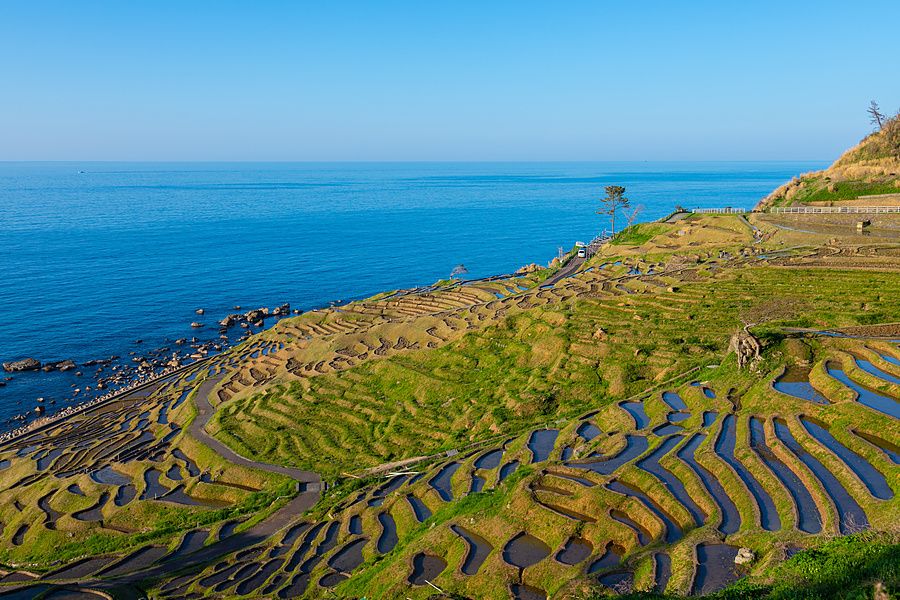
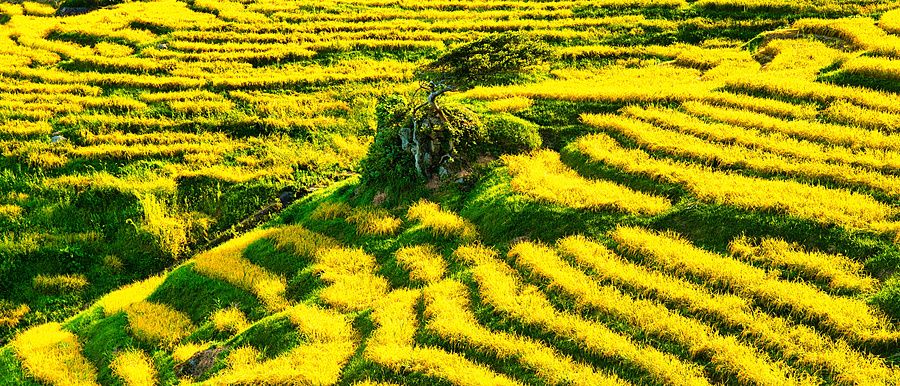
The season completely changes what you see. In May the fields have just been flooded for rice planting and turn into a thousand mirrors reflecting the sky. In summer everything is bright green against the blue of the sea, and around September the rice turns gold just before the harvest.
In winter the fields are bare, and snow turns them into a white pattern of lines and curves above a gray, choppy sea. It’s when you’ll find the fewest people by far, and if you can put up with the icy wind, it has its own appeal.
The best time of day is sunset, especially from spring through the end of summer, when the sun goes down right over the sea in front of the terraces and the flooded fields light up orange. It’s also when the viewing deck is most crowded: on weekends the parking lot fills up and you have to wait for a space.
Early in the morning, on the other hand, there’s no one but farmers at work and a few photographers with tripods, and all you can hear is the sea. On weekdays there’s plenty of room at any hour.
In rain or haze the sea disappears and you lose half the view. If the weather looks iffy, you’re better off putting off the stop until the next day than showing up to find everything gray.
The best shot
The most famous shot is taken from the viewing deck by the parking lot, with the paddies dropping away and the sea at the bottom, and it works at any time of day. To catch the fields shining, be there in the hour before sunset in May or June, when they’re full of water.
If the path is open, the shot few people get is from below, near the rocks, with the terraces climbing toward the road. From the top, with a telephoto lens, you can shoot the name posts lined up along the levees.
At a glance
- Highlight: a thousand terraced rice paddies that run right down to the Sea of Japan.
- When to go: May for the flooded fields or September for the golden rice, at sunset; winter for snow and rough seas.
- Best for: anyone driving around Noto, countryside and photography lovers, anyone who wants to see a piece of rural Japan getting back on its feet.
- Atmosphere: the sound of waves, wind off the sea, farmers at work among the wooden posts.
Final thoughts
There are no temples, no museums, nothing to check off here. What you get is a hand-farmed slope running down to the sea, and that’s where all of the place’s appeal lies: those steps of water and earth, one below the other. If you’re on the Noto Peninsula, the detour is worth it even just to look down from the top, and if you plan to get there at sunset in spring, you’ll get a view that’s hard to find anywhere else in Japan. If you’re looking for monuments, shops or things to fill a whole day, though, you won’t find any of that here. It’s a place to look at, not to tour.