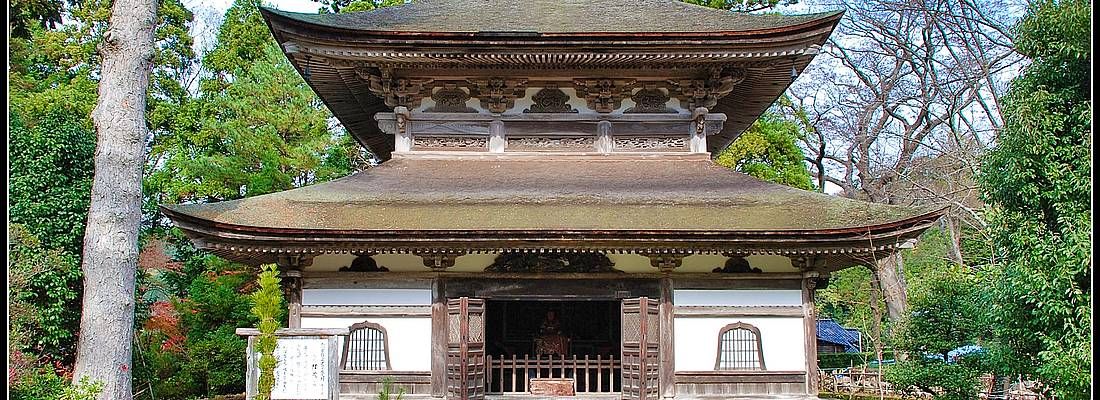
Sojiji Temple
Up on the Noto Peninsula, in the north of Ishikawa Prefecture, Sojiji Temple holds seven centuries of Zen Buddhist history.
It was built in 1321 with the support of Emperor Go-Daigo, and for centuries it was one of the most important temples in Japan. That changed with a huge fire in the late 1800s: its role as head temple passed to the Sojiji in Yokohama, and the Noto temple inevitably fell into decline.
Some buildings have been rebuilt and others survived the flames, and together they still give you a sense of its former grandeur. It remains one of the main sights on the peninsula.
Contents
Visiting Sojiji Temple
The first building you’ll come to on your way in is the Kyozo, where the Buddhist sacred scriptures are kept. From there you cross the Hakuji bridge to the temple’s main entrance, the huge Sanmon Gate, which was built in 1932 and stands 17 meters tall. On the other side is the heart of the temple, a lovely courtyard laid out around a small pond and framed by beautiful gardens. It’s a place to walk in silence, with the scent of the plants all around you.
A loop path starts from the courtyard and takes you past the main buildings. The ones that stand out are the Butsuden, which is the prayer hall with the statue of the Buddha, and the Sodo, a meditation hall. The Kannon Hall is one of the buildings that survived the fire. It’s among the oldest here, but it still has a lot of charm. Inside is a statue of the Buddhist deity Kannon. The spiritual heart of the complex, though, is the Daisodo, the great hall where the temple’s founders are venerated. When you’re in the Butsuden, look for the board with calligraphy by Yamaoka Tesshu, one of the Meiji era’s most famous master swordsmen and calligraphers.
The complex also includes the monks’ living quarters.
Two earthquakes and a long restoration
Earthquakes have shaped the temple’s recent history. The 2007 quake damaged most of the buildings, and the restoration wasn’t finished until 2021, just in time for the temple’s 700th anniversary.
Then the Noto Peninsula earthquake of January 1, 2024 hit it very hard again. Every one of the protected buildings was damaged, and some collapsed, either partly or completely. Sixteen structures, including the Sanmon Gate and the Butsuden, are designated Important Cultural Properties of Japan. The national government is supporting the recovery, which could take about ten years.
Keizan and the Yokohama connection
The temple was founded by the monk Keizan Jokin, who along with Dogen is considered one of the two fathers of the Soto school, the most widespread branch of Zen in Japan. Keizan turned a small temple that already stood here into a Zen monastery. Over the centuries it became the head temple for thousands of temples across the country.
After the fire, when the head temple moved to Tsurumi in Yokohama, the Noto complex was renamed Sojiji Soin, the “ancestral temple.” To this day, the Soto school traces its roots back here.
Because of the restoration work, some buildings may be closed or covered in scaffolding when you visit.
Getting There
From Wajima, take the Hokutetsu Noto bus on the Wajima line and get off at Monzen Sojiji-mae, a short walk from the temple entrance.
From Kanazawa, take the express bus to Wajima, get off at Konoki and change to the Anamizu line, which stops at the same Monzen Sojiji-mae stop.
By car, it takes about 2 hours from Kanazawa along the Noto Satoyama Kaido. You can park at Zen no Sato, a 5-minute walk from the temple.
Useful Info
- Monzen Sojiji-mae stop (Hokutetsu Noto bus, Wajima and Anamizu lines): right in front of the temple
- Konoki stop: transfer between the Kanazawa-Wajima express bus and the Anamizu line
Map
This place is on MarcoMaps
Sojiji Temple
My map of Japan: over 4,000 places I've tried myself, each with photos, rating, and hours. Filter by category and rating, find veg-friendly spots and places near you with GPS. No sign-up, right from your phone.
- 4,000+ places
- Rating, photos, and hours
- Veg friendly
- Near me (GPS)
- Favorites without login
- Works offline

