Stamp Collecting in Japan
In Japan, stamps are more than office supplies or collector’s items. They’re a living part of the culture, and when you travel, they can become a game, a ritual and a lasting memory. Some people collect the stamps at train stations, some get excited over every goshuin they receive at a temple, some have a kawaii custom inkan made, and some get pulled into a stamp rally they stumbled on in the subway. Keep an eye out for them, because this very Japanese obsession with stamps could easily become yours too. And I promise that once you start… it’s hard to stop.
Contents
- Train station stamps
- Goshuin, sacred stamps from temples and shrines
- Stamp rallies, Japan's treasure hunts
- Where to find the best stamps
- Post office stamps
- The stamp that works as a signature
- Kawaii and creative stamps
- Stamps as travel souvenirs
- Other ways to use your stamps
- My favorites (and a few hard-to-find ones)
- How to keep your stamps
- The joy of useless things
- Digital stamps? No thanks
- When the stamp isn't there
- How long stamps last
- Final thoughts
Train station stamps
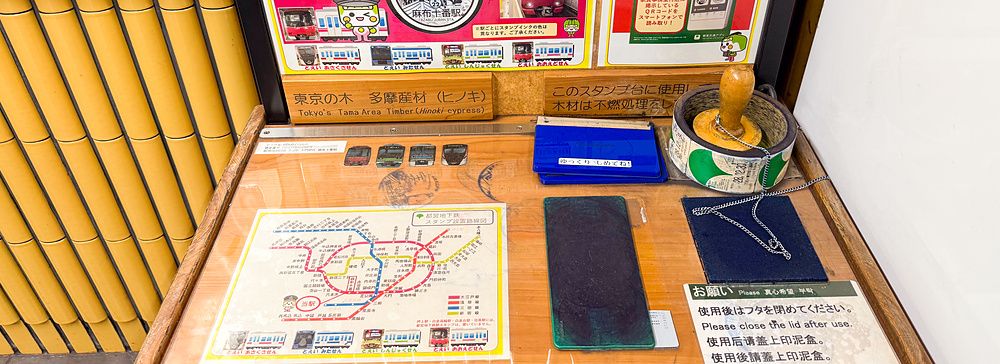
Travel around Japan by train and you’ll soon notice something surprising: every station has its own stamp. It isn’t advertising or marketing. It’s local pride, and each stamp shows something typical of the area, like a mascot, a famous landmark, a traditional dish, a landscape or a historical scene.
You’ll usually find them near the ticket gates or the tourist information desk, on a small table with a card you can stamp on. If you’re lucky, there’s also a blank booklet to fill in. If not, any notebook will do, but I’d bring one just for stamps, so it becomes a visual travel diary.
You don’t need to do anything special. The stamp is free and you don’t need to ask permission: just press it down and take that little piece of Japan home with you. We even know exactly when the habit started. The first station stamp appeared in 1931 in Fukui, featuring Eiheiji Temple, and people liked the idea so much that the following year stamps spread to stations all over the country. The real boom came in the 1970s, though, with the “Discover Japan” campaign that encouraged Japanese people to travel by train around their own country, and many of the designs you’ll see today still have that retro feel.
Goshuin, sacred stamps from temples and shrines
Goshuin are one of the most elegant and spiritual kinds of Japanese stamp. People don’t collect them for fun but as an act of respect and devotion. Whenever you visit a temple or shrine, you can ask for one: it’s a page decorated by hand with a stamp and calligraphy, written by a monk or a priest.
Every place has a different stamp, and many temples change the design with the seasons or for festivals. Some are true masterpieces, while others are simple but still charming.
To collect them you need a goshuincho, a special notebook just for goshuin. You can buy one at almost any temple, or in bookstores and specialty shops. I’d keep it for goshuin only and not use it for other stamps, like the station ones, because the goshuincho is considered sacred.
Prices vary, but each goshuin usually costs 300 to 500 yen. It isn’t a purchase but a donation, and you should treat it with respect. How you ask matters too. Visit first, then ask: the goshuin is proof that you were there and prayed, so you go to the counter at the end of your visit, not as soon as you arrive. Hand over your goshuincho already open to the right page, without its elastic band or case, and wait quietly while they write, without taking photos of the calligrapher’s hand. Have coins and small bills ready, since almost nowhere takes cards. And if they tell you that goshuin are only available on pre-written sheets that day, that’s perfectly fine: you just glue the sheet into your notebook when you get home.
Stamp rallies, Japan’s treasure hunts
Stamp rallies are one of the most fun and most underrated things to do in Japan. They’re routes with checkpoints where you collect stamps at specific places, which can be stations, shopping malls, tourist attractions or even stores.
When you finish the route, you often get a prize or some exclusive merch, but the real reward is the fun of wandering around with a map in your hand like you’re in a video game. Some rallies are designed for kids, but plenty are so good that you’ll dive right in even as an adult.
There are rallies themed on Pokémon, Evangelion, Hello Kitty, historic trains… and new ones pop up throughout the year. Keep an eye on JR stations and the posters in the subway, because you’ll only find them if you’re paying attention. It always works the same way. At the starting point you pick up the rally sheet, which is almost always free, and from then on you bounce from one checkpoint to the next with the map in hand. Prizes are handed out while supplies last, often at a single point on the route, so start early. Also check how many checkpoints you actually need, because you don’t always have to complete them all.
Where to find the best stamps
You’ll find stamps pretty much everywhere in Japan, but in some places the variety and beauty of the stamps are really impressive. These are the kinds of places I’d keep an eye on:
- Train stations, especially the big or touristy ones (Kyoto, Nara, Nikko, Kanazawa…).
- Tourist information offices: in lots of Japanese cities, the tourist office has one or more stamps of its own.
- Museums: almost every museum in Japan, even the smallest, has a stamp at the entrance or exit.
- Castles and historic sites: there are even official stamps for Japan’s “100 Fine Castles.”
- Temples and shrines: besides goshuin, some have simple stamps you can collect for free.
- Family attractions: aquariums, zoos, theme parks, shopping malls… they all have their own stamps.
Post office stamps
There’s one kind of stamp almost no traveler knows about, and it comes from Japan Post. They’re called fuukei-in, and they’re postmarks with a different design for each post office: the local landmark, a mountain, a flower, a scene from the local festival. Not every post office has one, but in tourist areas you’ll rarely come away empty-handed.
To get one, you need a postcard with a postage stamp already on it. Hand it over at the counter, ask for the fuukei-in, and they’ll stamp it by hand right in front of you. You can mail it or keep it for yourself, which is the nicest way to bring home a city’s stamp.
They’re a lovely little find precisely because hardly anyone looks for them. You’ll often be the only person asking, and the clerk will greet you with a smile.
The stamp that works as a signature
Japan is one of the few countries in the world where stamps replace signatures, even on official documents. This stamp is called an inkan (or hanko), and almost everyone in Japan has at least one for everyday use. Only the seal used for important legal documents, the jitsuin, has to be registered at city hall. All the others, the ones people use to sign for deliveries or at work, don’t need to be registered at all.
Tourists obviously don’t need a registered inkan, but many love the idea and decide to have a custom one made with their name in Japanese. It also makes a lovely souvenir. Some are extremely elegant, made of wood or stone, and others are pure kawaii, with anime characters, little animals and bright colors.
You can order them in specialty shops or online. Sometimes you can even watch your stamp being made on the spot, as a master carver cuts the characters into the seal by hand. If you’re looking for an original (and 100% Japanese) gift, a custom inkan is perfect.
Kawaii and creative stamps
Alongside the official ones, Japan has thousands of cute, creative stamps, often used to decorate planners, diaries, letters and gift bags, or just for fun.
Stores like Hands, Loft and Don Quijote have entire sections full of kawaii stamps featuring animals, funny phrases, seasonal designs and Japanese symbols. Some are self-inking, and others go with the classic colored ink pads.
The selection is endless, and I understand why so many people in Japan, especially girls, collect these stamps the way others collect postage stamps. If you love Japanese stationery, go and have a look. You’ll lose hours in there.
Stamps as travel souvenirs
One of the best things about Japanese stamps is that they’re all different and tied to a place. You’ll never find the same stamp in two different places. That makes them perfect souvenirs, linked to a specific moment of your trip.
You might forget what you ate at that little restaurant or exactly where that side street was, but the stamp is still there, in black and white, reminding you that yes, that place really existed.
It’s also a way to slow down. Stop. Look for the stamp. Press it carefully. Look at the design. Write down the name of the place. Maybe take a photo of the stamp with the view behind it.
Other ways to use your stamps
Besides building a regular collection, there are lots of creative ways to use the stamps you find around Japan. Here are a few you might not have thought of:
- Mail stamped postcards to yourself from every city you visit. When you get home, a printed, personal souvenir is waiting for you.
- Make an “art” travel journal by combining stamps, receipts, train tickets and little notes.
- Use them to decorate a photo album: stamp on the left, photo on the right.
- Stamp them on separate sheets and frame them: if you choose well, they look like tiny works of art.
Don’t wait until the end of your trip to begin. Start right away, even with a stamp from some random station. By the end you’ll have dozens, each with its own story.
My favorites (and a few hard-to-find ones)
On my trips I’ve come across some stamps I’ll never forget, and I always recommend looking for them if you’re in the area. Here’s a short list:
- The Nara Station stamp, with deer and the Great Buddha.
- The Miyajima one, with the floating torii and deer in the rain.
- The Uji Byodo-in goshuin in spring: elegant and minimal, with a floral touch.
- The hidden stamp at the Kyoto International Manga Museum: incredibly hard to find.
- The Evangelion rally in Hakone: every stamp was a work of art.
Some of these don’t exist anymore, and that’s part of the fun. They’re like rare trading cards: they were there, you got them, now they’re gone. But they stay in your collection.
How to keep your stamps
Once you start your collection, you’ll realize it isn’t just a game but a personal ritual. Every stamp means something and stands for a piece of your trip, so it’s worth looking after them properly.
Use a sturdy notebook with thick paper (avoid thin pages that soak up the ink). Japanese travel journals are perfect, and they’re easy to find at the better-stocked konbini, at stationery stores, or at shops like Loft and Hands.
Finally, number the pages or add a short handwritten note, something like “Nikko Station, rainy day, we were soaked but happy.” Over time these become precious memories, far stronger than any Instagram post.
The joy of useless things
One of the things I love most about Japanese stamps is that they’re good for nothing, and that’s exactly why they mean so much. They don’t get you discounts. They aren’t loyalty rewards. They don’t earn you points or cash back.
They’re there purely for the pleasure of collecting them, for the joy of stopping for a second, leaning over the little table, choosing the ink color and pressing down firmly. And of walking away with something concrete, physical and imperfect. In a digital world, ink on your fingers is a small, old-fashioned pleasure.
And let’s be honest, it’s a deeply Japanese thing: the attention to detail, the designs that are never the same, the local pride, the sense of continuity and memory.
Digital stamps? No thanks
In recent years, a few digital “stamp rallies” have appeared, mostly in tourism apps or in railway companies’ apps. They work with QR codes or geolocation: you go to the right spot and the app gives you a virtual stamp.
But I’ll be honest with you: it’s not the same thing.
What makes a Japanese stamp special is that it’s physical. The ink. The motion. The off-center print when you miss the circle. You can’t recreate that moment with a screenshot. So if you come across a digital rally, sure, give it a try. But never skip the real one.
When the stamp isn’t there
Unfortunately, in some places you’ll find the stamp is missing, has been moved, or is temporarily unavailable. Sometimes it’s been put away for maintenance, or because the ink has dried out or the pad is worn. In other places, especially small museums and tourist information centers, they keep the stamp behind the counter and you have to ask for it.
Don’t give up. If you really want to complete your collection, ask the staff politely. They’ll often pull the stamp out of a drawer or tell you where to find it. I’ve learned that in Japan it’s always worth asking, because people are surprisingly helpful, even over something as small as a stamp.
How long stamps last
People often ask me, “Does the stamp ink fade over time?” It depends. Some stamps fade a little, especially if you use paper that’s too smooth or too thin. Others, especially those made with water-based or low-quality ink, tend to turn grayish after a couple of years.
That’s why I recommend:
- Using matte, absorbent paper
- Letting the ink dry completely before you close the notebook
- Not pressing too hard, so the ink doesn’t spread and smudge
And if you want to keep them forever, you can make high-quality scans of them when you get home and build a digital archive of your trip.
Final thoughts
Collecting stamps in Japan is a lot more than a hobby. The stamps tell stories, spark your curiosity, help you discover new places, and above all turn every stop into a special moment. It’s a very Japanese way to travel: paying attention, showing respect, and valuing even the smallest gestures.
My advice is to start collecting from day one. You don’t need money or extra time, just a bit of attention and a notebook. By the end of the trip, you’ll have something nobody can buy: a journal made of ink, memories, and wonder.