Suwa Taisha
A shrine spread out around Lake Suwa in Nagano Prefecture, where instead of the usual main hall housing the deity, people pray to a mountain and two trees, and every enclosure has four huge logs planted at its corners. Suwa Taisha isn’t a single building. It’s four shrines, two on the south shore of the lake and two on the north, and no two are alike.
It’s the right place if you’ve already done Kyoto and want a big, ancient shrine away from the usual tourist routes. It also works if you’re spending a day in the Nagano mountains and want to understand how people worshipped here before there were temples.
What you’ll see
The upper shrines, south of the lake, are Kamisha Honmiya and Kamisha Maemiya. The lower ones, to the north, are Shimosha Akimiya and Shimosha Harumiya. Visiting all four in one go is called yonsha meguri, and people here really do it. At the stamp counter you’ll see visitors walk up with their stamp books and collect the stamps one after another.
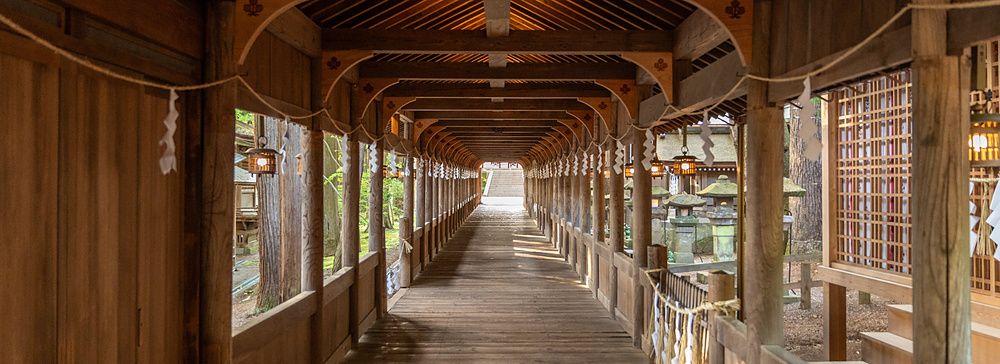
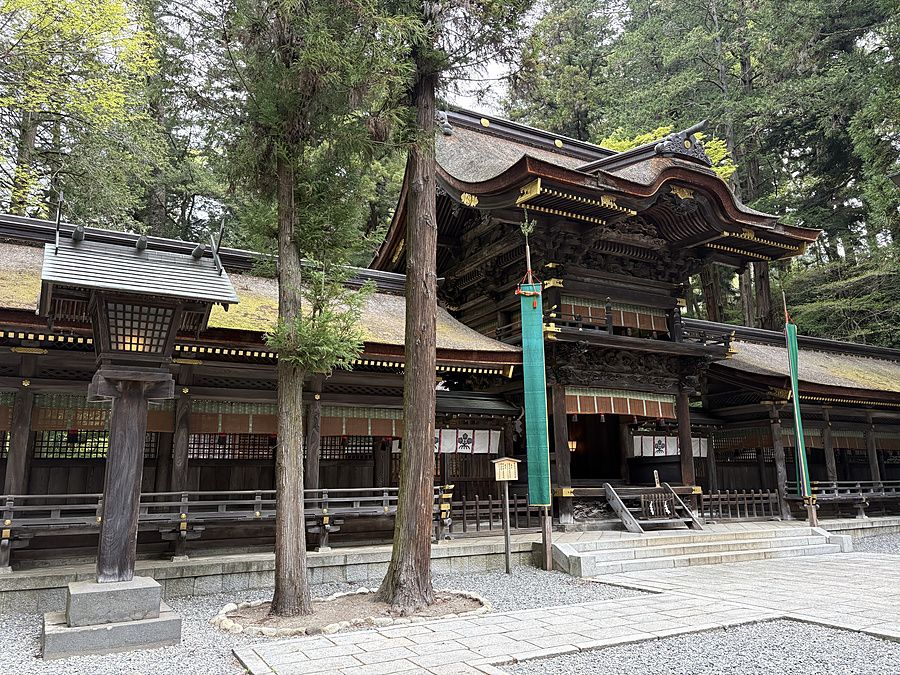
- Kamisha Honmiya: the largest of the four, with a long covered wooden corridor running alongside the buildings, gravel courtyards, and a worship hall that faces Mount Moriya, the shrine’s real deity.
- Kamisha Maemiya: the oldest and plainest, set among hillside fields, with an uphill walk to the hall and a spring-fed stream running right beside it.
- The onbashira: the four giant fir logs planted at the corners of each shrine. Once every six years they’re cut in the mountains and dragged down to the valley by hand.
- Shimosha Akimiya: the sacred yew tree behind the hall, the hall for sacred songs with a braided straw rope as thick as a tree trunk hanging over it, Japan’s largest pair of bronze guardian dogs, and a very old cedar just past the torii.
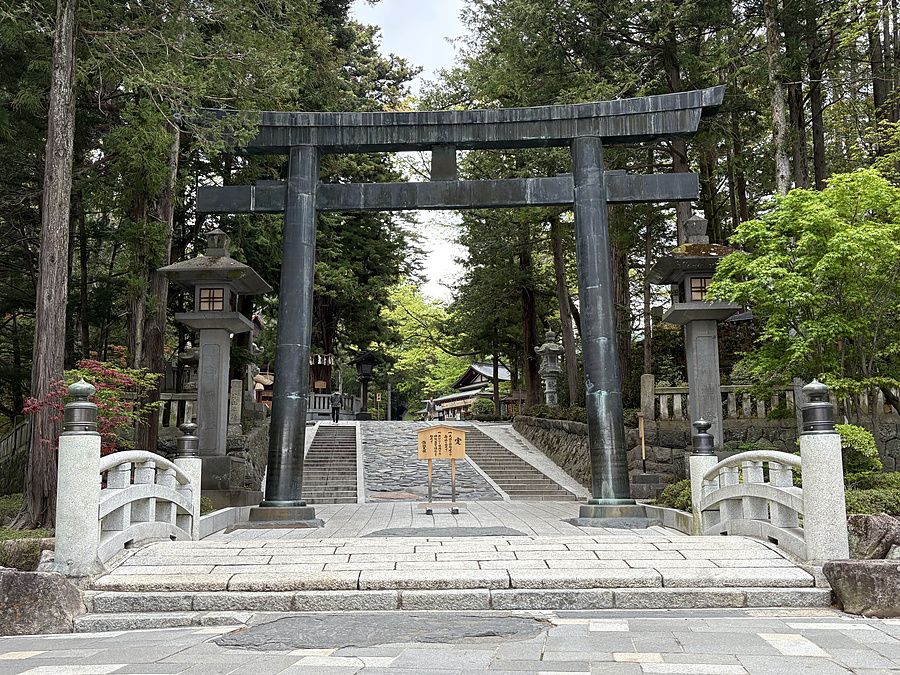
- Shimosha Harumiya: a roofed bridge standing in the middle of the road in front of the entrance, the cedar whose two trunks have grown into one, which people pray to for love, and the river out back.
- Manji no Sekibutsu: a two-meter stone Buddha by the river behind Harumiya. Its body looks like a big rounded boulder, with a tiny head resting on top, and people walk around it three times while making a wish.
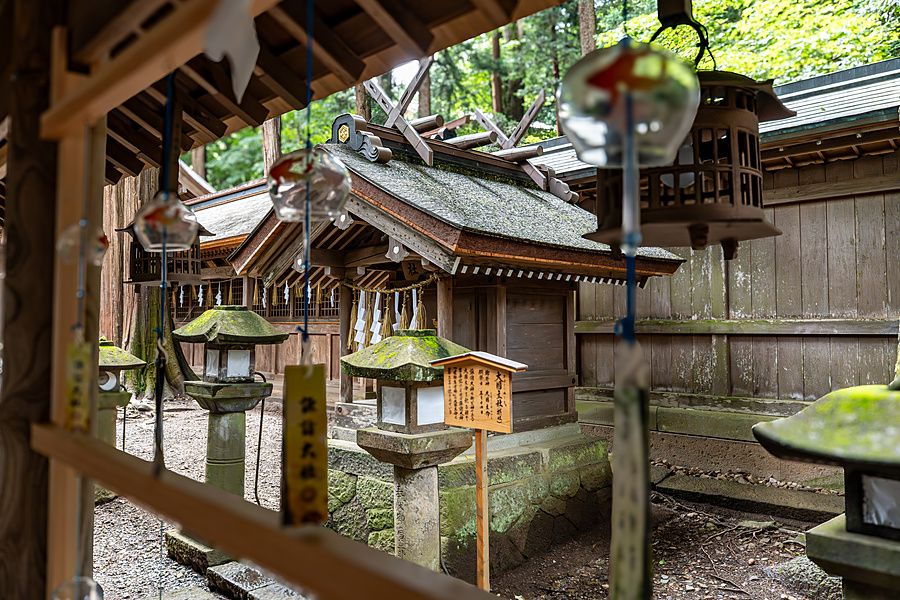
If you only have time for one, make it Maemiya, not Honmiya. At the other three you see the onbashira one or two at a time, with the rest hidden behind fences, but Maemiya is the only one where all four are right there in front of you and you can touch them. The walk up isn’t long, but it’s genuinely steep, on asphalt and gravel, and in summer you’ll be sweating in the sun.
Honmiya has the most to explore, and the biggest crowds. If you’re expecting a grand hall covered in gold and bright colors, it’ll throw you. The buildings are dark wood, with carvings that are worth a close look, and once you’re standing there you realize people pray toward the mountain behind it, not toward a statue or a closed room. The covered corridor along the side is what stays with you.
Akimiya is the tidiest of the four and the most photographed, thanks to the big rope on the hall for sacred songs. The neighborhood around it is Shimosuwa, with its hot springs and the low houses along the old post road. Harumiya is smaller, but behind it is the nicest walk of the lot: you cross a little red bridge onto the islet in the middle of the river, and a few steps later you’re at the stone Buddha, on flat ground the whole way.
When friends come to visit me in Japan and they’ve already seen the shrines in Tokyo and Kyoto, I bring them here for one reason: these logs catch them off guard. They’ve seen them in photos or in videos of the festival, with people clinging to a log as it hurtles down a sheer slope. Standing in front of them is something else, though: they’re as tall as a four- or five-story building and too thick to get your arms around. The festival is called Onbashira-sai, and it’s held in the years of the tiger and the monkey in the Chinese zodiac. In spring the logs are dragged down the mountain, and that’s when the famous plunge happens, with people riding them down the slope. Shortly afterward they’re hauled into town and raised at the four corners of each shrine.
Outside festival years, the logs you see are the ones from the last festival. They stay in the ground until the next one, when new logs replace them.
When to go
Early morning is the best time. At Maemiya you might have the place to yourself, with just the sound of the stream and a local or two stopping by to say hello, and Honmiya’s courtyards are still half empty too. Harumiya is the exception. Lots of people start the circuit there, so it’s busier in the morning, while in the late afternoon it empties out and the light slants in through the cedars.
On weekends and Japanese holidays, Honmiya and Akimiya fill up with tour buses and families, and there’s a line at the stamp counter. On weekdays you’ll have all the room you want.
Akimiya is packed from morning till night for the first three days of January, when people make their first shrine visit of the year. If you’re in the area then, stay away or wait until January 4 to go. The same goes for onbashira years, when the whole valley fills up with people for the festival.
In autumn the maples around the shrines turn red, and that’s when the four-shrine circuit is at its best. Winter here is seriously cold, with snow on the roofs and the lake sometimes frozen over. The silence and the white courtyards are beautiful, but dress as you would for the mountains, because you spend a lot of time outdoors getting from one shrine to the next.
Doing the circuit
Seeing all four shrines means going around the lake, which is very different from visiting a shrine in the city. This isn’t a place you walk into, look around, and leave. It’s a route with four stops. None of the shrines takes long to see, and most of the distance is in between.
I think it’s best to visit Maemiya and Honmiya in the morning, when they’re quieter, and end with Harumiya, the river and the stone Buddha toward evening. Then you wrap up in Shimosuwa with dinner or a hot spring bath, which you’ll need after a day on your feet on gravel and slopes.
With kids, the full circuit is a lot, because the best parts are details that don’t mean much to them. You’re better off picking Akimiya, with the bronze dogs and the straw rope, and Harumiya, with the red bridge and the Buddha to walk around, which kids love.
A stroller is hard work on the gravel courtyards, and pushing one up to Maemiya is tough.
At a glance
- The highlight: the sacred logs at the corners of the enclosures, with all four within touching distance at Maemiya.
- When to go: early morning on weekdays, and autumn for the colors. Avoid Akimiya at New Year and on weekends.
- Best for: people who already know the classic shrines and want something older, and anyone in the Nagano mountains with time for the full circuit.
- Atmosphere: dark wood, gravel, towering cedars, the stream at Maemiya, and hardly anyone around in the morning.
Final thoughts
You don’t come to Suwa Taisha for the buildings. None of the four halls stops you in your tracks the way Kyoto’s Golden Pavilion does. You come to see what worshipping the mountain, the logs and the trees actually looks like, and to do that properly you need all four shrines, not a quick stop on the way somewhere else. If you’re heading to the Japanese Alps or you’re in Matsumoto, even just Maemiya and the stone Buddha by the river are worth the detour. If you only have a few days in Japan and want the big names, save it for another trip. People come here on purpose, not because it happens to be on their way.