Tabata
Tabata is one of those Tokyo neighborhoods where you’ll barely see a tourist, and that’s a good thing. It’s a Yamanote Line stop just like Shibuya or Shinjuku, but the moment you step outside you’re surrounded by houses, slopes and quiet.
I come here when I feel like walking without rushing and seeing everyday Tokyo, the one where people actually live. The neighborhood has a history of writers and painters, plenty of trains to watch and a hill where you can catch a glimpse of the Skytree.
It won’t fill half a day, but squeezed in between two better-known stops, it sticks with you more than you’d expect.
Contents
Nearby neighborhoods
Which exit to take
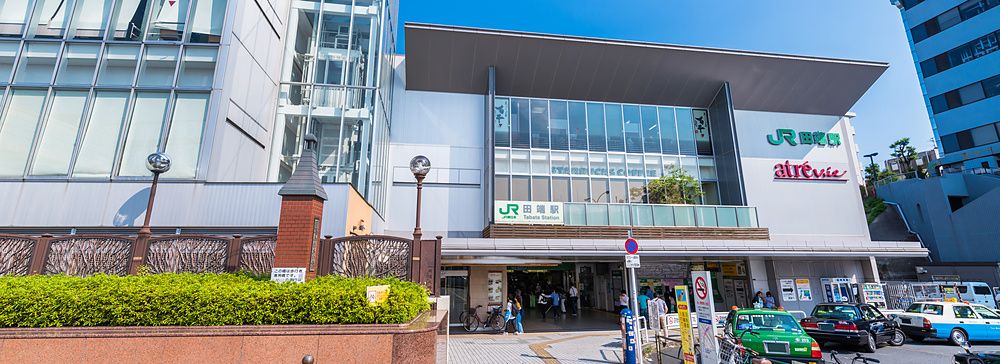
The station has two exits, and which one you pick changes your whole day. The north exit puts you right inside a small shopping center, Atré Vie, where you’ll find staff, restrooms, a supermarket and a few restaurants. It’s the place to grab a quick bite or freshen up before moving on.
The south exit is the complete opposite, and the first time around you might not even find it. Nothing nearby makes it stand out: no shops, no staff, just an intercom to call for help if you need it. On that side the station sits higher than the tracks and cars can’t reach it, so you can only get there on foot.
My advice is to take the north exit if you want convenience, and the south exit if you want to see right away why I come here. The area sits on higher ground, and from certain spots between the houses you can see the Skytree and central Tokyo in the distance.
Temples and graves among the houses
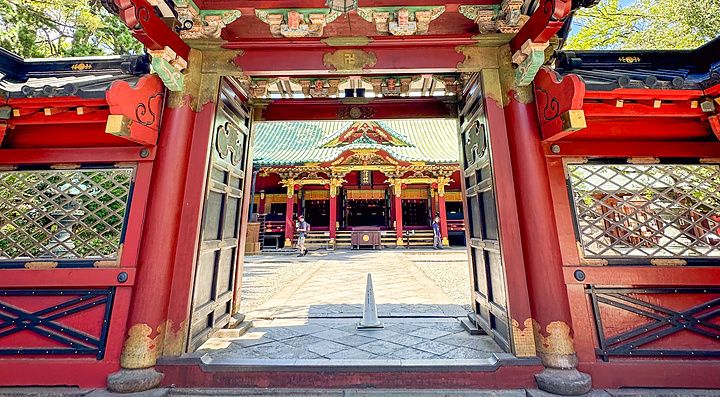
Tabata doesn’t have a postcard landmark, so you have to go looking for the good stuff. The first is at Tokakuji Temple, where two guardian statues from 1641 stand at the entrance, completely covered in slips of red paper. You stick a slip on the statue on the same part of the body that hurts on you, and once you’ve healed, you come back and leave a pair of straw sandals. Under all that paper you can’t even see the statues anymore, and that’s exactly what makes them special.
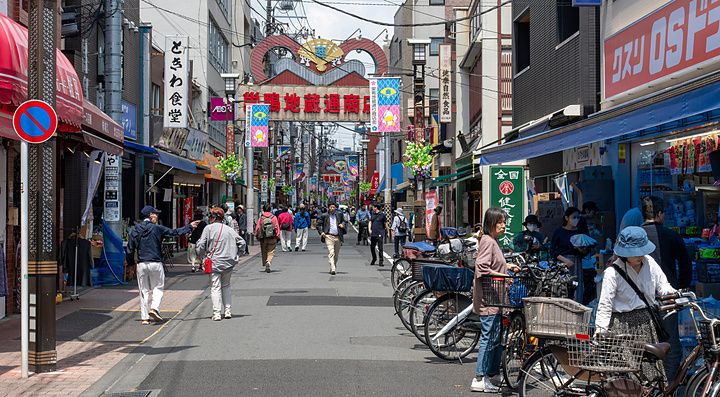
Right next door is Tabata Hachiman Shrine, the old village’s shrine, and a little further on is Dairyuji Temple, where Masaoka Shiki is buried. He’s the poet who revived haiku for the modern age, and he asked for a quiet grave. He couldn’t have found a quieter one. Each of these three stops takes about ten minutes, but they’re the reason a walk here never wears you out.
The writers’ village
In the early 1900s Tabata was full of writers and artists, and the reason was simple. Tokyo’s art school, today’s Geidai, was in Ueno, just a few minutes away by train, so young painters and sculptors looked for places to live nearby.
The writers followed them. The most famous was Akutagawa Ryunosuke, who lived here for about thirteen years, and writers like Muro Saisei and Kikuchi Kan gathered around him. The catch is that almost nothing is left of their old homes. War damage wiped out the feel of those years, and today what you’ll mostly find are plaques marking the spots where they once stood.
If you’re curious, there’s a small free museum near the north exit, with a model of Akutagawa’s house. And there’s a treat for anime fans, too: the slope at the south exit appears in a Makoto Shinkai movie, and on one of the lampposts there’s a code you can scan that leads you to the locations from the story.
The slope from the movie
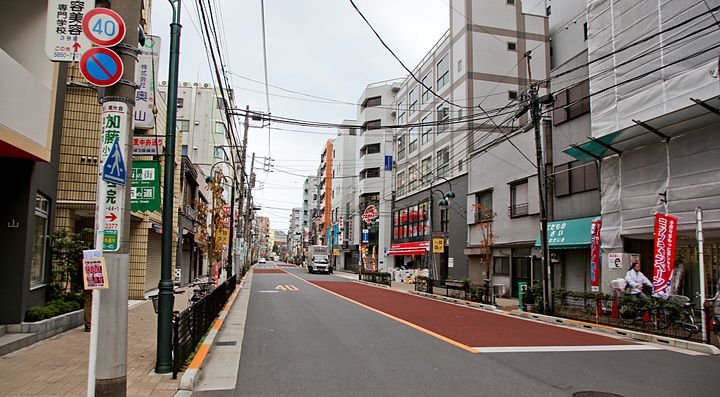
The slope that starts at the south exit is the one from Weathering with You, and if you’ve seen the movie you’ll recognize it instantly: the bare little station with its vending machine, the road that climbs straight up for a couple hundred meters, the tracks running below on the left.
In real life it looks exactly like the animation, and that’s my favorite part: nobody has set anything up for visitors. No signs, no souvenir shop, no lines. It’s just a neighborhood street going uphill, with people walking home with their groceries and every now and then someone stopping to take the same shot.
Train town
Tabata was a rail hub before it was ever a neighborhood, and you can still feel it today. On the south side there’s a huge train depot that draws rail fans from all over Japan, and from the right spots you can watch Shinkansen and other trains go by nonstop. If you love trains, it’s a free show. My spot is the Tabata Fureai pedestrian bridge, which spans a wide stretch of tracks. The bridge has real Shinkansen parts on display, a wheel and a coupler cover, and underneath it the Yamanote, the Keihin-Tohoku and the faster trains all run side by side. Stand there for five minutes and something is guaranteed to come through.
There’s also a detail few people know. The Yamanote Line, which everyone pictures as a loop, officially starts at Shinagawa and ends right here at Tabata, while the rest of the circle goes by another name. It’s trivia for sticklers, but it explains why this stop matters more than it seems.
On its own, you can walk around Tabata in just under an hour, so it’s worth pairing it with something nearby. These are the places I usually suggest:
- Yanaka and its shopping street: to stay on this quiet side of Tokyo.
- Komagome and Rikugien Garden: one of the nicest green spaces for a walk in the area.
- Kyu-Furukawa Garden: with its Western-style mansion and rose garden.
The way I see it, nothing around here is going to leave you speechless, but it’s the kind of Tokyo you’d come back to live in. And sometimes that’s exactly what you’re looking for.
Getting There
Tabata is a stop on the Yamanote Line, so you can get there without changing trains from almost anywhere in Tokyo. From Tokyo Station or Ueno it's just a few minutes north, and from Shinjuku or Ikebukuro you simply stay on the loop.
If you're already exploring the Yanaka area, the nicest way to get there is on foot: about twenty minutes of ups and downs between the houses, which is already half the walk.
Useful Info
Name: Tabata
Time needed: Just under an hour to walk around the neighborhood, an hour and a half if you also stop at the writers' village museum
Closed: The writers' village museum is closed on Mondays and on the day after national holidays. It also closes from late December to early January, and for a few days whenever the exhibitions change.
Tips: Take the south exit and walk all the way up. The slope keeps climbing well past the first few meters, and the best view over the tracks and the Skytree is higher up, where almost nobody goes. Save the writers' village museum for last. It's your backup plan if the weather turns.
Getting there:
- Tabata Station (JR Yamanote, JR Keihin-Tohoku)
- Nishi-Nippori Station (JR Yamanote, JR Keihin-Tohoku, Chiyoda subway line, Nippori-Toneri Liner): one stop away
- Komagome Station (JR Yamanote, Namboku subway line): on the other side, if you're coming from Rikugien Garden
Map
MarcoMaps100% free
This place is on MarcoMaps
Tabata
My map of Japan: over 4,000 places I've tried myself, each with photos, rating, and hours. Filter by category and rating, find veg-friendly spots and places near you with GPS. No sign-up, right from your phone.
- 4,000+ places
- Rating, photos, and hours
- Veg friendly
- Near me (GPS)
- Favorites without login
- Works offline

