Taikoban
A simple ryokan on Mount Yoshino in Nara Prefecture, closer to a family-run guesthouse than a hotel, along the road that climbs past temples, little shops and cherry trees. Taikoban is a no-frills place: tatami rooms, futons on the floor, shared bathrooms, and home cooking that’s the real reason to stay.
It’s a good fit if you want to sleep up on the mountain instead of going up and back down in a day, if you’re on a budget, and if all you need is a clean bed, a home-cooked dinner and kind people who’ll tell you where to go the next day.
Contents
Rooms
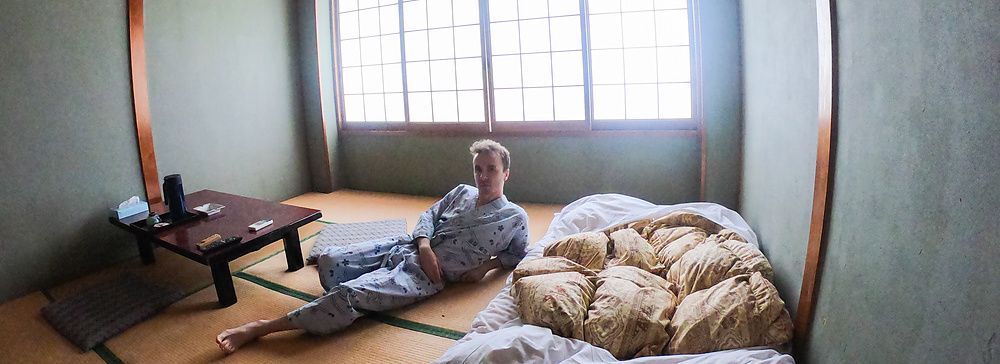
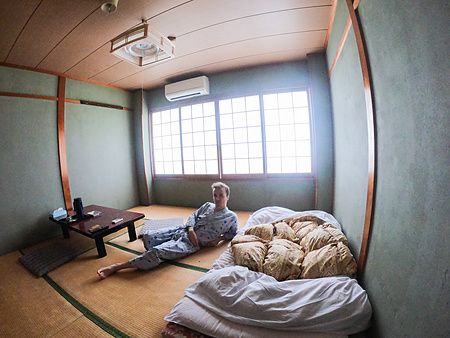
The room is Japanese-style, with tatami. There’s a low wooden table with floor cushions, pale walls and a window with a wooden frame and shoji paper that lets in soft light even when the sun’s strong outside. In the evening the futon is laid out on the floor by the window, pillows and all, and the room turns into your bedroom. I’ll say it up front: it’s as basic as it gets, and I mean that literally. No huge TV, no sofa, no furniture out of a magazine. You arrive, put on your yukata and stretch out on the tatami, and that’s enough for me.
It’s a traditional futon. If you’re not used to it, it’ll feel firmer than a mattress the first night, but you get used to it. Bathrooms and other facilities are shared, like in old Japanese guesthouses, so the room is just for sleeping. For bathing there’s a large shared bath in the inn, with a hair dryer already there, so you don’t need to bring one.
You can choose from:
- Tatami room for two: the basic option, with a low table and futons, good for a couple or someone traveling alone.
- Tatami room for three or four: the same setup with more tatami and more futons, for a family or a small group of friends.
- Group room for five or more: for groups heading up the mountain together, on a pilgrimage or a hike, for example.
If you’re traveling with a big hard-shell suitcase, you’ll see the problem right away. Open it on a tatami floor and it takes up half the floor, and at night, when the futon comes out, you’ll be shoving it into a corner. If you can, come up to Yoshino with a backpack or a soft bag and leave your main luggage in the city.
When you book, tell them exactly how many of you there are and whether you want dinner. Everyone eats together at the same time here, and if they know you’re coming, they’ll have food ready for you. This isn’t the place if you want a Western-style bed or a ryokan where staff in kimono bow at every door. That’s the style of the place, not a shortcoming. Taikoban is a home that takes in travelers, and you can tell the moment you take your shoes off at the entrance.
Price-wise, it doesn’t cost much, and for that you get home cooking, a room to yourself and a bed right on the cherry blossom mountain. People who come to Yoshino usually choose between a ryokan with a hot spring bath with a view, which costs quite a bit more, and heading back to the city for the night. Taikoban falls in between, and it’s the easiest way to stay on the mountain after sunset.
It’s where I send people who ask me where to stay in Yoshino without spending a fortune. When you get back after a day of walking from temple to temple, there’s a hot dinner waiting and someone who asks how your day went. For cherry blossom season, from late March into April, book well ahead. Yoshino fills up in those weeks, and a place like this is the first to sell out.
Dinner and breakfast
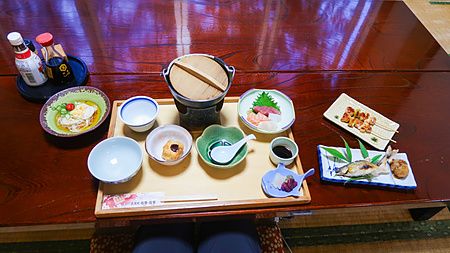
Sit down to eat and you’ll see why people come back. It’s home cooking, made by the owner with what the mountain and the Yoshino River provide: mountain vegetables, river fish and seasonal dishes. Dinner comes on a wooden tray set on a polished table, with lots of little bowls lined up side by side. There’s sashimi, skewers, grilled fish and other small Japanese dishes, each a small portion, but together they leave you properly full.
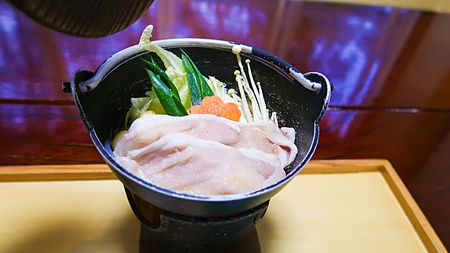
Next to the tray sits a small cast-iron pot on a little burner that’s lit in front of you. Inside are raw meat, leafy greens, enoki mushrooms and a carrot cut into a flower. You wait for it to boil and then cook it all yourself, a piece at a time. It’s a meal you take your time over, in your yukata, chatting away.
Taikoban is also, first and foremost, an eel restaurant. On the ground floor they serve grilled unagi with sweet sauce over rice, and in summer eel and river fish also show up in the overnight guests’ meals. If you have it for lunch, don’t expect the kind of eel you get at Kansai’s famous restaurants. This is eel cooked the simple way in a mountain village, eaten after the climb.
Breakfast is Japanese, so no pastries or drip coffee, just rice, soup and small savory dishes. It’s the right breakfast before tackling the climbs on Mount Yoshino, and for me the meals are Taikoban’s real strength. The food is good, there’s plenty of it, and you get dishes you’d otherwise only find at much higher-end ryokan.
The staff
Taikoban is run by a family, and you can tell. They’re kind without any fuss or formality. They welcome you, show you your room, tell you where the bathrooms are and what time meals are served, and if you ask about trails or temples, they’re happy to tell you what to see and which way to go. On a mountain like Yoshino, where the temples and shrines are spread out along kilometers of uphill road, that really helps.
English isn’t their strong point, but with a few words, a smile and the map on the table, you’ll always manage to communicate. Besides tourists, the guests include yamabushi, the pilgrims who climb the mountain to practice Shugendo, the mountain religion that started right around here. Running into them at dinner or in the hallway gives you a sense of where you are.
Taikoban is one of three inns run by the same family on the mountain. The highest of them, Kamukamu, has a large bath with heated stones, and Taikoban guests can use it for a small extra charge. Ask how it works when you arrive, since it’s in a different building.
The area
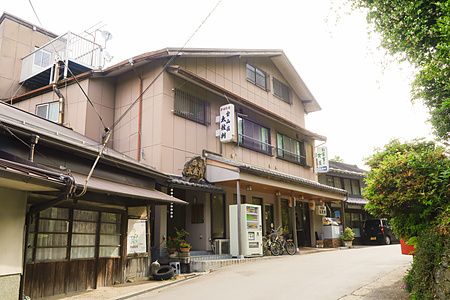
The inn is a house a few stories tall with a facade in muted colors, facing the uphill road that runs through Yoshino village. The same road is lined with souvenir shops and people selling kuzu, the root starch the area is known for, and farther up are the main temples, like Kinpusenji with its huge wooden hall. During the day, especially in spring, there’s a constant stream of people going up and down.
Evenings are a different story. Once the day-trippers leave, the shops close and the street empties, and all that’s left is the dark of the mountain and the forest all around. You sleep in silence, and early in the morning you head out before the tour buses arrive.
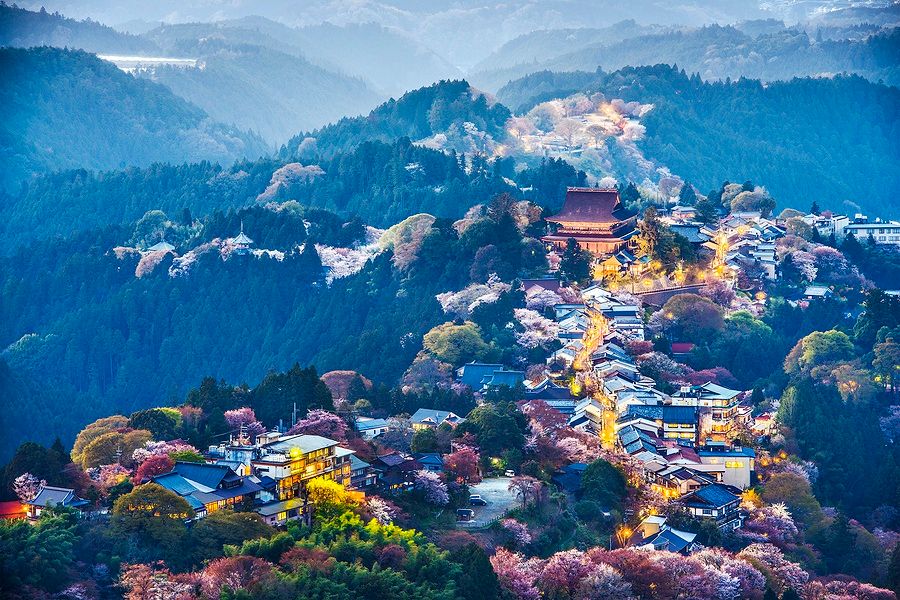
That’s why staying the night in Yoshino is different from a day trip from Nara or Osaka: the only time you see the cherry blossom mountain without the crowds is in the evening and at dawn. Off season, in summer or in fall with the red leaves, the village is even quieter, and Taikoban becomes the place to come back and rest after a whole day walking in the woods.
At a glance
Pros:
- home cooking with mountain and river dishes, including the little pot on the burner
- kind family with tips on what to see on the mountain
- you sleep on the mountain on a budget
Cons:
- shared facilities, no private bathroom
- basic tatami room, just futons and a low table
Best for: anyone who wants to spend one or two nights in Yoshino, eat well and save money, without needing hotel comforts
Atmosphere: old mountain guesthouse, tatami and shoji, yukata at dinner, pilgrims and travelers at the same table
Final thoughts
There’s a moment in the evening at Taikoban when everything falls into place. The pot is bubbling on its little burner, the flower-shaped carrot floats among the enoki, and the shoji window goes dark as the street outside empties. Back in your room, the futon is already laid out, and outside the mountain sits there, still and silent.
The next morning you head out early, when the only people on the road are pilgrims and a few shopkeepers opening up, with cool air rising from the woods. For an evening like that, if you’re passing through Nara, head up the mountain and stay the night at Taikoban.
Getting There
From Osaka, the easiest way is the Kintetsu train from Osaka Abenobashi Station to the end of the line at Yoshino. On the limited express it takes just over an hour.
From the station you ride the Yoshino Ropeway up to the village (at certain times of year a bus runs instead), then keep going uphill on foot along the main street to the inn.
Taikoban also has a shuttle from the station at Yoshino. Ask for it when you book.
Useful Info
- Kintetsu Yoshino Station (Kintetsu Yoshino Line): end of the line, inn shuttle by reservation
- Yoshino Ropeway: from Senbonguchi Station up to Yoshinoyama
Map
This place is on MarcoMaps
Taikoban
My map of Japan: over 4,000 places I've tried myself, each with photos, rating, and hours. Filter by category and rating, find veg-friendly spots and places near you with GPS. No sign-up, right from your phone.
- 4,000+ places
- Rating, photos, and hours
- Veg friendly
- Near me (GPS)
- Favorites without login
- Works offline

