Tenjinbashisuji
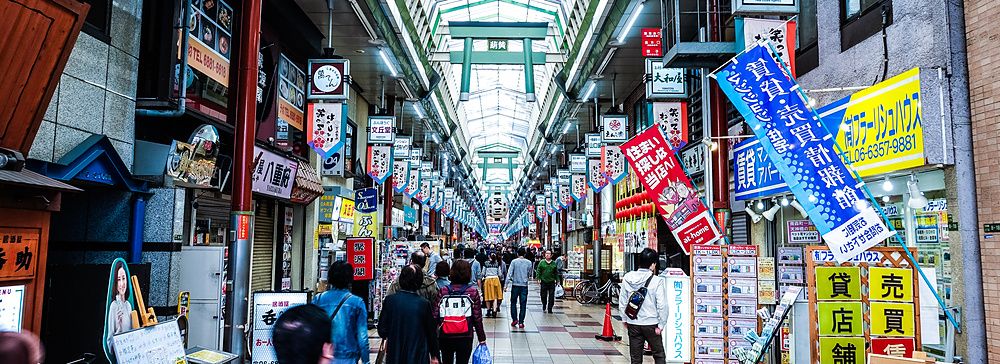
A covered shopping street running south to north through Osaka’s Tenma area, with shops crammed together along a stretch that seems to go on forever. You come here to walk, eat standing up and watch a neighborhood go about its day.
Tenjinbashisuji is the longest in Japan. It has a shrine at one end and a museum at the other, but most of it is open shutters, fryers, tofu stands and bicycles going past. Locals do their shopping and eat dinner here, and you can tell.
Come if you want to spend an afternoon seeing everyday life in Osaka, if you like eating while you walk, and if you want somewhere where the weather doesn’t matter.
Contents
What you’ll see
What you’re here to see is the street itself, not any single sight: an arched roof overhead, overlapping signs, and a different trade every hundred meters. Still, there are a few specific stops to watch for along the way.
- Osaka Tenmangu: the shrine just off the arcade, toward the south end. There’s a gravel courtyard, the smell of incense and hundreds of wooden plaques covered in students’ wishes, because this is where people come to ask for help with their exams.
- Tenma Tenjin Hanjotei: the rakugo hall right next to the shrine grounds, where a single performer kneeling on a cushion tells comic monologues. Even from outside you’ll recognize it by the board with the names and the row of lanterns.
- The different sections: the arcade changes height, shape and color as you head north, with torii designs overhead, red lanterns and the big summer festival dolls hanging above the entrances.
- Osaka Kurashi no Konjakukan: at the north end, inside a building, a whole piece of Osaka from two centuries ago has been rebuilt at full scale. You can actually walk into the wooden houses, and the lighting cycles from dawn to night while the sounds change with it.
- Neighborhood shops: knives, tea, tofu, used books, stamps, kimono, futon, pharmacies, variety stores. This is what makes the walk different from a mall.
- Ura-Tenma: the alleys that branch off beside the arcade in the middle stretch, with tables outside, plastic tarps and grills fired up. In the evening, that’s where the crowds head.
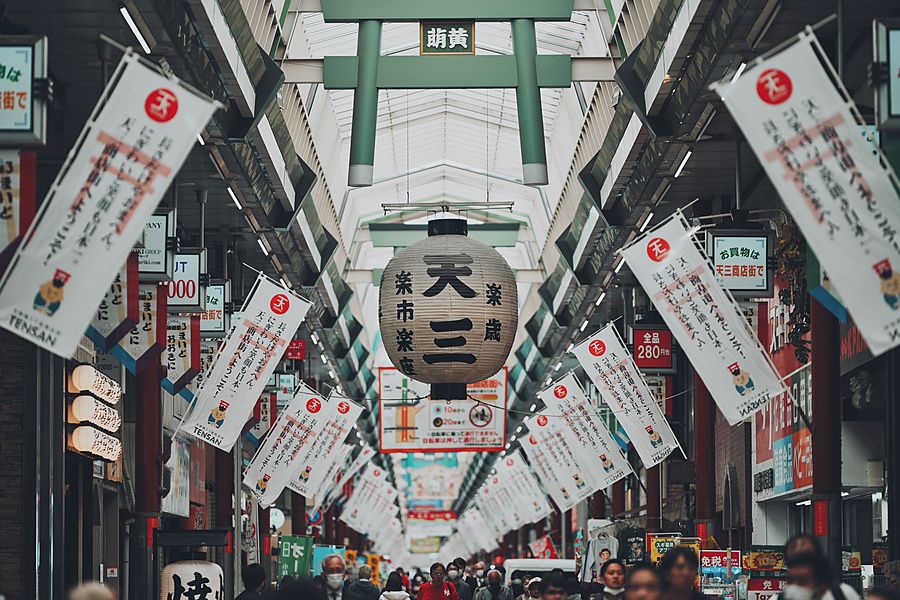
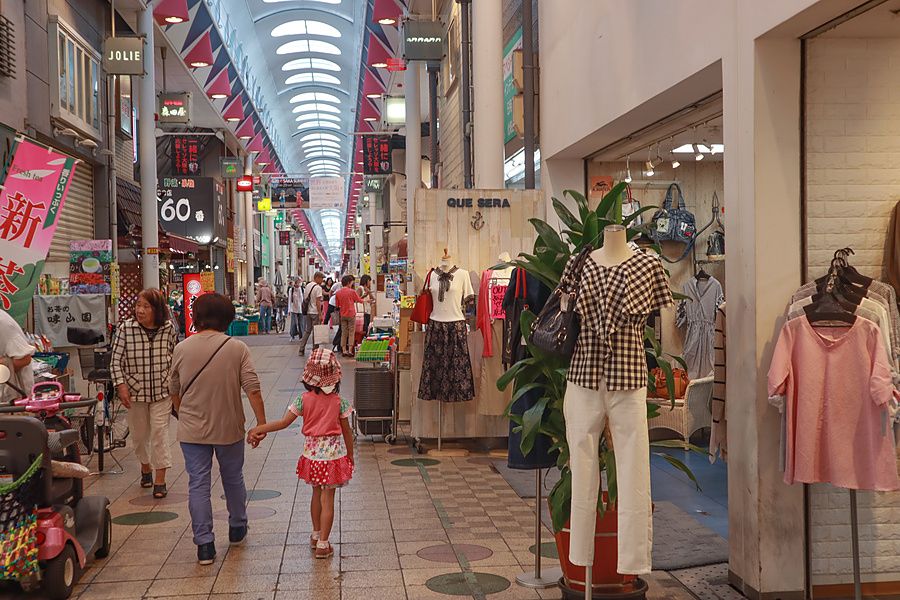
Some stretches are better than others. The stretch from the shrine end through the third section is where the food is concentrated, along with the old signs and the tourists. Heading north it turns into everyday shopping, with linen stores, hair salons and pharmacies, and you walk faster because there’s less to stop and look at.
The museum at the north end is the part people skip most, and for me it’s what ties everything else together. After walking so far past neon signs and fryers, stepping into a wooden house and watching the light change is the best moment of the day. If you want to see it while your legs are still fresh, walk from the north end toward the shrine, not the other way around.
Then there are the bikes. Signs ask riders to get off and walk, and half of them pedal through anyway, bell and all, so walk in a straight line and don’t stop suddenly in the middle of the walkway.
If you’re looking for order, greenery or a nice view, there’s none of that here. Overhead you get a plastic roof and a row of signs, and on both sides the goods are stacked right up to the edge of the walkway. People who like spotless, polished places come away puzzled, but if you like people-watching, this street gives you more than any redeveloped neighborhood.
I spend the afternoon here every time I’m in Osaka with someone who hasn’t seen it, because it’s where I eat five different things one after another and still find a shop I hadn’t noticed the time before.
Why it’s so long
There’s a clear reason for the length. The street started out as a shrine approach, the road that led worshippers to Osaka Tenmangu, and close by was the big Tenma vegetable market, one of the city’s most important markets in the Edo period. Between the pilgrims and the merchants, shops kept opening one after another, farther and farther north.
The roof and today’s signs came much later, but the idea hasn’t changed: a street where you buy things, not one for window shopping.
That’s why the arcade is split into numbered sections, from the first near the shrine to the seventh toward the museum, and each one has its own association that decides on decorations, colors and festivals. It’s also why the roof and decorations keep changing as you head north.
When to go
The best time is late afternoon running into the evening. The arcade lights come on, the fried-food stands are going full tilt, and in the side streets the outdoor tables start to fill up. Once it gets dark the sound changes completely: the noise of shoppers gives way to the chatter of people over beers.
Midday brings the lunch rush, with real lines outside the two or three famous places and people eating standing up, leaning against the walls.
On weekdays there’s room to breathe. In the northern stretch you’ll run into older locals pulling shopping carts, moms with child seats on their bikes and shop staff setting out their goods. On Saturday and Sunday afternoons, though, the south end moves at a crawl, and getting past someone means squeezing between two displays.
Rain changes nothing, and that’s the arcade’s big advantage. While it’s pouring outside, you stay dry from start to finish in the arcade, and those are exactly the days when the street is busier than usual.
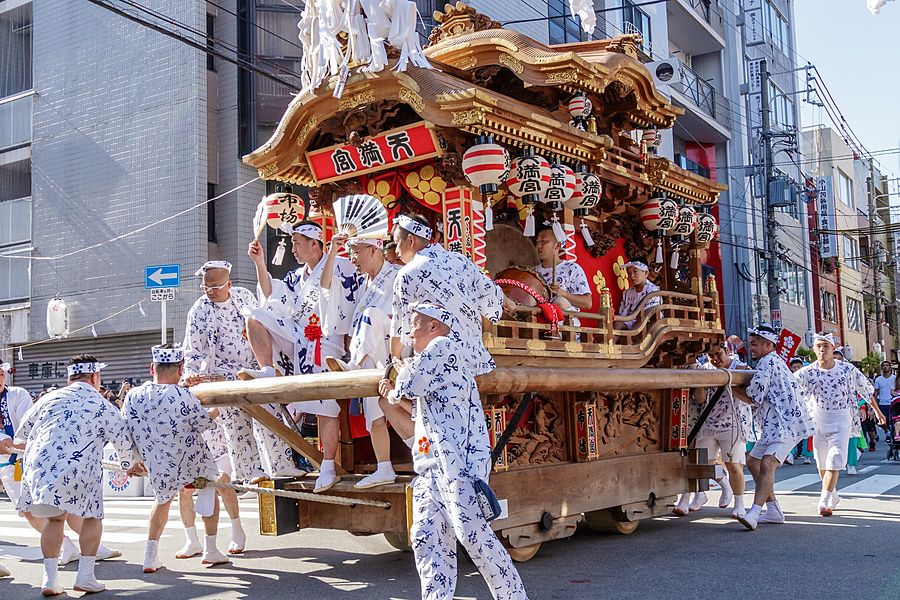
In summer the roof keeps off the sun but not the humidity, and by mid-afternoon the air inside the arcade is still and hot. The fans hanging in the shops don’t help much. If you’re coming in July, find out about the Tenjin Matsuri, the shrine’s big festival: on those days a flood of people pours in along with the floats and food stalls, and walking here becomes a real struggle.
Winter changes very little, which is another point in its favor. It’s one of the few places where the cold won’t ruin your day out.
What the walk is like
Walking the whole thing takes you from one neighborhood into another, and your legs feel it. It’s flat, with no stairs or slopes, but there are no benches either, and the places to sit down are the cafés and bakeries. With small kids and a stroller you’ll get through the north end easily, while the south end at lunchtime turns into a slalom around lines, sandwich boards and people stopped to look at shop windows.
Comfortable shoes aren’t just the usual advice here: you actually need them. End to end, it runs about 2.6 kilometers and has around 600 shops. Without stopping it takes almost an hour, but with breaks to eat and poke around, the full walk takes up the whole afternoon.
The width keeps changing. Some stretches are roomy enough for three people side by side with a cyclist going past, while others get so narrow that the goods on display brush your shoulder.
You don’t have to go all the way to the end. Every cross street takes you out into the ordinary neighborhood, with houses, small temples, coin laundries and little places with four stools. Walk a stretch of the arcade and then pick a side street at random. That’s what most people never do.
In the northern stretch, lower, older covered arcades cross the main one and run off to the left and right. They’re short and I’d recommend going in, because that’s where you still find shops with wooden counters and owners who chat with everyone who walks by.
Eating on the go
Food is the real reason to come. At Nakamuraya there’s a line for potato croquettes fried to order, which come out scalding hot in a paper bag that turns see-through. You’ll buy three, thinking one would be enough.
In the northern part, at the entrance to one of the side arcades, you’ll find Umaiya, one of the oldest takoyaki stands in the city. It’s a bare-bones counter with two tables, and the balls are soft inside and crisp outside, without mountains of sauce on top.
For seafood, Harukoma is the place with the line outside. The fish is cut and the sushi served right in front of you at the counter. The portions are normal, and customers keep coming and going. If you’d rather have something on a skewer, there are kushikatsu stands along the street with the rule written on the wall: you dip in the sauce once, and no double-dipping.
Then there are the things you don’t go looking for but just come across: the tofu stand with soy pudding you eat with a little plastic spoon, old-style cafés with fake-leather armchairs, shops frying fish balls, and fruit stands selling pineapple slices on a stick.
In the evening the action shifts to the side streets, where people drink standing up in the steam from the grills, using old beer crates as tables. It’s the part of Osaka that best explains why this city eats the way it does: nothing fancy, everything hot, everything fast, and people talking loudly.
At a glance
- The highlight: the arcade that never ends, with food stands and neighborhood shops side by side.
- When to go: from late afternoon on, on weekdays. On weekends the south end is packed.
- Best for: people who want to see everyday Osaka, people who like eating on the go, and anyone with a rainy day to salvage.
- Atmosphere: loud and no-frills, with neon, fryers, bike bells and locals doing their shopping.
Bottom line
You don’t come here for a monument. You come for the street life that’s been swept away in other parts of Osaka: food you pay for at the counter, shops that sell just one thing, and the museum at the north end, which rounds it all off by showing what the neighborhood used to be like.
It’s worth the detour for one specific reason: you eat better here, elbow to elbow with the people who live in the area, than in the places where everyone ends up. If you’re after views, gardens or a quiet stroll, though, skip it without a second thought. It’s loud, narrow and long, and it doesn’t even try to be anything else.