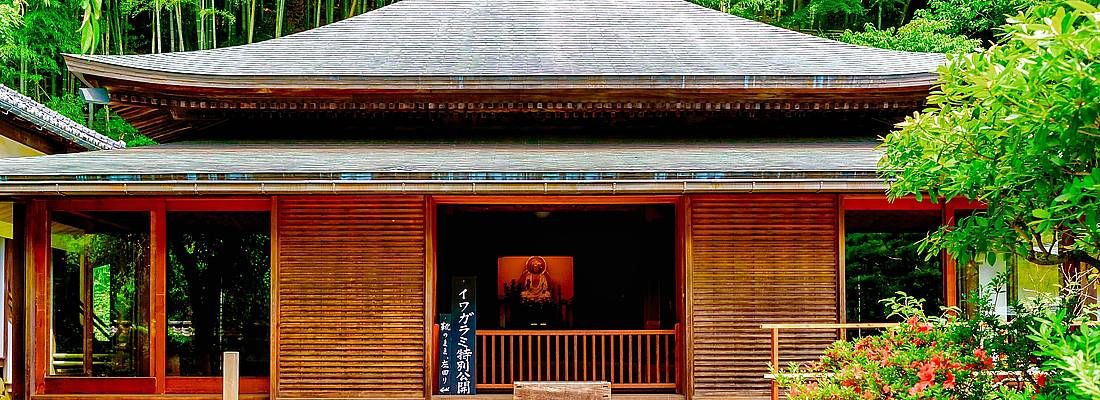
Tokeiji Temple
At Tokeiji Temple, nature and architecture blend so well that each one creeps into the other’s territory, until you can’t really tell where one ends and the other begins. The result is a place with a deep sense of calm, where the colors and scents of each season draw plenty of visitors. The grounds are full of flowers and cherry trees, which give the temple a colorful, romantic setting from spring through fall.
A few of the buildings are closed to the public, but that doesn’t make the visit any less enjoyable. What really makes Tokeiji special is its gardens, along with a fascinating history tied to the protection of women, which sets it apart from other temples.
It sits in the hills of Kamakura, a short walk from Kita-Kamakura Station, and it’s definitely not one to miss.
History
The widow of Hojo Tokimune founded the temple in 1285, and for more than 600 years it served as a convent and refuge for women running away from violent husbands, playing a major role in defending women’s rights. Back then it was the only way out for a wife who wanted a legal divorce. Until the end of the Edo period (1603-1868), a woman who took refuge at Tokeiji and spent 3 years studying and practicing Buddhism there could obtain an official divorce.
To keep the women safe, men weren’t allowed inside the temple.
The temple’s treasure hall holds legal divorce documents from several different eras, and they’re now regarded as an important part of Japan’s cultural and historical heritage.
The law that let the temple grant divorces was abolished in the late 1800s. Tokeiji remained a convent for nuns for a few more years, until it was turned into a Zen training temple in the early 1900s.
Getting There
From Tokyo or Yokohama, take the JR Yokosuka Line and get off at Kita-Kamakura, one stop before Kamakura. Leave the station on the Engakuji side and follow the road along the tracks toward Kamakura. In about 4-5 minutes you'll see the temple steps on your left.
If you're coming from central Kamakura, you can ride the train one stop or take a nice walk of about 25-30 minutes along the road past the Kita-Kamakura temples.
Useful Info
- Kita-Kamakura Station (JR Yokosuka): 4-5 minutes on foot
- Kamakura Station (JR Yokosuka, Enoden): 25-30 minutes on foot, or one stop by train
Map
This place is on MarcoMaps
Tokeiji Temple
My map of Japan: over 4,000 places I've tried myself, each with photos, rating, and hours. Filter by category and rating, find veg-friendly spots and places near you with GPS. No sign-up, right from your phone.
- 4,000+ places
- Rating, photos, and hours
- Veg friendly
- Near me (GPS)
- Favorites without login
- Works offline


Flowers through the seasons
The real reason to come back to Tokeiji more than once is that every season gives the temple a completely different look. The plum blossoms kick things off in late winter, followed in March by the big white magnolias and then by the cherry trees.
June is probably the most unusual time to visit. Besides the hydrangeas and irises, the damp rock walls bloom with iwatabako, delicate little purple flowers that grow straight out of the stone, and there are few other places in Kamakura where you can see them like this.
In the fall, the red leaves of the maples frame the paths, and the whole place feels more hushed and a little melancholy.
Famous names in the cemetery
If you keep climbing past the gardens, you reach the hillside cemetery, one of the most atmospheric corners of the temple, with moss-covered gravestones, stone lanterns and towering trees that filter the light.
Several major figures in twentieth-century Japanese culture are buried here, starting with Daisetsu Teitaro Suzuki, the scholar who did more than anyone to introduce Zen to the West. Next to him lie the philosopher Kitaro Nishida and the publisher Shigeo Iwanami, who founded Iwanami Shoten.
Even if those names mean nothing to you, the climb is worth it. Up here is where you feel the temple’s silence the most.