Tokyo Water Bus
Riding the Tokyo water bus is one of the nicest ways to get between Asakusa and the bay, and I think it should be part of any first trip to the city. You head down the Sumida River under a string of bridges that all look different. The Skytree falls away behind you, Tokyo Tower appears between the buildings, and in under an hour you’re in Odaiba or at Hamarikyu Gardens.
There are two companies, the boats vary quite a bit from one line to another, and the right route depends on how you’ve planned your day. Knowing the differences before you get to the pier saves you a lot of waiting and running back and forth.
Contents
Two different operators
Tokyo’s river boats are run by two different operators, and figuring that out early saves you a lot of confusion when you look up schedules and tickets. The first is Tokyo Cruise, the name the city’s long-established sightseeing boat company goes by. It runs the most departures, has the spaceship-looking boats and uses the best-known piers: Asakusa, Hamarikyu, Hinode Pier, Odaiba Seaside Park and Toyosu.
The second is the Tokyo Mizube Line, run by the organization that manages Tokyo’s metropolitan parks. It starts from Ryogoku, Tokyo’s sumo district and home of the Kokugikan, and connects Asakusa and Odaiba, with some longer trips that head north up the Sumida.
In practice the difference is simple. Tokyo Cruise runs frequent boats every day and is aimed mostly at tourists. The Mizube Line has fewer departures and doesn’t sail every day of the week, but it takes you to places the other one doesn’t go.
Asakusa has two piers as well, and they’re not in the same spot. Tokyo Cruise leaves from under Azumabashi Bridge, down toward Sumida Park, a few minutes’ walk from Asakusa Station. The Mizube Line docks farther north, near Nitenmon, one of Sensoji’s side gates. Check which one you need before you head out, because more people go to the wrong pier than you’d think.
The Sumida River Line
The line almost everyone takes is called the Sumida River Line, and it’s the simplest. It starts in Asakusa, stops at Hamarikyu Gardens and ends at Hinode Pier, between Hamamatsucho and the bay. The ride to Hinode takes about 40 minutes, and you’ll be at Hamarikyu in just over 30.
Boats leave often, roughly every 30 to 45 minutes during the day, and you usually don’t need to book. The fare is low, around 1,000 yen per person to Hinode, and kids pay half price.
A lot of Tokyo Cruise’s classic boats run this route. They’re the more traditional ones, with big windows and often an open deck at the back. They’re not as nice to look at as the spaceships I’ll get to in a moment, but the view is the same and they cost less.
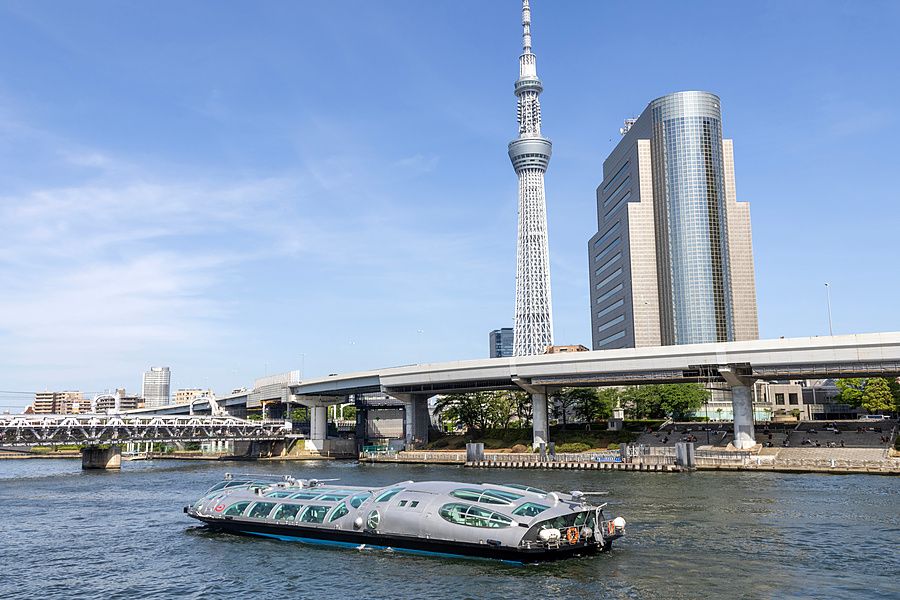
Between Asakusa and Hinode you pass under more than a dozen bridges, each with its own shape and color. The best known are Kiyosubashi, a suspension bridge whose cables trace an elegant curve, Eitaibashi with its big arch, and Kachidokibashi, the old drawbridge that used to open to let ships through. Seen from the boat, only a few meters above the water, they look completely different from when you cross them on foot or by taxi.
Getting off at Hamarikyu
Hamarikyu is the stop I recommend most often. The Tokugawa shoguns built this Japanese garden on the edge of the bay, with saltwater ponds that rise and fall with the tide and a teahouse on the water, and today the Shiodome skyscrapers surround it.
The pier is inside the garden, so when you get off here you walk straight in without going through the gates. The Asakusa–Hamarikyu ticket already includes admission to the garden, which costs a few hundred yen on its own.
The one thing to know is that at Hamarikyu the boats mostly just drop passengers off. If you’re arriving on foot and planning to board here for Asakusa, check carefully before you count on it.
This is my favorite way to do the trip: Sensoji in the morning, the boat in the late morning, then lunch and a walk at Hamarikyu, and from there on foot to Ginza or Shimbashi, which are close by. If fish is more your thing, you can keep going to Tsukiji Outer Market, about a 20-minute walk from the garden.
Himiko, Hotaluna and Emeraldas
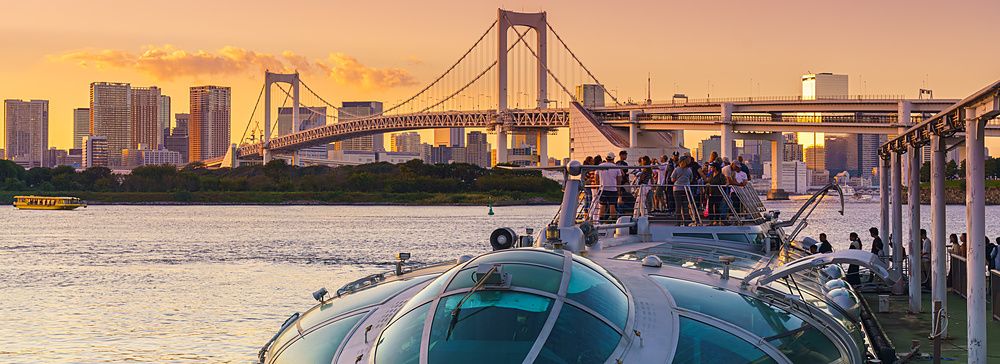
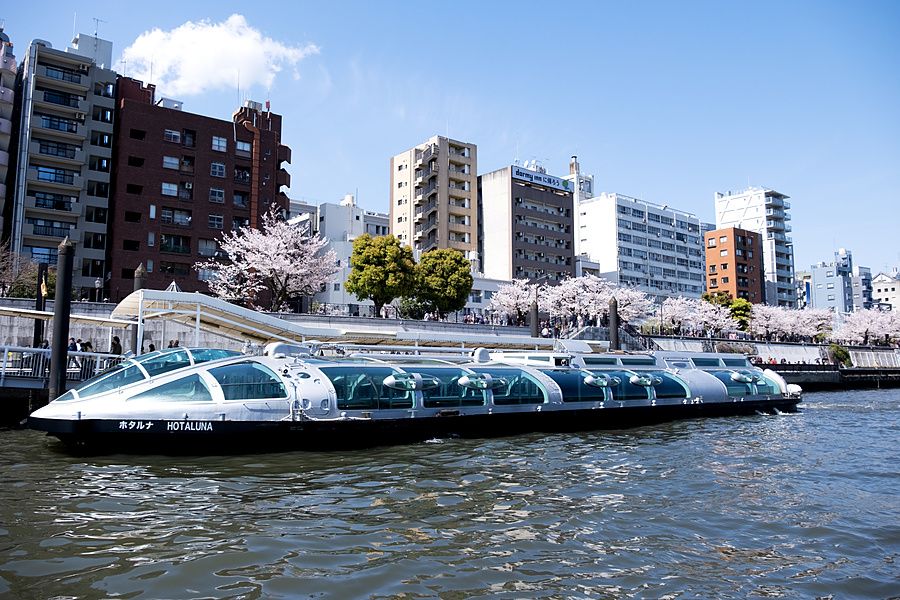
The boats that end up in everyone’s photos are Himiko, Hotaluna and Emeraldas. They were designed by Leiji Matsumoto, the mangaka behind Captain Harlock and Galaxy Express 999, and it shows right away. They’re low, glossy and all curves, with glass that runs up to the ceiling, and they really do look like spaceships parked on the river.
On board, the announcements are voiced by Galaxy Express 999 characters. If you grew up with Matsumoto’s anime, that alone makes the trip worth it.
The three boats aren’t the same, and they don’t run the same route:
- Hotaluna links Asakusa, Hinode Pier and Odaiba, and has an open-air upper deck where you can go up for photos without glass in the way, though it’s only open on the stretch across the bay between Hinode and Odaiba.
- Himiko is fully enclosed and runs the Asakusa–Odaiba–Toyosu route. You’re comfortable inside even in rain or cold, but your photos will pick up reflections from the glass.
- Emeraldas runs the direct route between Asakusa and Odaiba and is the newest of the three, with a very bright interior.
- On all three the crossing takes about an hour and the ticket costs about twice as much as the classic line, around 1,700–2,500 yen depending on the route, but check current prices before you go.
These boats run much less often than the Sumida line, with only a few departures a day, and seats sell out fast, especially on weekends and during cherry blossom season. For Himiko, Hotaluna and Emeraldas I always recommend you book online.
On to Odaiba
Arriving in Odaiba by water feels great. Once you leave the mouth of the Sumida, the river opens up into the bay, the boat picks up a bit of speed and the Rainbow Bridge appears ahead. You pass under it before docking at Odaiba Seaside Park, a short walk from the man-made beach and the Fuji TV building.
From there you can spend the rest of the day checking out the shopping malls, the giant Gundam and the area’s museums, then head back downtown in the evening on the Yurikamome monorail, which crosses the Rainbow Bridge too. Out by boat and back by monorail, you see the bay from two different heights, and it’s one of the routes I most like to suggest to anyone with a free day in Tokyo.
If Himiko or Hotaluna is full, you have two options. One is to take the classic line to Hinode and switch to one of the boats that shuttle over to Odaiba, which is a much shorter ride. The other is the Mizube Line, which connects Asakusa and Odaiba with less flashy boats that have an open deck, at prices similar to the spaceships.
At the Mizube Line pier in Odaiba you can’t pay in cash. It’s card or electronic payment only, so sort that out ahead of time.
The Tokyo Mizube Line
The Mizube Line gets overlooked a lot, and that’s a shame. It’s the right choice if you’ve already done the classic line, or if you want a longer trip on the water without watching the clock.
It operates out of Ryogoku, near the sumo arena and the Edo-Tokyo Museum. From there the boats head along the Sumida and stop at a few small piers on the way: some trips go north as far as Senju, others head down to Odaiba. The long round trip from Ryogoku takes almost three hours, so it’s a real outing, not a way to get somewhere.
There aren’t many departures, though. The boats don’t sail every day, and the schedule depends a lot on weather and tides. Before you count on this line, check the calendar on the official website.
Tickets and reservations
Buying a ticket is easy. On Tokyo Cruise’s classic line you go to the ticket office at the pier a few minutes before departure, pay and get on. For the Matsumoto boats and on busy days you need an online reservation on the official website instead. Booking opens on the first day of the previous month and closes at 17:00 the day before, and the ticket arrives by email.
You’ll find the same tickets on platforms like Klook or KKday, sometimes with a small discount, but booking closes earlier there. If a date shows as sold out, it’s usually still worth going to the pier anyway, because a few last-minute seats often turn up.
A few practical tips to avoid surprises:
- Get to the pier at least 15 minutes early, because a line forms for the most popular boats and the best seats go to whoever boards first.
- Look for seats by the windows. Some boats have rows of seats facing inward, and you can’t see much from there.
- If you get seasick, sit in the middle or at the back, where the boat moves less. On the river the water is almost always calm anyway, and you only feel the rocking out in the bay.
- Keep an eye on the weather. Sailings are canceled in strong wind or heavy rain or when the river is too high, and cancellations are posted on the website the same day.
- Small children usually ride free, one per adult, and kids six and up pay half price.
All the boats have a restroom on board. The recorded announcements are in Japanese and only partly in English, but you don’t need them to enjoy the ride. Just look out the window.
When to go
The best time for the water bus is cherry blossom season, from late March to early April. The banks of the Sumida around Asakusa and Sumida Park turn completely pink, and you won’t see them like that from anywhere but the boat. It’s also the busiest time, so book everything for those days and expect a line even for the regular boats.
Fall and winter are lovely. The light is crisper, and from Odaiba you get a good view of the city skyline too. In summer the heat and humidity hit hard and you bake on the open deck, so I’d pick the early morning boats or the late afternoon ones.
As for time of day, late afternoon departures are my favorite. You reach the bay as the sun goes down, the buildings start to light up, and the Rainbow Bridge glows above you as you pass under it.
The regular boats stop fairly early, though, by early evening. For a real night cruise you’ll need to look at the special cruises or the yakatabune, the traditional boats with dinner on board, which are a different experience altogether and cost quite a bit more.
Is it worth it?
I’ll be honest with you: as a way to get around, it’s not the fastest. From Asakusa to Odaiba, the subway and the Yurikamome take about the same time and cost less, and you’ll get to Hamarikyu sooner by train.
But you don’t take the water bus to save time. You take it to see Tokyo from an angle almost no tourists get to see, with bridges overhead, warehouses and apartment buildings facing the river, people running along the embankments, and the Skytree sitting there behind you for a good part of the trip.
I wouldn’t recommend it if your itinerary is very tight, because you have to fit the best boats into your schedule and that takes some flexibility. It’s a great fit for families with kids, who have a lot of fun on the boat, and for couples with a day to spend on the east side of the city.
People who’ve already been to Tokyo and want something new to do without going far will come away happy too. Let’s face it, after a morning in the Sensoji crowds, sitting for an hour watching the water is a nice break.
If I were you, on a first trip I’d take the classic line to Hamarikyu, at an easy pace, and save Hotaluna for another day, maybe toward evening, so I’d reach Odaiba as the lights come on. And if you feel like coming back for more, there’s always the Mizube Line from Ryogoku. Which pier would you start from?