Toyosu Senkyaku Banrai
A fake neighborhood of dark wood and tile roofs, built right next to the Toyosu fish market, where you eat standing at the counters and wrap up with your feet in hot water, looking out over the bay.
That’s Toyosu Senkyaku Banrai: two or three streets rebuilt in Edo style, stalls selling raw fish and skewers, a real onsen in the building next door and a footbath garden on the eighth floor with a view of the Rainbow Bridge.
Come if you have a free morning and like eating as you walk, or if you want to end the day somewhere warm with Tokyo spread out in front of you. It works fine with kids, but be prepared for lines.
What you’ll see
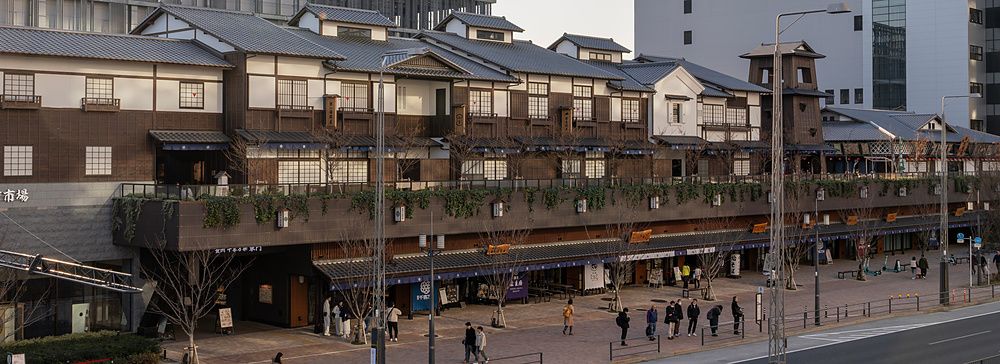
The complex is two connected buildings, a three-level restaurant block and the onsen tower, and the whole thing sits on a sort of raised platform above the street. Inside, the reconstruction is genuinely well done: beams, gray tiles, fabric signs, stone underfoot.
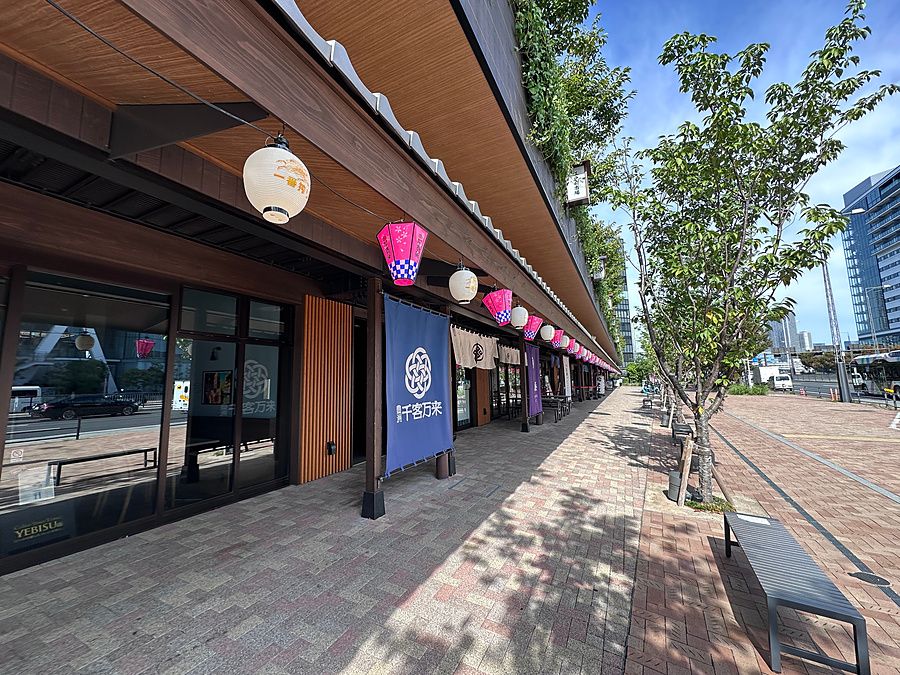
- Toyosu Menuki Odori, the main street: wooden facades on both sides, a canopy overhead and rows of lanterns that light up yellow and purple as evening comes on.
- Mekiki Yokocho, the alley of stalls on the second level: sea urchin, scallops on the griddle, fatty tuna skewers, omelet on a stick. You eat standing up, leaning on the counter.
- The footbath garden on the eighth floor: hot spring water brought all the way here from Hakone and Yugawara, and a raised corner where you can see the Rainbow Bridge, the Toyosu bridge and the wall of apartment towers behind them.
- The bell tower in the central square: this is the Toki no Kane, a bell that marks the hours several times a day, the way bells did in Edo-period towns, with a board for wishing plaques underneath. It’s where everyone meets up.
- The fire lookout tower and the colorful fishermen’s flags hung up high: look up every now and then, because the best stuff is above the shop signs.
- The food court on the third level: the only place where you can buy from three different stalls and then sit down at a table with everything together.
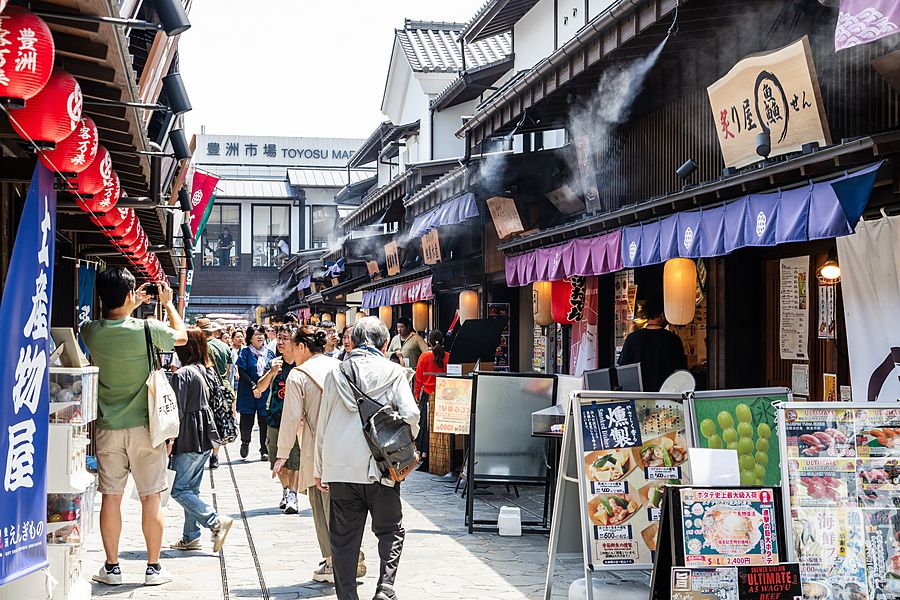
The Toyosu fish market itself is next door, in a separate building. There’s no tuna auction in here and no cold storage. This is the outer market, the part where you eat.
Shopping is practically nonexistent. There’s one souvenir shop and little else, and the rest is all food, so if you’re after things to take home, you’re in the wrong place.
Portions are tiny on purpose. A skewer is two bites, a cone of fried shrimp is three, and the right way to tackle it is to make six or seven quick stops rather than sit down somewhere.
The real problem is finding a seat. The stalls have very few stools, and people eat standing up everywhere, leaning against the low walls. If there are four of you with a small child, head straight to the third level.
It delivers on what it promises. It’s openly a tourist reconstruction with no pretense of authenticity, and it’s genuinely fun, because the fish comes from the market next door and is in a different league from anything you’d get at a covered market rebuilt for tourists.
The eighth floor is what brings me back. When friends visit, I bring them here in the late afternoon: we wander the stalls eating, then go up and soak our feet while the sky changes color over the bay. That’s the part that leaves everyone speechless, and it takes no effort at all.
When to go
Early morning on weekdays is the only time you can walk around normally. By late morning the main street fills up with guided groups, and at the best-known stalls, like the tuna one, the line wraps around the corner.
On Saturdays and Sundays you move at a crawl from one stall to the next, and with a skewer in your hand and people pushing behind you, half the fun is gone. During the long holiday breaks at New Year’s and in mid-August, don’t even bother.
Evenings are a different story, and for me they’re the best time. When the lanterns come on under the wooden canopy, the street fills with light, the groups have thinned out and you’re left with couples and Japanese people stopping by after work.
Up top, meanwhile, the view lights up: the lights on the bridge, the Harumi towers, the traffic on the elevated roads. It’s like two different places a few hours apart.
The seasons matter more than you’d think, because the garden at the top is open to the sky. Between December and March, hot water with freezing air on your skin is the perfect combination, while on a midsummer afternoon there isn’t a scrap of shade up there, and you last five minutes before bolting.
In heavy rain there’s no point going up, and even the main street, though it’s covered, turns into a line of people squeezed together under the canopy.
What it’s like inside
It’s an easy place to get around. You go up and down by escalator and elevator, there are no flights of stairs or slopes, and you can take a stroller everywhere without any hassle. The stone paving is even, which really helps with wheels.
The only thing to figure out is the elevator to the footbath, which is in the onsen tower, not the restaurant building. Ask the staff: they’re friendly and know right away where you’re trying to go.
Up there you take off your shoes, sit on the wooden edge and soak your feet. If you forgot a towel, you can buy one there, and there’s a little stand for drinks.
In the early afternoon on Sundays, every spot along the edge is taken and you have to stand and wait your turn. In the evening, though, you’ll find a spot easily and can just sit there doing nothing.
The inner streets are narrow on purpose, so it really does feel like an old town, but when a group of thirty comes through, it turns into a bottleneck. Going against the flow is impossible: you do the full loop and that’s it.
There’s also the onsen itself, with outdoor baths and rooms where you can stay overnight, so you can go from a day at the stalls to the bath without leaving the complex. Keep in mind that you can’t go into the bathing areas with visible tattoos. The eighth-floor footbath, on the other hand, is open to everyone and has nothing to do with the onsen, so you can go up even if you have no plans to bathe.
The best photo
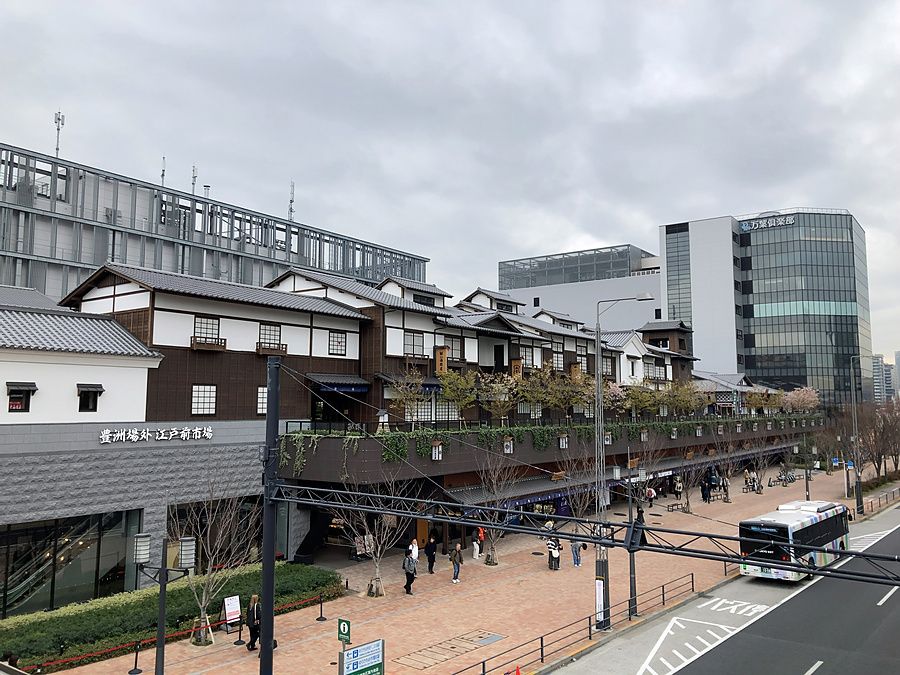
The shot worth taking home isn’t inside. It’s from below. From the road running alongside the complex you can frame the whole block of wooden buildings and tile roofs raised above the street, with the glass towers and construction sites around it. That contrast between the fake old town and Tokyo growing up all around it sums up the whole point of the place in one picture.
Take it after sunset, when the warm lights are on and the sky is still dark blue.
Inside, the spot to shoot from is the entrance to the main street, looking straight down its length with the row of lanterns trailing off into the distance. During the day people’s heads ruin the perspective, but not in the evening.
Up top, head up to the raised corner of the garden. From there the railings don’t block the bridge, and you also get the lit-up complex down below. Wait your turn, because everyone is after that little patch.
At a glance
- Highlight: the panoramic footbath at the top, with the Rainbow Bridge in front of you and your feet in the water.
- When to go: weekdays early in the morning to eat without lines, or after sunset for the lights; winter beats summer.
- Best for: street food lovers, anyone who wants an hour’s break up high, and families with kids, who don’t get worn out here.
- Atmosphere: wood, tiles and fabric signs, constant chatter, people eating standing up, the smell of the griddle and grilled fish.
Conclusion
You don’t come here for history or to buy anything. You come to eat fish straight from the market as you walk, and for that break up high with your feet in the water, which you won’t find anywhere else in Tokyo. It’s worth the detour just for the rooftop, as long as you’re OK with the lines and the small portions.
If you hate places full of tourists, if you’re looking for a working market or if you want a relaxed sit-down lunch, this isn’t for you, and I won’t sugarcoat it. For everyone else, it’s one of the best things anyone has built on the Tokyo waterfront.