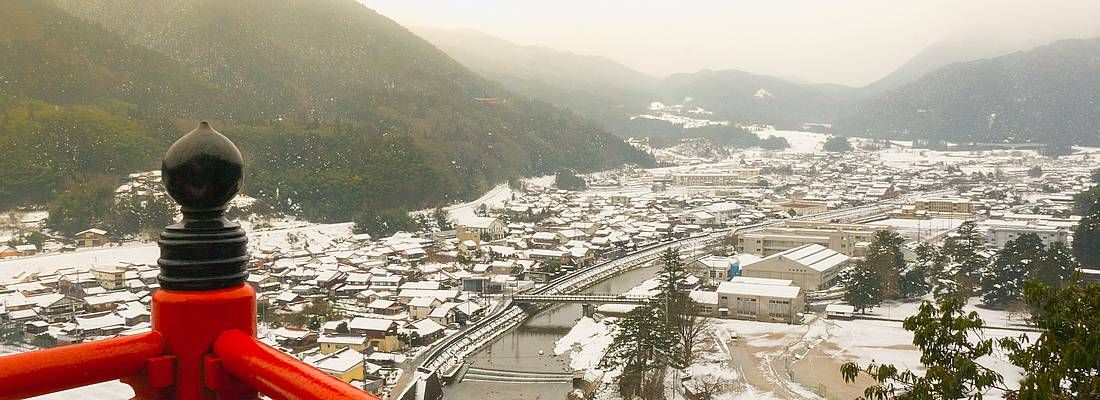
Tsuwano
Surrounded by the green hills of Shimane Prefecture, Tsuwano is a small town with a romantic feel, where the landscape and the old traditions have been carefully preserved. It grew up around a castle built in the 1300s. Mass tourism hasn’t really discovered it yet, even though there’s quite a bit to see, and it’s an ideal place to unwind while you get to know the most authentic, traditional side of Japan. People often call it “Little Kyoto,” and you’re sure to fall for its streets of old samurai residences, its small historic shops and the carp-filled canals that flow slowly through the lanes.
Contents
A walk through the old town
The first thing you’ll notice as you walk around the old town is the red tile roofs. They’re typical of this area, where heavy snow and cold call for a sturdy roof, and besides being practical, they give Tsuwano a look all its own. One of the nicest areas to explore is Tonomachi, the old samurai district, where some of the former residences are now open to the public as museums. Hundreds of koi carp swim in the canal along the street. They’ve been raised here since the Edo period, and people in Tsuwano have always said the carp outnumber the residents. In June it’s even prettier, when Japanese irises bloom along the banks and the patches of purple are reflected in the water next to the white walls of the residences.
The neighboring merchant quarter, between Tsuwano Station and Tonomachi, isn’t as well preserved, but it still has a few historic buildings that are now home to museums and shops selling craft sake.
Have fun getting lost in the maze of narrow lanes. Between the white walls of the houses and the wooden buildings where small shops have been in business for more than a hundred years, you’ll get a real feel for old Japan.
Museums and more
A lot of visitors see Tsuwano on a day trip from nearby Hagi and Yamaguchi, but there’s actually enough here to fill a couple of days without getting bored. For a start, there are several interesting museums, some of them devoted to local figures and artists. One is dedicated to the famous writer and poet Mori Ogai, whose childhood home stands right next to it, and another to Mitsumasa Anno, the illustrator and children’s book author. Other museums focus on local traditions and crafts, like the Yorokan. This was the domain school, founded in 1786, where the sons of samurai studied the Confucian classics, medicine and math alongside the martial arts, and today the historic building hosts exhibits on Tsuwano’s history and local traditions.
The Morijuku Museum of Art is also housed in a historic building, this one 150 years old. It was once the home of the village headman, and it’s been restored and opened to the public as an art gallery. A visit lets you see the inside of an elegant building of great historical value while you look at paintings and artwork by local artists who mix Japanese tradition with a Western style.
Temples, shrines and churches
One of the town’s main sights is Taikodani Inari Shrine, considered one of Japan’s five most important Inari shrines. It was built in the mid-1700s northeast of Tsuwano Castle, specifically to protect the castle and the town, and today worshippers come here to pray for a good harvest, prosperity and luck. The more unusual sight, though, is Tsuwano Catholic Church, built in 1931 by a priest of German origin. From the outside it looks like a typical Christian church, but step inside and you’ll be surprised by its tatami floor.
Just a 10-minute walk from the station you’ll find Yomeiji Temple, which has been a Zen Buddhist temple since 1420. It has a prayer hall with a thatched roof, a lovely Zen garden and a treasure hall full of artifacts and artwork.
The Otome Toge martyrs
The tatami floor in the Catholic church isn’t a one-off oddity. Christianity runs deeper in Tsuwano than you might think, and its story here is a tragic one. In 1868, at the start of the Meiji era, 153 hidden Christians from the village of Urakami, near Nagasaki, were exiled all the way up here and locked in an abandoned temple at Otome Pass. They were put through brutal torture to force them to renounce their faith, and 36 of them didn’t survive.
Just outside the center, the small St. Mary’s Chapel was built in their memory in 1951 by a German priest. Inside, eight stained glass windows each depict a scene from that persecution, and every spring the faithful walk up to the pass in a procession.
The castle ruins
All that’s left of the once-imposing Tsuwano Castle is a few ruins, on top of the hill that rises right behind the town. A fire started by lightning destroyed it in the late 1600s and it was never rebuilt, but the high walls that surrounded it and its foundations still give you an idea of how grand it once was. To get up to the ruins you can take a nice forty-minute walk through the forest, or go the easy way on the chairlift and enjoy the view from above. Once you’re at the top, you can wander around the green space that now covers the castle grounds and stop to take in the beautiful views over the town.
On clear mornings in fall and early winter, the valley fills with fog and only the tops of the hills poke out. That’s what earned the ruins the nickname castle in the sky. It doesn’t last long, because the sea of clouds usually clears by mid-morning, but if you catch it, you’ll go home with the best photo of your whole trip.
Onsen and washi paper workshops
Set aside some time to relax and explore the area around Tsuwano, where you’ll find places like Hori Teien, a large villa with beautiful gardens that’s very popular in the fall for the autumn colors. Tsuwano also has a hot spring area where you can relax in a hot bath in the evening, and the Sekishukan museum and workshop, devoted to washi paper, where you can find out more about what was Tsuwano’s main industry for centuries. At the museum you can join a workshop and learn to make washi by hand, or pick up cute souvenirs like dolls and other things made of paper.
What to eat in Tsuwano
The dish to try is uzumemeshi, a specialty that’s been made here for centuries and is worth a stop all by itself. Fish, vegetables and tofu, cut into tiny pieces, are hidden under the rice in the bowl. Then hot broth is poured over the top, and the dish is finished with a touch of wasabi. The name comes from the verb meaning to bury. The story goes that the ingredients were tucked under the rice so they wouldn’t catch anyone’s eye at a time when the domain was under strict orders to live frugally.
The town’s signature sweet is genji-maki, a thin layer of sponge cake rolled around red bean paste. You’ll find it at the long-established sweet shops in the town center, often made right in front of you, and it’s the classic souvenir to bring home.
Tsuwano’s festivals
Tsuwano holds a few truly unusual festivals that still keep some of the old traditions and dances alive.
The Tsuwano Yabusame festival takes place on the second Sunday of April at Washibara Hachimangu Shrine, at the foot of the castle ruins. There’s a full program of performances and events, and the one everyone waits for is the horseback archery contest. The lively, colorful show is made even better by the cherry blossoms on the shrine grounds, which are at their best right at this time of year.
The Sagi Mai festival takes place toward the end of July at Yasaka Shrine, near Taikodani Inari Shrine, and centers on a very old traditional dance. The two dancers are dressed as a male and a female heron and act out the birds’ courtship dance. Today Tsuwano is the only place in Japan where you can see this dance.
Getting There
The easiest way is to get to Shin-Yamaguchi, a shinkansen stop, and continue on the JR Yamaguchi Line with the Super Oki limited express. It's a little over an hour climbing through the mountains, and it's covered by the Japan Rail Pass. The old town starts a few minutes' walk from Tsuwano Station, and you can get around the rest on foot or by bike, which you can rent at the station.
On weekends and holidays in the warmer months there's a more romantic option: the SL Yamaguchi steam locomotive, which covers the same route in about two hours, with just one run a day.
From Hagi, your best bet is the direct bus run by Bocho, about an hour and a half; by train it takes more than 3 hours with a change at Masuda. From Matsue and Izumo, the Super Oki gets you here without changing trains in about 3 hours.
Useful Info
Among the museums, the Anno Mitsumasa is closed on Thursdays, while the Mori Ogai Memorial Museum and Hori Teien are closed on Mondays.
- Tsuwano Station (JR Yamaguchi Line): terminus of the Super Oki limited express and the SL Yamaguchi
- Shin-Yamaguchi Station (Sanyo Shinkansen, JR Yamaguchi Line): where you change trains coming from Hiroshima and Osaka
- Tsuwano Bus Center: arrival point for Bocho buses from Hagi and Higashi-Hagi
Map
This place is on MarcoMaps
Tsuwano
My map of Japan: over 4,000 places I've tried myself, each with photos, rating, and hours. Filter by category and rating, find veg-friendly spots and places near you with GPS. No sign-up, right from your phone.
- 4,000+ places
- Rating, photos, and hours
- Veg friendly
- Near me (GPS)
- Favorites without login
- Works offline

