
Uguisudani
A Yamanote Line stop right next to Ueno, with a row of love hotels pressed up against the tracks. Uguisudani is more of a handy base for me than a destination in its own right. I’ll be upfront: this isn’t one of the major neighborhoods, it’s not touristy, and those love hotels are the first thing you notice when you walk out of the station.
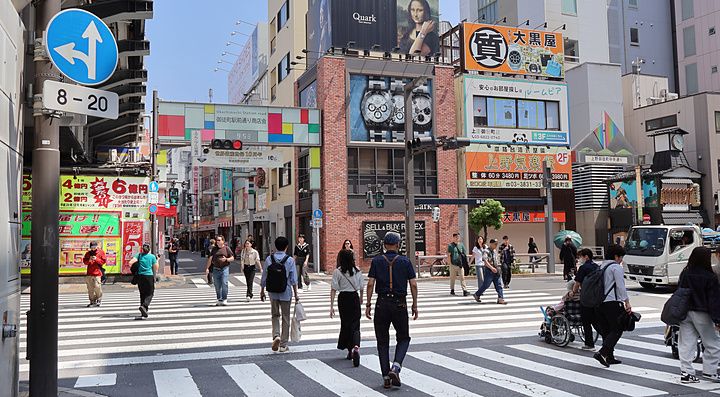
I wouldn’t send you here on purpose for a whole day. But getting off here puts you a few minutes’ walk from the north end of Ueno Park, and the area around the station is still a piece of old Tokyo, the Tokyo of the old downtown neighborhoods.
Think of it as a quirky detour, not something to put on your itinerary.
Contents
Shops
Nearby neighborhoods

Nishi-Nippori
Hongo
The love hotels
There’s a heavy concentration of love hotels around the station, especially on the east side, where they’re packed along the slope running down from the tracks. During the day the signs are switched off and the streets stay quiet. In the evening the neon comes on and you see a completely different crowd.
There’s nothing shady about it, and you can walk around on your own without worrying, since this is still one of the safest cities in the world. If you don’t know how these places work, here’s the short version:
- Rest or overnight: you choose between a stay of a few hours and an overnight stay, and after a certain time in the evening the overnight rate is usually the better deal.
- Low prices: you’re looking at a few thousand yen per room, but rates vary a lot from one place to the next.
- No reservations: you check the panel at the entrance to see which rooms are free and pay discreetly, often without running into anyone.
Lots of travelers also use them as a cheap place to sleep instead of a regular hotel. Just keep two things in mind: rooms are rented for set time slots, and the area around you is still a red-light district, not a shopping street.
The station nobody uses
One number tells you more about this place than anything I could say. Every day 24,000 people board trains at Uguisudani, the lowest figure of any Yamanote Line station, while at Shinjuku, on the same line, it’s over half a million. For years it was the least used station on the loop.
That’s because you can’t transfer to any other line here, and during the day there’s no reason to get off. If you’re going to the museums you stop at Ueno, and if you’re heading to Yanaka you get off at Nippori.
For you, though, that’s a plus. The platforms stay half empty even at the height of rush hour, and one stop from the crowds at Ueno you’re standing in a station that feels like it belongs to a different Tokyo.
Where the name comes from
The name means nightingale valley. The uguisu is a small bird known for its song in early spring, and before Tokyo swallowed everything there really was a small wooded valley here where these birds lived. The story goes that an abbot of Kaneiji Temple in Ueno had a lot of them brought here so he could hear them sing.
All that’s left of the valley today is the change in elevation. The north exit is up high, above the hollow, which is handy if you’re going to Ueno Park and the museums, while the south exit takes you down between the tracks into the old neighborhood of Negishi. Uguisudani doesn’t actually exist as an address. It’s only the station name: the area is really Negishi, and you won’t see Uguisudani on any street sign. The nightingale has survived in one place, though. In the morning, between announcements, you’ll hear a recorded uguisu song on the platform. It’s a tiny detail, but it makes you smile.
Negishi is old downtown Tokyo the way it used to be, all small houses and narrow lanes, and I like it because a few steps from the neon you get small-town quiet. From the Edo period to the Meiji era this was a quiet residential area popular with writers and artists, and it’s still associated with the poet Masaoka Shiki, one of the big names in haiku, who lived here.
If you’re after something different, the Tokyo Kinema Club is also close by. It’s a former cabaret that became a concert hall and still has its postwar feel. Expect shows in Japanese, not big international names, but to me it’s the place that best shows what kind of neighborhood this is.
Masaoka Shiki’s house
In Negishi you can still see Shiki’s house, and it’s the only place in the area you can actually visit. It was originally staff housing at the Maeda family’s residence. Shiki moved there in 1894 and spent his last years confined to his futon with tuberculosis, writing until a few days before he died.
The original house burned down in the 1945 air raids, but his manuscripts survived in the masonry storehouse behind it. What you visit today is the 1950 reconstruction his students had built.
There’s very little inside, and that’s exactly why it works: two tatami rooms, the low desk with a cutout for the leg he could no longer bend, and the window onto the little garden he watched from his bed, the same garden that ended up in his last poems.
Getting There
From Ueno it's one stop north on the Yamanote, but if you're already inside the park you're better off walking: from the Tokyo National Museum area it's a little over ten minutes.
Pick your exit carefully. The north exit leaves you up top, on the side with the park and the museums, while the south exit takes you down into the old neighborhood of Negishi.
From Nippori you're only one stop away, and you can also walk it in about fifteen minutes by following the tracks.
Useful Info
Name: Uguisudani
Time needed: Half an hour to walk around the station, an hour if you also head down into Negishi
Closed: Shikian, Masaoka Shiki's house, is open only on Wednesdays, Saturdays, Sundays and public holidays, and is closed for all of August and from December into January
Tips: Come by twice if you can: during the day it's a low-rise neighborhood, and after sunset the signs light up and it feels like a different place. Also, from the upper exit, look down: that hollow is the nightingale valley the station is named after.
Getting there:
- Uguisudani Station (JR Yamanote, JR Keihin-Tohoku): north exit toward Ueno Park, south exit toward Negishi
- Iriya Station (Hibiya subway line): about 8 minutes on foot
- In the middle of the day Keihin-Tohoku trains go through without stopping, so rely on the Yamanote
Map
MarcoMaps100% free
This place is on MarcoMaps
Uguisudani
My map of Japan: over 4,000 places I've tried myself, each with photos, rating, and hours. Filter by category and rating, find veg-friendly spots and places near you with GPS. No sign-up, right from your phone.
- 4,000+ places
- Rating, photos, and hours
- Veg friendly
- Near me (GPS)
- Favorites without login
- Works offline

