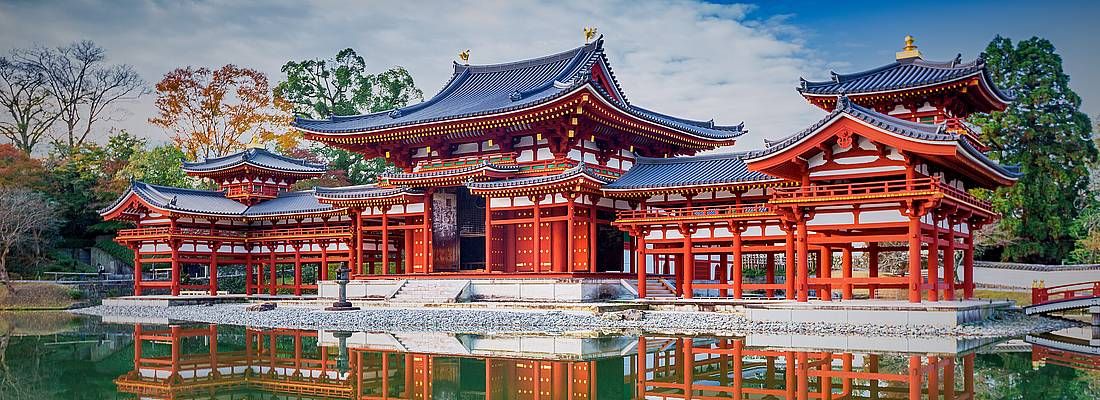
Uji
Uji is a picturesque, elegant little town between Kyoto and Nara. Being so close to the two former capitals turned it into a cultural and religious center, and it has some of the oldest temples and shrines in Japan.
The soft green hills around town are covered in tea fields, and tea is what Uji is famous for. The neighborhoods along the river are said to have inspired “The Tale of Genji,” and Uji Bridge is still a favorite spot for couples.
Uji is only a short ride from Kyoto, so it’s perfect for a day trip or an escape from modern life.
Contents
Uji’s green tea
The story starts with Eisai (1141-1215), the monk credited with bringing Zen Buddhism to Japan. He brought tea seeds back from China and gave them to another monk, Myoe, who planted them first at Toganoo and then chose the hills of Uji for their misty climate. That’s how Uji tea was born, and it soon became famous all over the country for its exceptional quality.
Today green tea is Uji’s biggest draw. Wander along Byodoin Omotesando and stop at its little restaurants and shops to try a wide range of green tea specialties and sweets or pick up some souvenirs. You can also join a tea ceremony or one of the town’s workshops, and visit Tsuen, the oldest tea shop in Japan.
If you’re in Uji in October, don’t miss the Uji Tea Festival, an event devoted entirely to tea that takes place at Koshoji Temple.
What to try in Uji
In Uji you don’t just drink matcha, you eat it. Along the street leading to the Byodoin, the historic tea houses serve layered parfaits, ice cream that ranges from mild and sweet to intensely bitter, and chasoba, soba made with green tea in the dough and served cold with the dipping sauce on the side.
In summer the thing to order is kakigori, a mound of shaved ice drowned in matcha syrup with sweet beans, and all year round you’ll find grilled dango and warabimochi buried under powdered tea. If matcha is too bitter for you, go for hojicha, a roasted tea that tastes almost like hazelnuts, or ask them to pour you some gyokuro, Uji’s real pride and joy. You drink it lukewarm from tiny cups, and it’s so concentrated it’s almost like broth.
Uji’s romantic side
The Uji River runs right through the middle of town and splits it in two. It’s lovely to walk along its banks, taking in the scenery and the settings that inspired Japan’s most famous tale. Near the bridges you’ll find several statues of characters from “The Tale of Genji,” along with a sculpture of the author, the court lady Murasaki Shikibu. If you’d like to know more about the story, head to The Tale of Genji Museum.
Uji Bridge dates back to 646, though it has been rebuilt, and it’s one of the town’s main sights, depicted in many paintings and illustrations. One of the most romantic ways to see the river and explore the town is on a daytime or evening cruise.
Japan’s oldest shrine building
The main hall of Ujigami Shrine dates back to 1060, which makes it the oldest Shinto shrine building still standing in Japan. All that history shows in the mix of architectural styles, since the buildings come from different periods. The shrine is also one of the sites that make up Kyoto’s World Heritage listing, and both the main hall and the worship hall are National Treasures. The main hall sits hidden behind the worship hall, so many visitors leave without ever really looking at it. Next to the entrance is the Kirihara spring, one of Uji’s seven famous springs. People still use it for ritual purification today, and in the past it was used for the tea ceremony.
Uji’s temples
Uji is dotted with beautiful historic temples, each with something that sets it apart. Byodoin Temple is a UNESCO World Heritage Site, and many visitors may recognize it from the 10-yen coin. Mimurotoji Temple is nicknamed the “flower temple” for its lush gardens, while Mampukuji Temple, head temple of the Obaku school of Zen, stands out for the strong Chinese influence on its buildings and gardens. Mampukuji was founded in 1661 by the Chinese monk Ingen, who brought a different approach to Zen to Japan. Walking the corridors, you’ll immediately notice the large wooden fish that sets the rhythm of the monks’ day, and the round, Chinese-style windows. You can also try fucha ryori here, the vegetarian cuisine of the Obaku school. It’s served in dishes meant for sharing and is much richer than the more austere shojin ryori.
Getting There
From Kyoto the easiest option is the JR Nara Line. Rapid trains from Kyoto Station get you to JR Uji Station in about twenty minutes, and from there it's a ten-minute walk along the tea shop streets to the Byodoin.
If you're starting from central Kyoto, you can take the Keihan Line and change at Chushojima. Keihan Uji Station drops you right on the riverbank, a short walk from the bridge and the way up to Ujigami Shrine.
From Nara it takes about half an hour, again on the JR Nara Line. For the Mampukuji, get off one stop earlier at Obaku, and for the Mimurotoji, get off at Mimurodo on the Keihan Line.
Useful Info
- JR Uji Station (JR Nara Line): 10-minute walk to the Byodoin
- Keihan Uji Station (Keihan Uji Line): next to the bridge, on the shrine side
- For the more out-of-the-way temples, trains also stop at Obaku (Mampukuji) and Mimurodo (Mimurotoji)
Map
This place is on MarcoMaps
Uji
My map of Japan: over 4,000 places I've tried myself, each with photos, rating, and hours. Filter by category and rating, find veg-friendly spots and places near you with GPS. No sign-up, right from your phone.
- 4,000+ places
- Rating, photos, and hours
- Veg friendly
- Near me (GPS)
- Favorites without login
- Works offline


Uji through the seasons
Uji changes a lot from season to season, so it’s worth picking the season for your visit. In spring the cherry blossoms are reflected in the Byodoin pond and line the riverbanks. From late April to early July Mimurotoji fills first with azaleas and then with thousands of hydrangeas, and on some evenings the garden stays open and lit up.
In summer there’s ukai on the river, night fishing with cormorants, and in Uji it’s mostly women who do it. In autumn red maple leaves set the riverbanks and temple courtyards ablaze, while winter is the quietest season and the best time to enjoy the tea houses.