Yoyogi
If you want to be right next to Shinjuku without getting swallowed up by all its chaos, Yoyogi is your stop.
It’s on the Yamanote Line, squeezed in between Shinjuku and Harajuku, so a few minutes on the train puts you among the skyscrapers or in the middle of the Takeshita-dori crowds. Step out of the station here, though, and the mood changes: narrower streets, lots of students, small izakaya and offices. This isn’t a bucket-list neighborhood. It’s a place where people live and eat well without spending much. I’ll walk you through what’s around, what to eat, and why this isn’t the station for the park.
Contents
Restaurants
Nearby neighborhoods


Aoyama
Yotsuya
Students and izakaya
Yoyogi is an area of private schools, office buildings and homes, not shops aimed at tourists. During the day, the people you see around the station are mostly kids from the cram schools that prep students for university, plus people on their way to work. What sums it all up is the Yozemi tower, the cram school skyscraper that rises next to the tracks: twenty-six floors of classrooms, study rooms and even a dorm for students from outside Tokyo. Once you spot its outline, you’ll always know which way the station is, and you’ll also get why the neighborhood skews so young.
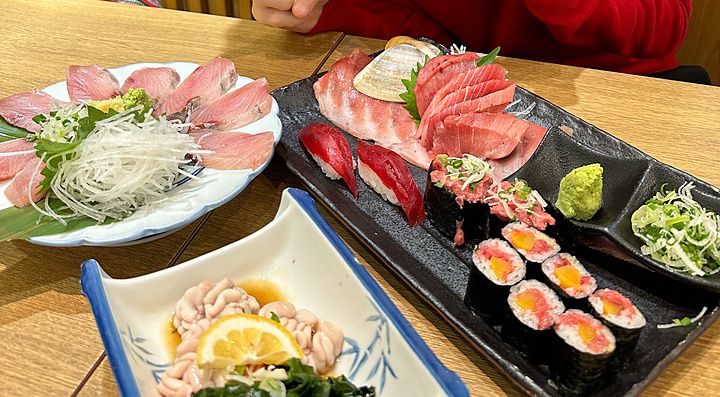
In the evening the backstreets fill up with small izakaya, Korean places and chain restaurants where you can eat for very little. Here a set menu with lots of dishes and unlimited drinks still comes at a low price, one students can afford. If you want a simple dinner before or after Shinjuku, I think this is the right place: fair prices, no crazy lines, and proper tables where you can sit and take your time.
Don’t expect fancy places or views from up high. You come here for everyday Tokyo, the side of the city a lot of travelers never stop to look at.
The skyscraper with the clock
As soon as you leave the station, look up. That pointed spire, which looks like something out of 1930s New York, belongs to the Docomo Tower. At more than 240 meters, it dominates the neighborhood, and you can see it from a good chunk of Tokyo.
On its north side there’s a huge clock, fifteen meters across, with hands that weigh about a ton each. For years the building was the tallest clock tower in the world.
You can’t go inside, though. It’s not an observation deck but a building full of offices and telephone exchanges, closed to anyone who doesn’t work there. Still, it’s the handiest landmark you’ve got around here: whatever backstreet you’re in, you look up and immediately know which way the station is.
The park is elsewhere
Yoyogi Park itself is farther away than the station name suggests. If what you’re after is the big lawn with trees and people walking their dogs, get off at Harajuku or at Yoyogi-koen station, both much closer to the entrances.
Over on the park side, though, there’s something worth the detour: Kenzo Tange’s National Gymnasium, built for the 1964 Olympics, with that suspended roof that seems to bend all on its own. It’s one of the most beautiful buildings in postwar Tokyo, and even from the outside it’s worth a couple of minutes. It’s all in the cables. The roof doesn’t rest on columns inside: it hangs like a suspension bridge, from two big masts on the main arena and from a single one on the smaller arena. That’s why there’s not a single column inside blocking your view. The Japanese government has listed it as an Important Cultural Property, which is extremely rare for a postwar building, and both arenas still host sports events and concerts. If you happen to be there when there’s an event, you can go in and see it from the inside.
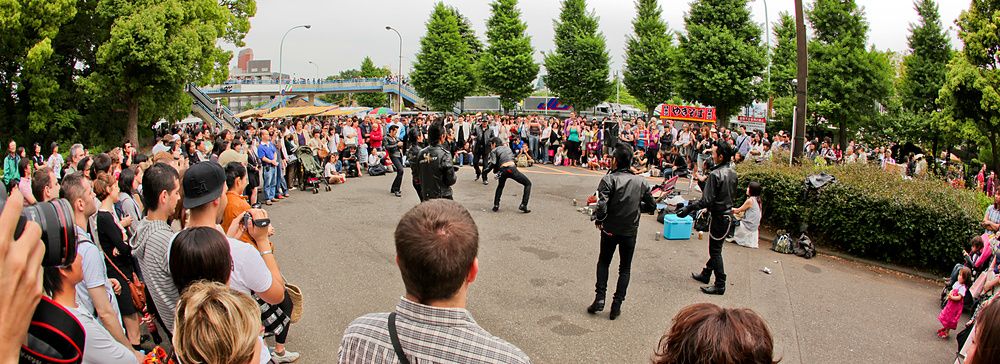
On Sundays the rockabilly dancers gather at the Harajuku-side entrance to the park: leather jackets, slicked-back pompadours and 1950s rock and roll at full volume.
I almost always pair Yoyogi with a walk over there, because in half an hour on foot you go from the izakaya where students hang out to one of the wildest and most fun scenes in the city.
Is Yoyogi a good place to stay?
If you’re still figuring out where to stay in Tokyo, Yoyogi is one of those smart choices hardly anyone makes. You’re one stop from Shinjuku and one from Harajuku, so you can get anywhere fast, but at night you come back to a quiet street instead of the madness of Kabukicho.
The hotels here are almost all business hotels: small, basic rooms, no views and no luxury, but you pay less than you would a few hundred meters away.
The one thing to watch is which side of the station the address is on. With the tracks in between, a hotel that looks really close on the map can turn into a long walk around.
Getting There
Yoyogi is the next stop after Shinjuku on the Yamanote Line, a couple of minutes by train, and it's just one stop from Harajuku going the other way.
If you're not in a hurry, you can also walk from Shinjuku in about 15 minutes: take the south exit, then cross over the tracks.
Once you're there, the exit you pick matters. The west and north exits face the greenery of Meiji-jingu and also lead to the Oedo Line, while the east side is the residential side, with backstreets full of small places. If you're aiming for the park entrances, you're better off staying on the train one more stop.
Useful Info
Name: Yoyogi
Time needed: A couple of hours to walk around the station and have dinner, half a day if you add the walk toward the park and the gymnasium
Tips: Come to Yoyogi in the evening, not during the day. That's when the backstreets behind the station light up with small izakaya and Korean places at student prices. And if you're headed for the park, don't get off here. You want a different stop.
Getting there:
- Yoyogi Station (JR Yamanote, JR Chuo-Sobu): west, north and east exits
- Yoyogi Station (Toei Oedo): connected to the JR west and north exits
- On foot from Shinjuku: about 15 minutes
Map
MarcoMaps100% free
This place is on MarcoMaps
Yoyogi
My map of Japan: over 4,000 places I've tried myself, each with photos, rating, and hours. Filter by category and rating, find veg-friendly spots and places near you with GPS. No sign-up, right from your phone.
- 4,000+ places
- Rating, photos, and hours
- Veg friendly
- Near me (GPS)
- Favorites without login
- Works offline

