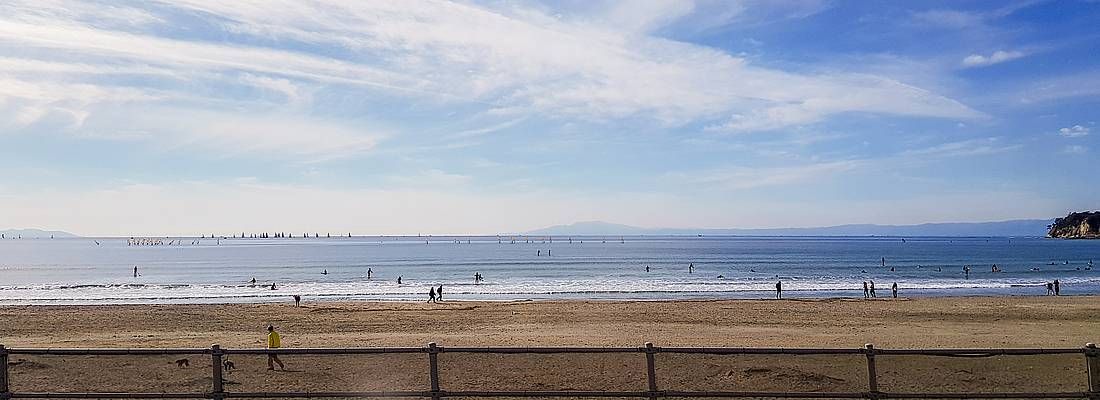
Yuigahama Beach
Kamakura has plenty of beaches, and in summer they’re a favorite getaway for people from nearby Tokyo and Yokohama. Beach facilities are officially open from July through August, but on any nice day the rest of the year you can still take a pleasant walk along the shore and relax in the sun, or watch the sunset to the gentle sound of the waves breaking on the sand. The most popular of Kamakura’s beaches is Yuigahama, which stretches along Sagami Bay not far from Enoshima, an island that’s another big draw for visitors. If you’re traveling in summer, it’s worth taking a short trip out here to enjoy the sea and everything else the area has to offer.
Contents
What to do at the beach
Yuigahama gets a lot of visitors in summer, so you may find it a bit crowded, especially on weekends. Besides room to lie in the sun and water that’s good for both swimming and water sports, you’ll find plenty of facilities: shops renting out water-sports gear, beach umbrellas and other beach accessories, plus a few snack bars and stalls selling food and drinks. The seabed slopes very gently and the water stays shallow a long way out, which is one reason you’ll see so many families with kids at Yuigahama.
The beach runs for almost a kilometer, and past the mouth of the Namerigawa River it continues without a break into Zaimokuza Beach. If the middle stretch feels too packed, just walk east and you’ll find a lot more space.
Yuigahama is especially popular with people who surf and windsurf: almost every day you’ll see windsurf sails out on the water, and you can sign up for surf lessons at places right by the beach.
Away from the central stretch you’ll also notice the simple fishing boats and the wooden structures the fishermen use for their work, which give the place a picturesque, slightly old-fashioned look. In summer the fishermen’s constant activity fades into the background, but in winter it’s practically the only sign of life on an almost deserted stretch of sand, and you get to see real everyday life up close.
Beach houses
Every summer the umi no ie, known as beach houses, pop up on the sand at Yuigahama. They’re wooden structures put up at the start of the season and taken down at the end of August, when the beach goes back to being empty as if they’d never been there. You’ll find quite a few lined up side by side, each with its own style and its own crowd.
Inside there are showers and lockers, plus loungers and deck chairs to rent, but the real draw is the terrace looking out over the water, where people sit down to eat curry, yakisoba and kakigori, Japanese shaved ice, or drink a beer while watching the waves. You don’t have to go swimming to use one. Plenty of people just spend the afternoon there, and it’s probably the best way to experience this beach the way Japanese people do.
A beach with a history
Yuigahama isn’t just a place to have fun. It played an important role in the history of Kamakura and the surrounding area, and several battles were fought here, including the decisive one that ended the Kamakura period in 1333. The attack was led by Nitta Yoshisada. According to legend, when the hills around the city blocked his way, he threw his sword into the sea at Inamuragasaki and prayed for the tide to go out. The water receded, his men advanced along the shore to Yuigahama, and for the Hojo clan, who had effectively ruled the country for more than a century, that was the end.
Because the beach is so wide and open, mounted archers once used Yuigahama for training. The Minamoto shogun who ruled the region considered the beach sacred, and before visiting the city’s shrines he would perform purification rites in the water off the shore.
What lies under the sand
It’s hard to imagine as you walk across all this sand, but Yuigahama is also one of Kamakura’s most important archaeological sites. Digs in the area behind the beach have turned up thousands of human bones. For centuries the city buried and cremated its dead here, and the shore was also used as an execution ground.
Researchers have found sword cuts on quite a few of those bones, direct evidence of the fighting that went on around here. None of this past is visible today, but knowing about it lends such a peaceful beach an unexpected gravity.
Getting There
The beach is a few minutes' walk from Yuigahama Station on the small Enoden line. Head toward the sea and you'll be on the sand in 4–5 minutes. Wadazuka and Hase stations work just as well, since they're practically the same distance away.
If you take the JR to Kamakura Station, you can walk down Wakamiya Oji Avenue all the way to the shore. It's about 20 minutes on foot through the center of town.
Useful Info
- Yuigahama Station (Enoden): 5-minute walk
- Kamakura Station (JR Yokosuka and Shonan-Shinjuku lines, Enoden): 20-minute walk
- The Enoden stops at Wadazuka and Hase are also close to the beach
Map
This place is on MarcoMaps
Yuigahama Beach
My map of Japan: over 4,000 places I've tried myself, each with photos, rating, and hours. Filter by category and rating, find veg-friendly spots and places near you with GPS. No sign-up, right from your phone.
- 4,000+ places
- Rating, photos, and hours
- Veg friendly
- Near me (GPS)
- Favorites without login
- Works offline


Video: Yuigahama Beach in Kamakura

Fireworks on the water
The big event of the summer is the Kamakura Hanabi Taikai, the city’s fireworks show, usually held in July right off Yuigahama and neighboring Zaimokuza. What makes it special are the suichu hanabi, underwater fireworks.
They’re launched into the sea from boats and burst right at water level, fanning out across the surface while their reflections light up the whole bay. There are very few other places in Japan where you can see this. In the hours before the show, the beach fills up with people sitting on the sand waiting for dark, and it’s one of the times when Yuigahama is at its best.
Yuigahama in winter
In the off-season, Yuigahama looks completely different, and if you like empty beaches, it may be the best time to come. In the clear winter air you can easily make out Enoshima from the shore, with Mount Fuji’s cone rising behind it. In summer the haze hides that view almost all the time.
The sun sets directly over the sea only around late December and early January. The rest of the year it goes down behind the Inamuragasaki headland, on your right as you face the water.
And if you walk along the water’s edge with your eyes on the ground, look for sakuragai: tiny pink shells, as thin as a fingernail, that the sea leaves in little piles with other shells. Finding an unbroken one is no easy task, and hunting for them is one of the favorite pastimes of people who live around here.