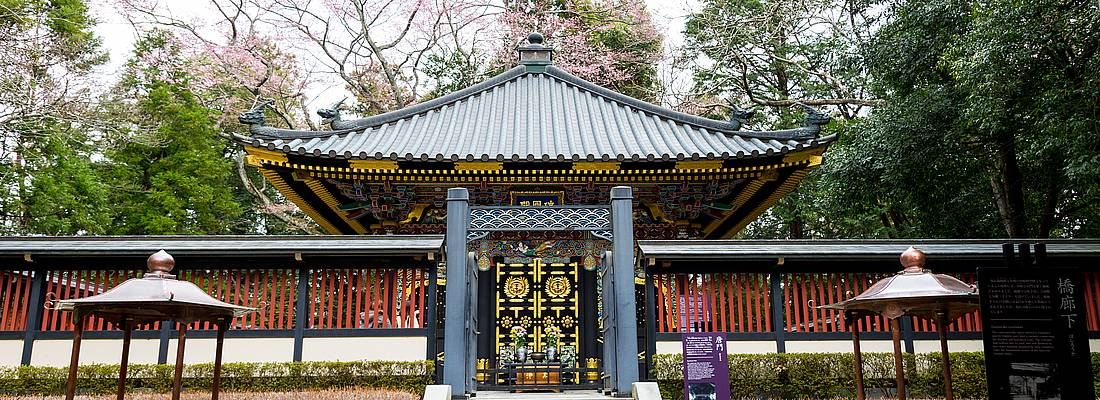
Zuihoden Mausoleum
Set at the top of a steep staircase, tucked away from central Sendai, the Zuihoden Mausoleum is a place of silence and calm. It’s a good place to learn about the city’s history through one of the most famous clans in Japanese history: the Date, who ruled here throughout the Edo period.
Plenty of places in Sendai pay tribute to the Date clan, especially Date Masamune, the legendary samurai and daimyo nicknamed the “One-Eyed Dragon” because he’d lost an eye. Masamune was the city’s founder, and the Zuihoden Mausoleum is dedicated to him. It’s one of Sendai’s main sights, partly for its historical importance but mostly for its intricate architectural details.
Contents
Visiting the Zuihoden Mausoleum
With its elaborate, intricate style, the Zuihoden Mausoleum looks a lot like the Tokugawa mausoleum in Nikko. Both are fine examples of traditional Momoyama-period architecture, recognizable by their bright colors and refined woodwork with geometric patterns and intricate inlays. The resemblance probably comes down to the ties between the two clans, since Date Masamune was a close ally of the Tokugawa.
The buildings you see today, though, aren’t the originals from 1637. The old mausoleum had been a national treasure since 1931, but it was destroyed in a single night during a bombing raid in July 1945. It was rebuilt in 1979, and while the builders tried to reproduce the old structures faithfully, they made a few small additions, like the lion carvings on the pillars and the dragon heads on the four corners of the roofs. The complex was then renovated for the city’s 400th anniversary, and the 2001 restoration brought the gilding and carvings back to life. That’s why the reds and golds still look so vivid.
The site also holds the mausoleums of Masamune’s two successors. His son Date Tadamune and his grandson Date Tsunamune are buried next to the powerful daimyo, in mausoleums built in the same style but on a smaller scale. Each has its own name: Kansenden is Tadamune’s and Zennoden is Tsunamune’s, and a path through the woods takes you there in a few minutes. A little further on are the graves of other lords of the clan and their families, in a part of the complex where hardly anyone goes. There’s also a museum that holds some personal belongings and relics of the Date family.
The museum and Masamune’s tomb
In 1974, before the mausoleum was rebuilt, archaeologists opened the burial chambers and found Date Masamune’s complete skeleton, along with those of his son and grandson. The weapons, writing tools and other grave goods buried with them survived in good condition thanks to the lime that filled the coffins.
The complex’s museum grew out of that excavation. Besides the finds, you’ll see facial reconstructions of the three lords, made from their skulls with help from forensic pathologists and anthropologists. Coming face to face with the One-Eyed Dragon right after visiting his tomb is the part that strikes you most.
Once you’ve seen the mausoleum, take some time to explore the area around it. The paths are lined with towering cedars, and as you walk among them you can breathe in the smell of the forest and take in its colors.
Kyogamine hill and the twenty loyal retainers
The mausoleum stands on Kyogamine, a wooded hill overlooking the Hirose River. Masamune chose it himself as his burial place, and his son Tadamune honored his wishes, building the Zuihoden Mausoleum the year after his father died.
On either side of the mausoleum, lined up among the trees, are twenty small stone pagodas. They commemorate the fifteen vassals and five servants who took their own lives to follow their lord in death, in keeping with the custom of junshi. It’s easy to walk right past them, but they say more about what it meant to be loyal to a daimyo than any explanation could.
Getting There
The easiest way to get there is the Loople Sendai sightseeing bus, which leaves from Sendai Station and drops you right outside the mausoleum entrance in about fifteen minutes.
If you'd rather take a city bus, get off at Otamayabashi-Zuihoden-iriguchi and walk about ten minutes.
Either way, you'll cover the last stretch on foot. A steep stone staircase climbs through the cedars from the gate, so allow a few extra minutes and wear comfortable shoes.
Useful Info
- Zuihoden-mae stop (Loople Sendai bus): right outside the entrance, fourth stop on the loop
- Sendai Station (JR, Shinkansen, Namboku and Tozai subway lines): starting point of the Loople Sendai
- Several city buses also stop at Otamayabashi-Zuihoden-iriguchi
Map
This place is on MarcoMaps
Zuihoden Mausoleum
My map of Japan: over 4,000 places I've tried myself, each with photos, rating, and hours. Filter by category and rating, find veg-friendly spots and places near you with GPS. No sign-up, right from your phone.
- 4,000+ places
- Rating, photos, and hours
- Veg friendly
- Near me (GPS)
- Favorites without login
- Works offline


Tanabata evenings and fall colors
A couple of times a year, the Zuihoden Mausoleum looks completely different. During Sendai Tanabata in early August, the complex stays open into the evening: bamboo lanterns dot the staircase, the grounds fill up with the festival’s paper decorations, and a few concerts are held among the trees.
In the fall it’s the maples’ turn. Toward the end of November the woods around the mausoleums turn red, and on some evenings the leaves are lit up, with traditional umbrellas set up among the trees. If your trip falls in either of these periods, go in the late afternoon and stay until dark.